



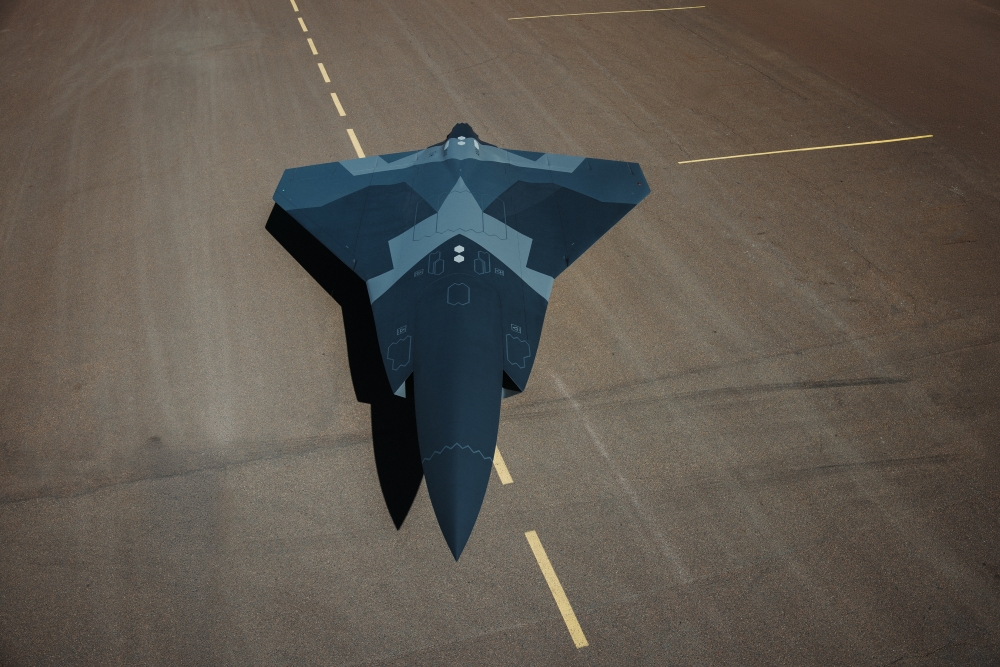
Saab’s unveiling of its A3 high-end autonomous collaborative platform at the Swedish Air Force’s centenary air show reveals an already funded Swedish demonstrator sequence, with two supersonic autonomous collaborative platforms (A1 and A2) planned before 2030 and powered by the General Electric F414, while the displayed A3 represents a later operational-direction concept rather than the immediate demonstrator itself.
Therefore, Saab is progressing through an incremental programme intended to support a Swedish decision on the future combat-air force by 2028, two years earlier than previously expected.
From FFS to KFS
The conceptual basis remains Saab’s Future Fighter System work, which sought to identify the technologies and industrial model necessary for Sweden’s next generation of combat aviation. That effort has now acquired a more concrete contractual form through the Future Combat Aviation Concept (Koncept för Framtida Stridsflyg, or KFS) managed by the Swedish Defence Materiel Administration, FMV, and led principally by Saab.
In October 2025, FMV awarded Saab a SEK 2.6 billion follow-on contract for conceptual studies and technology development under KFS. The purpose is to enable the Swedish Government and Armed Forces to decide how to address the combat-air requirement that will ultimately follow the GRIPEN-E, which began entering Swedish Air Force squadron service in October 2025.
The distinction is important. FFS was a broad industrial and technological framework while KFS gives that work a state-backed, structured route towards a national force-planning decision. Saab’s earlier timetable envisaged technology selection and maturation in 2026–30, followed by more substantive development from 2031. The newly visible A1–A3 roadmap provides the practical bridge between those phases.
The Swedish model is deliberately evolutionary. In fact, rather than immediately committing to an immensely costly manned sixth-generation fighter, it is using autonomous aircraft to test the foundations of future combat aviation: low-observable shaping, autonomy, artificial intelligence, mission systems, sensor fusion, networking, survivability and manned-unmanned teaming.
The aircraft displayed at Malmen should be understood as A3, not as the first aircraft in the sequence. Saab is already funded to develop two supersonic autonomous collaborative-platform demonstrators, A1 and A2. A1 is a low-observable air vehicle already in production at Saab’s Linköping facilities. It is expected to make its first flight within approximately 15 months of the August 2026 disclosure, well before 2030 and is likely to feature an internal weapons bay, making it a more operationally relevant demonstrator than a basic autonomy testbed.
The roadmap displayed at Malmen points to A1 and A2 first flights during 2026–30, followed by the first flight of an A3 prototype in the 2031–35 period. Initial operational capability is shown in the same latter period, while 2036–50 is allocated to development of the core fighter. Saab's phylosophy on uncrewed systems is that these aircraft are not necessarily an accessory to the future fighter but they could act as its advance guard. This staged route is consistent with Saab’s earlier view that an uncrewed, remotely piloted or autonomous demonstrator would be simpler than a new fighter and therefore the most efficient vehicle for maturing key FFS technologies.
The A3 design
The A3 is a tailless, turbojet-powered air vehicle with a broad blended-delta planform, strongly swept leading edges and no conventional vertical tail surfaces. The configuration is a clear departure from traditional fighter architecture, as eliminating vertical stabilisers reduces a major source of radar signature. In addition, the blended body and aligned edges are consistent with low-observable shaping. The large central volume potentially supports fuel, sensors, electronic-warfare equipment and internal payload carriage. Saab itself highlights low observability, autonomy and multi-domain operation as core attributes.
The aircraft’s design is therefore more accurately read as a survivable penetrating CCA than as a low-cost “wingman”. It could precede the crewed formation into the threat area, conduct electronic attack, collect targeting data, expose hostile emitters, launch stand-in effects or carry weapons into areas that commanders would prefer not to enter with a pilot aboard.
Saab has suggested that a final high-end aircraft might cost around half the price of a GRIPEN-E (comparing with recent contracts, a GRIPEN-E/F can represent roughly €140–160 million per aircraft when support and associated equipment are included), with one crewed fighter potentially accompanied by two or three such platforms.
Sovereignty and cooperation
The Swedish Government’s 2028 decision point will determine whether Stockholm proceeds independently, joins another future-fighter undertaking or constructs a hybrid partnership model. Saab chief executive Micael Johansson has said there are no substantive partnership negotiations under way, while confirming that Saab maintains exchanges with Airbus, Dassault and BAE Systems to understand the evolving landscape.
As highlighted by FW MAG, a collaboration with France nevertheless remains plausible in principle. With the former Franco-German-Spanish FCAS/SCAF framework having broken down, Dassault is examining a nationally led fighter demonstrator and remains open to partners. The prospect of a smaller, less expensive aircraft than GCAP (one capable of meeting French carrier requirements and Swedish short-runway and dispersed-operations needs) creates a potentially more compatible starting point than the original FCAS architecture.
The more immediate area for convergence may be the ecosystem rather than the fighter itself: autonomous platforms, human-machine teaming, electronic warfare, weapon effects, data architecture and mission-system sovereignty. A3 gives Sweden a credible technological contribution to such a partnership, rather than placing it in the position of a junior customer seeking access to another nation’s programme.



Privacy Policy

Powered by © Mobilbyte s.a.s. Information Technology