



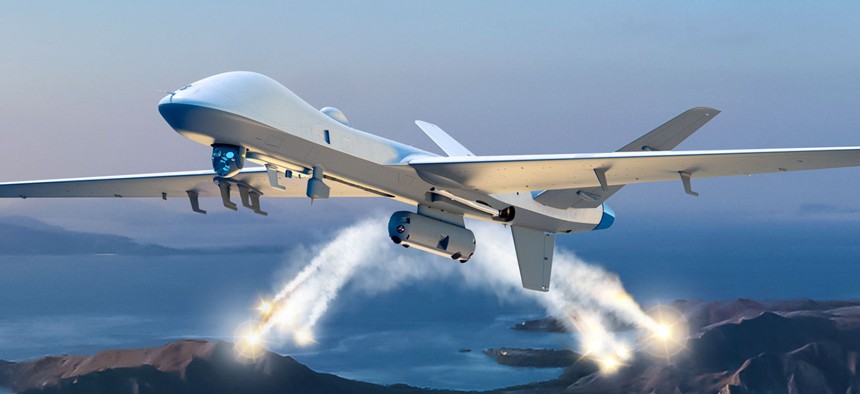
With 30 years of experience in MALE-type drones and having undoubtedly shaped internal perception and benchmarks of what a MALE drone even is with the PREDATOR-REAPER-MQ-9B family, General Atomics is now looking to the future and claims to have an impressive, mature project in the works.
For now, no images are being released and no specifications are being detailed, but speaking to AviationWeek, GA spokesman C. Mark Brinkley has mentioned a number of metrics that he says have “shaped” the internal work on WILDFIRE.
According to his statements, GA’s engineers went to work on an aircraft “with a 10,000 nautical miles ferry range” and able to carry as many as 4 large missiles, specifically AGM-158C Long Range Anti-Ship Missile or, presumably, JASSM in alternative. Other “demands” included looking at swarm operations of up to 100 aircraft under “semi-autonomous” control, all while fusing all collected data into an effective common operating picture, while coming up with “affordable mass” scalable in times of need.
Brinkley claims that the new WILDFIRE that resulted from such lofty initial asks is “ beast” and that he believes anyone looking at what it can do would not want “100 of them as fast as we can make them”.
What WILDFIRE is trying to do is fundamentally significantly more ambitious, and apparently significantly different, than what the USAF is seeking with the recent Massed Modular Aircraft requirement.
In terms of payload, the MMA must carry “at least” 2,800 lbs. This is significantly less than the MQ-9A REAPER’s payload of 3,850 pounds (1,746 kg), consisting of up to 850 pounds (386 kg) internal and 3,000 pounds (1,361 kg) external. This is, however, a threshold requirement and greater detail on the eventual separation between internal and external fits might reduce the extent of this apparent gap.
Combat radius unrefueled must be at least 2,300 nautical miles with payload on board; the aircraft must be able to self-deploy in one-way travels of “at least” 8,000 nautical miles.
Crucially, the MMA is required to be particularly affordable so it can operate not by trying to be survivable, but by absorbing losses while continuing to be available in great, “affordable” numbers.
This USAF solicitation says that attrition is “inevitable” and that this new type of uncrewed aircraft will have to operate through the deployment of “larger numbers of less-expensive unmanned platforms” designed from the start “with the expectation that some will be lost in combat”.
GA has already made clear it does not feel MMA is an adequate vision for a true successor to the MQ-9 and Brinkley has also declared all of his doubts, and thus the Company’s doubts, about the vision for truly disposable aircraft which must at the same time deliver a certain level of capability.
Brinkley has previously declared that the US does undoubtedly need “an immediate backfill solution to a critical shortage of unmanned MALE ISR/Strike”, but went on to say that he doesn’t think MMA does that, certainly not quickly enough, and that it also does not depict a good MQ-9 replacement earlier. “Some say we need cheaper, disposable aircraft, so that we can use them and throw them away, or lose them and not feel bad about it. No one is talking about actual capability, ready today,” Brinkley said when speaking to The War Zone (TWZ).
He feels the vision for disposable aircraft that can used and so remorselessly thrown away, at least at present, is an illusion based on “make-believe weapons that don’t exist” and thus have the luxury of pretending to be anything we’d like them to be.
He thinks more attention should be paid to solutions readily available, to include actually investing in available solutions (a number of countermeasure pods for self-defence have been tested over the years) to increase survivability instead. He confirms GA did submit a proposal for MMA but that WILDFIRE is “not dependent” on that program.
He also says WILDFIRE can be delivered “years earlier than the current schedule”, although he does not reveal what such schedule is like at present.




Privacy Policy

Powered by © Mobilbyte s.a.s. Information Technology