



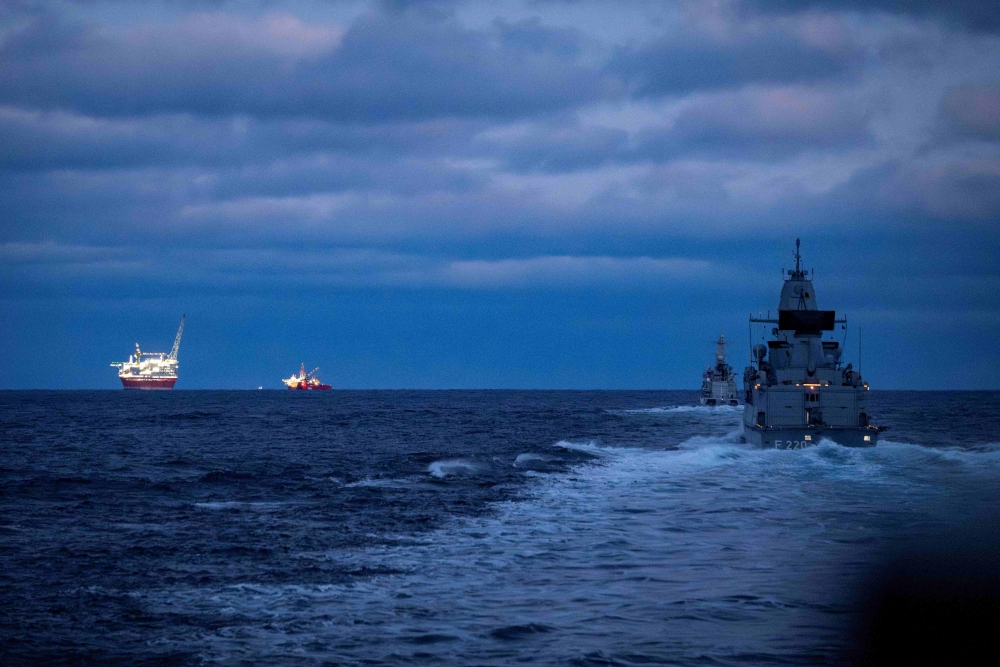
The Royal Canadian Navy’s (RCN’s) new maritime strategy is underlining the contribution of different government stakeholders, including the navy itself, plus the commercial sector in securing the country’s critical undersea infrastructure (CUI).
The RCN is in the process of refreshing its operational-level maritime strategy thinking – and assessing new operational requirements this revised thinking may mandate – to reflect changes to the world order and the nature of warfare prompted by the Russo-Ukraine war erupting in February 2022.
One significant change since then has been heightened awareness – in NATO’s political and public debates, but also amongst NATO adversaries – of the physical and political vulnerability of critical national infrastructure, including in the underwater domain. In its war, Russia has routinely targeted Ukraine’s critical energy infrastructure ashore, with Ukraine ultimately reciprocating. The current US/Israel versus Iran Gulf war has also seen regional energy infrastructure targeted regularly.
Where perhaps the most significant impact has been felt, though, is on the seabed. Several incidents in the Baltic between September 2022 and January 2026, which included gas pipeline and data and power cable disruptions, brought the CUI threat into sharp focus.
Canada’s geostrategic disposition is fundamentally different from many of its European NATO allies. Much of the European theatre’s CUI risk derives from the fact that a vast, dense CUI network criss-crosses relatively confined waters that include chokepoints and littoral shallows. For Canada, much of its energy supply is indigenous, and is transported over land. However, the power connector between Newfoundland and Nova Scotia is one of the world’s largest seabed electricity cables. Moreover, Canada is a landing point for major trans-Atlantic data cables.
“Regarding the security of information flow, 98% of our internet comes from underwater cables,” the RCN’s Captain Robert Watt – the service’s Director Naval Strategy, and leading on the maritime strategy refresh – told FW MAG.
The strategy’s review of Canada’s maritime security requirements encompasses CUI risks and needs, and the RCN’s operational role therein. “The strategy will lay out the ends, ways, and means of how our navy delivers its portion of maritime security,” said Capt Watt. “That’s an acknowledgement, I think more than in previous documents, that maritime security comes from things other than just the navy.”
“A prime example of that is CUI,” he added.
“CUI security needs to be a ‘whole of nation’ approach,” Capt Watt continued. “It isn’t a navy problem to solve, but there's certainly a navy piece of it.”
The navy’s role is clear, especially in that it provides bespoke military capability and skills to meet the CUI task that no other stakeholder has. These capabilities and skills build deterrent presence at sea and maritime domain awareness (MDA), plus capacity to conduct visit, board, search, and seizure (VBSS) taskings related for example to ‘ghost ships’ that may be suspected of involvement in malign activity around CUI sites. In the strategy, the navy will be articulating its contribution here, Capt Watt said.
Speaking at the Combined Naval Event 2026 conference in the UK in May, Capt Watt said this contribution to the comprehensive MDA picture-building process encompasses: underwater domain surveillance; integrating data from various at-sea resources like coastguards and open-source monitoring; and harnessing shore- and space-based sensing stations. Co-ordination with other countries will be key too, Capt Watt continued. He added that creating CUI-specific rules of engagement (RoE) for tackling specific threats should be part of any comprehensive solution.
Underlining NATO’s need to address what is an active CUI threat, the UK for example has recently revealed details of the RoE for how its naval forces will closely monitor Russian naval vessels in and around its waters, and of the legal framework it has established for allowing its military forces to conduct VBSS activities against ‘ghost fleet’ ships. Publishing such details in itself may have been intended to have deterrent effect
Capt Watt told FW MAG that several other Canadian government organisations have a stake in CUI security, including the public safety ministry, national police force, agencies operating space-based surveillance resources, and the Canadian Coast Guard (which is now part of the naval service).
“Industry also has a huge piece of this,” Capt Watt continued. “We need to be working with industry to ensure they’ve got resilience including adequate repair capacity, and that they’re [sharing] information.”
Currently, commercial industry – notably, the offshore oil and gas sector – provides the bulk of uncrewed underwater vehicles and supporting surface vessels that generate the capacity to conduct seabed CUI surveillance. The offshore sector is also conducting much of the research relating to enhanced CUI monitoring technologies, for example adding sensors to the pipelines and cables themselves. There is also growing security capacity and expertise within the offshore wind sector.
Industry also possesses most of the cable laying and repair capacity. However, a UK parliamentary report from late 2025 recommended that the UK Royal Navy (RN) should develop a dedicated pool of vessels and personnel able to conduct repairs if needed, including in crisis situations.
To strengthen CUI security going forward, Capt Watt told FW MAG that legal frameworks also need to be developed, to help close legal loopholes that adversaries may seek to exploit in certain contexts and certain locations. Currently, he said, “there aren’t a lot of legal frameworks to address the CUI threat.”
Capt Watt told the CNE conference that addressing the lack of legal frameworks would be a key step in building the capacity to secure CUI.
Follow us on Telegram, Facebook and X.




Privacy Policy

Powered by © Mobilbyte s.a.s. Information Technology