



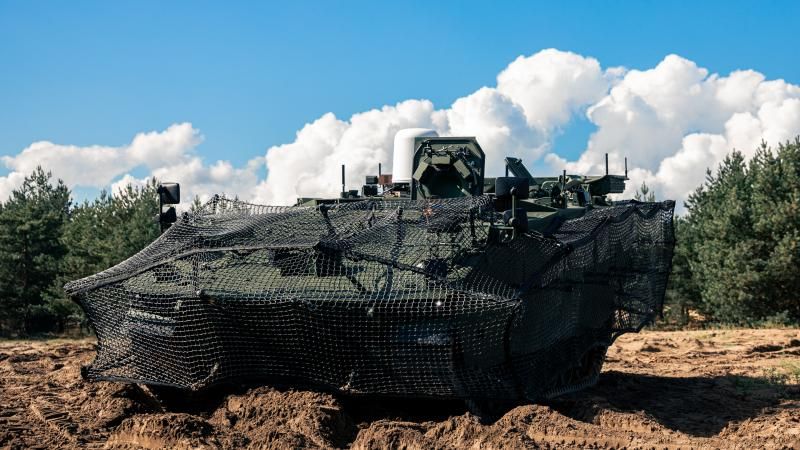
On Thursday 27 August, Latvia’s army benefitted from a demonstration of various anti-drone (C-UAS) sensors and protection systems. The trial, with the support of General Dynamics European Land Systems - Santa Barbara Sistemas, was centered on the HUNTER IFV (MEDNIEKS in Latvian) and the potential C-UAS solutions that could be adopted directly on it and on accompanying Uncrewed Ground Vehicles (UGVs).
The demonstration was conducted in the Adazi training ground using a HUNTER/MEDNIEKS base vehicle, still not fitted with its intended remotely operated Elbit Systems UT30 MK2 turret. Deliveries of the first completed HUNTER IFVs to the National Armed Forces is scheduled for October.
This demonstration allows the armed forces to identify in advance appropriate solutions that might be integrated on the IFVs.
Of particular interest in the demo was the use of sensors deployed on accompanying UGVs. The images released show 2 different types of UGVs have been involved, with one being the 8-wheeled BULLFROG from GDELS and the other being the Latvian-developed HADES GEKON M2 by LV-TEH.
In the images seen so far, no specific payload can be observed on the BULLFROG but the HADES GEKON has been equipped with a PIRAYA electro-optic passive detection sensor by Marduk Technologies.
Microflown AVISA, invited by GDELS, has supplied its CASTLE acoustic sub-array. The acoustic sensors have been installed both on the HUNTER IFV and on the HADES GEKON UGV and they have been employed to detect multi-copter drones.
The CASTLEs acoustic heads offer full hemispherical coverage for all relevant frequency bins, notably also for the lower frequency ground tones of multi-copters. SKYSENTRY algorithms were used to demonstrate the ability to provide a 3D elevation angle versus incoming multi-copters. Though it was not part of this demonstration, CASTLE can also support, with adequate software, gunshot localization functions. If networked, the same CASTLE heads can also work together and, with appropriate software, locate hostile artillery positions. Other sensors and systems involved in the demo have not yet been officially confirmed. The images however suggest the installation on the HUNTER of an ARGUS SHIELD EO/IR passive detector by EagleNXT. Multiple arrays can also be observed that could be MyDefence WATCHDOG 150 passive RF sensors, although identification from the images available is complex.
The HUNTER is also wrapped in a protective net not unlike the TARIAN products originally developed in the UK for anti-PRG protection. Latvia is procuring 84 MEDNIEKS in total. The IFV is based on the GDELS ASCOD 2 tracked platform. They will equip Latvia’s Mechanized Infantry Brigade.




Privacy Policy

Powered by © Mobilbyte s.a.s. Information Technology