



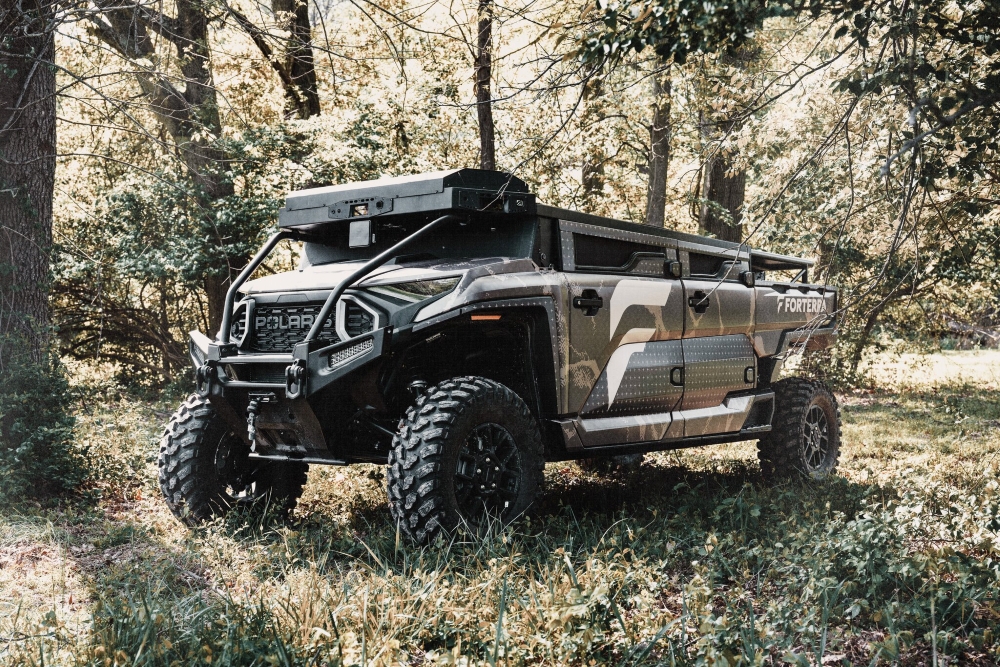
Forterra’s MESA uncrewed ground vehicle (UGV) has been selected for the US Army’s Infantry Last Tactical Mile (ILTM) program. As ground services seek to integrate uncrewed vehicles into their operations, FW MAG chatted with Pat Acox, Vice President of Defense at Forterra, about the company’s UGV and the future of uncrewed technology.
The US Army explained on 11 August that the ILTM program is aimed at modernizing infantry support for soldiers “through rapidly deployable logistical resupply platforms capable of performing casualty evacuation operations and network extension to the forward line of own troops," said Colonel Ken Bernier, the Army's project manager for Autonomous Robotic Capabilities.
Six vendors will supply systems designed for beyond-line-of-sight autonomous control for multi-domain operations. The industries selected are Forterra, Maren-Go, Overland AI, Hendrick’s Motorsports, American Rheinmetall, and HDT. Contracts are expected to be finalized “in the coming weeks,” followed by demonstrations which will culminate in an Operational Assessment with an Army unit in early 2027.
Acox confirmed to FW MaG, “we are underway on tests and demonstrations across a few fronts that will be announced this fall.”
Forterra’s MESA UGV was unveiled earlier this year and is based on a factory-modified Polaris Ranger XD 1500 platform; MESA also integrates Forterra’s AutoDrive and Vektor products. Unveiled during the Modern Day Marine 2026 expo, the UGV displayed a Kongsberg RS2 remote weapons system as a payload, FW MAG wrote at the time.
FW MAG asked Forterra’s Acox about the challenges of integrating counter-uncrewed aerial systems (Counter-UAS) and other payloads on UGVs, as companies tend to use terms like “open architecture,” “modular,” and “plug and play” concepts. The Forterra executive explained that some terms “get thrown around a lot, and at the connector level it's mostly true. Meaning, you can get a C-UAS payload talking to a vehicle in a few weeks,” adding that, “the hard part is everything after that.”
Acox went on to explain that UGVs in principle were not designed to carry a radar and a weapon, “so you’re fighting capacity items such as power and space.” Another challenge is that “the jamming gear can blind the vehicle’s own navigation and radios.” Moreover, speaking of counter-UAS systems, “the whole chain” - spotting a drone, identifying & tracking it, deciding what to do and neutralizing it – “has to happen fast enough to work while the vehicle is moving.”
The Forterra executive concluded by stating, “getting two systems to talk to each other is easy in 2026,” but “getting them to work as one system is still measured in months of real testing, not an afternoon of sorting configuration files or playing with APIs.” This is an important message to keep in mind as more companies announce partnerships to integrate a variety of payloads aboard UGVs, aerial drones, or surface (or maritime) uncrewed vehicles.
FW MAG will soon publish a long analysis on integrating Counter-UAS systems aboard UGVs and their future in military operations. As for logistics, without a doubt, heavy-duty uncrewed vehicles like MESA can transport weapons & ammo, food and water, other technologies, or be used for casualty evacuation, significantly lightening the load of dismounted soldiers.
A mobile counter-UAS can be very helpful: “ground vehicles are ultimately becoming the maneuver force's air defense,” Acox told FW MAG. A UGV with a C-UAS payload can even move away from where troops are located, becoming an alternate target, keeping troops safe as their position isn’t given away, “and keeps the defense dynamic.” Adding a payload can certainly help an infantry squad’s offensive and defense capabilities, but the technology is still in development.
“At this point, the battlefield ends up as a resilient network: dozens of low-cost ground and air nodes sharing a common picture,” with UGVs providing a “common backbone,” Acox concluded. The ILTM is one of many similar programs the US military is carrying out that will define the future of warfare.
Follow us on Telegram, Facebook and X.




Privacy Policy

Powered by © Mobilbyte s.a.s. Information Technology