



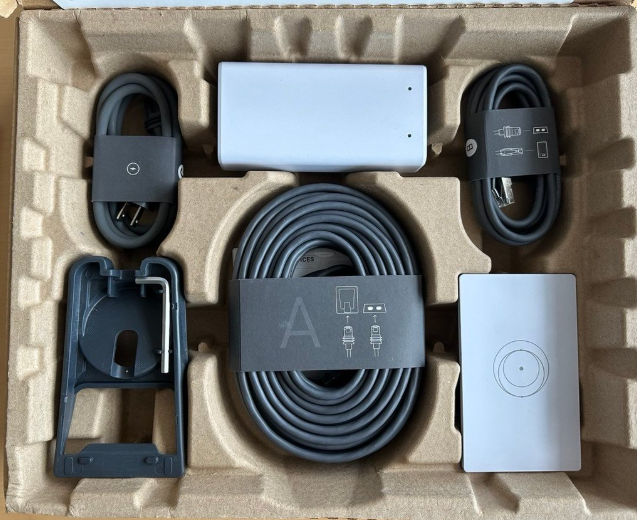
According to reports circulating on social media and in local press sources, the Ukrainian Armed Forces have reportedly begun using the new STARLINK V5 satellite terminals, manufactured by the well-known company SpaceX, in the theatre of operations. The news, however, has not yet been officially confirmed nor can it be independently verified.
Compared to the previous V4 model, the new version introduces a series of improvements, particularly in terms of size, weight and power consumption – features which, should their operational use in Ukraine be confirmed, would prove particularly significant in a context where STARLINK has, since 2022, been one of the fundamental elements of the communications, command and control architecture of the Ukrainian armed forces.
The main new feature of the V5 concerns the miniaturisation of the terminal. The dimensions have been reduced from 594×383×39.7 mm for the V4 to 384×306×34 mm for the V5, whilst the weight has fallen from 2.9 kg to just 1.1 kg, representing a reduction of more than 60 per cent. Power consumption is also significantly lower, falling from an average of75–100 W to 35–50 W. Finally, there has been a significant increase in the installed terminal’s wind resistance, which has risen from 96 to 265 km/h. These are by no means minor features on the battlefield. The reduction in power consumption effectively extends the terminal’s operational range when powered by batteries and portable power stations, reducing the need for generators and spare batteries. The lower weight and smaller dimensions, meanwhile, make it easier for frontline units to transport the terminal and, above all, to conceal the antennas inside trenches and bunkers or beneath camouflage netting, thereby reducing their visual signature.
However, the most interesting aspect concerns the potential implications of the V5 for unmanned systems. Ukrainian forces are already deploying STARLINK terminals on UAVs, Unmanned Ground Vehicles (UGVs) and Unmanned Surface Vessels (USVs), utilising satellite connectivity to maintain command and control links even beyond the range of traditional radio data links. The V5’s compact size, light weight and low power consumption could simplify and expand an integration process already underway, extending the use of STARLINK to a wider range of unmanned systems. The new terminal’s specifications would, in fact, result in a lower impact on the payload and the energy availability of the system on which it is installed – a particularly significant advantage for UAVs and, more generally, for small-scale platforms.
The satellite connection also enables the transmission of images, telemetry and operator commands over distances of several hundred kilometres, reducing reliance on conventional ground-based radio links. The claimed high wind resistance could represent a further advantage when used on UAVs and unmanned naval systems, which are more exposed to the elements and, in the latter case, to stresses caused by wave motion. Furthermore, the use of STARLINK does not make these systems immune to Russian countermeasures. The terminals produce electromagnetic emissions that can potentially be detected by SIGINT/ELINT systems and remain vulnerable to interference, connection degradation and any software or geographical restrictions imposed by the operator.
Particularly adverse weather conditions can also affect performance. Compared with traditional military SATCOM systems, the main advantage of STARLINK lies in the combination of high bandwidth, low latency, relatively low costs and large-scale availability. Dedicated military systems, on the other hand, retain advantages in terms of communications security, resilience to electronic countermeasures and control over the infrastructure.
Should the operational deployment of the V5s in Ukraine be confirmed, their introduction would represent a further development of the command, control and communication capabilities of the Ukrainian forces. Their reduced weight, size and power consumption could, in fact, facilitate their wider deployment on the front line and, above all, further extend the use of satellite connectivity on Ukrainian unmanned systems.




Privacy Policy

Powered by © Mobilbyte s.a.s. Information Technology