



On Monday 31 August, Director General of the Israel Ministry of Defense (IMOD), Maj. Gen. (Res.) Amir Baram, and his Greek counterpart, Ioannis Bouras, signed the largest defence export deal in the history of Israel-Greece relations, and one of the largest in the history of the State of Israel.
The deal delivers the vision of Greece’s ACHILLES’ SHIELD program for improved air and missile defence. According to the Greek MoD, the total budget is €3,035 billion and it will lead to the acquisition of a multi-layered air defence array which will complement and integrate the existing PATRIOT batteries.
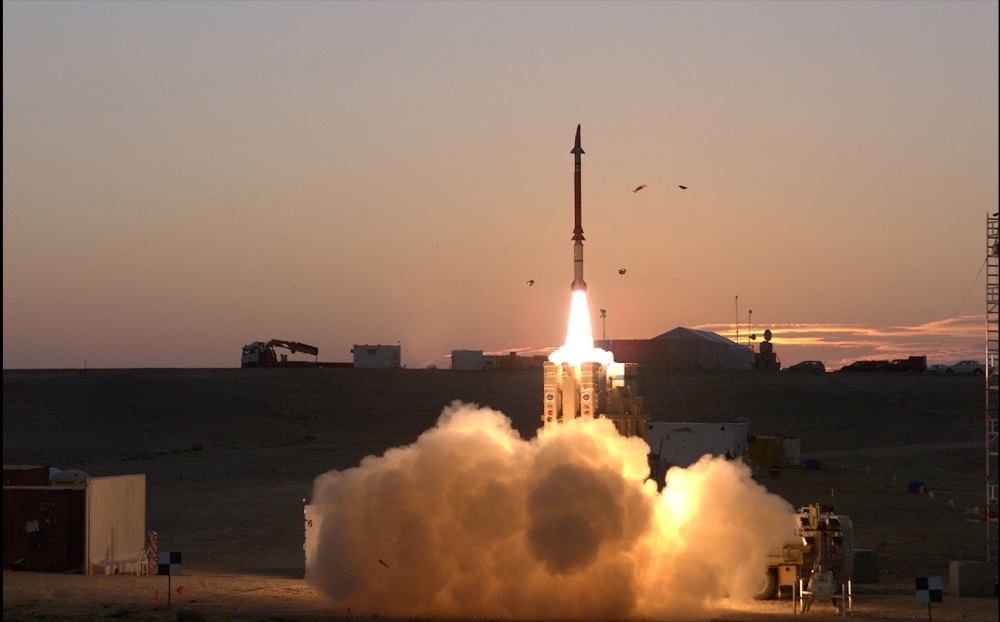
The lowest layer of the defence will be ensured by the SPYDER short-range missile system, manufactured by Rafael Advanced Defense Systems. A medium-range, area defence layer will be delivered through the use of the BARAK MX missile system, manufactured by Israel Aerospace Industries (IAI), and an upper layer or anti-missile protection will be assured by DAVID’S SLING, a system developed by the Israeli Missile Defense Organization within the Ministry's DDR&D, with Rafael as prime developer.
Backing the new missile batteries will be a number of ELM-2084 Multi-Mission Radar (MMR), manufactured by ELTA Systems, an IAI subsidiary. The MMR, the “eye” of the Israeli IRON DOME and associated to DAVID’S SLING, is an advanced mobile S-band 3D/4D Active Electronically Scanned Array (AESA) that is used for air and missile defence and also to pinpoints the origin of hostile artillery, mortar, and rocket fire.
The MMR has already been selected by other NATO countries, in the past including Canada, Czech Republic and Hungary. Finland picked the 2311 variant, a C-band, scaled-down radar specifically focused on Artillery Locating tasks mainly for counter-battery purposes.
A new national command and control system will also be delivered to “consolidate the full range of air defense capabilities”. Its development will be led by Rafael. A supplementary deal valued at €26 million was also signed for Rafael's DRONE DOME C-UAS systems, which Greece will deploy to defend strategic sites against drones.
The Greek MoD reports that a substantial participation of the Hellenic defence and technological industries is part of the arrangement, with “19 Greek companies already participating”. The industrial return value “exceeds 25%” and has an estimated value of €750 million.
One of the Greek industry products involved is KENTAVROS developed by Hellenic Aerospace Industry (HAI). It is an electronic-warfare system meant to soft-kill enemy drones. KENTAVROS detects drones through surveillance of the electromagnetic emissions and then defeats them through disruption of their command, communications, and navigation links. KENTAVROS has already been demonstrated as an integrated addition to the BARAK-MX missile system, with combined operation throughout the engagement chain, from threat detection and assessment to data transfer and electronic jamming.
The involvement of local industry is expected to result in the creation of a production base in Greece, which could play a role in supporting future export deals for the systems. For Greece, the ACHILLES SHIELD is an integral component of the “Agenda 2030” for Defence.
The SPYDER family comprises highly mobile truck-mounted systems that, depending on the interceptor employed, ensure a coverage from short range and low altitude potentially all the way to altitudes of 18 km with a range of 100 km in the LR (Long Range) variant.
A couple of years ago the SPYDER XR proposal was added: this used the DERBY missile enhanced with a new booster that extends its reach to up to 160 km and enables it to engage targets at altitudes exceeding 24 km, with capability against both conventional targets and terminal ballistic missiles. The new XR missile is designed to be compatible with the Missile Firing Units (MFU) of the SPYDER LR and SPYDER MR, so a relatively easy upgrade to existing batteries is possible.
A standard SPYDER battery includes truck-mounted Command and Control Unit (which in the SR and ER variants of the system includes a radar sensor unit); a separate truck-mounted radar for the MR/LR variants of the system; and 3 to 6 Missile Firing trucks, with their organic TOPLITE TM Electro-optic sensor.
The BARAK MX system used a family of interceptor missiles to offer a layered shield that, with the ER interceptor, can extend to altitudes of 30 km and a range of 150 km.
DAVID’S SLING is made to intercept tactical ballistic missiles and large-calibre rockets at “keep-out altitudes” that minimize collateral damage from debris. The launcher carries up to 12 STUNNER interceptors.
Greece operates a unique mix of missile batteries for air defence that still include Russian S-300 systems. ACHILLES’ SHIELD will enable their removal from service and might finally lead to Athens forwarding its residual S-300 equipment to Ukraine. Similarly, the new systems will enable the complete withdrawal of the French-origin CROTALE short-range missiles.




Privacy Policy

Powered by © Mobilbyte s.a.s. Information Technology