



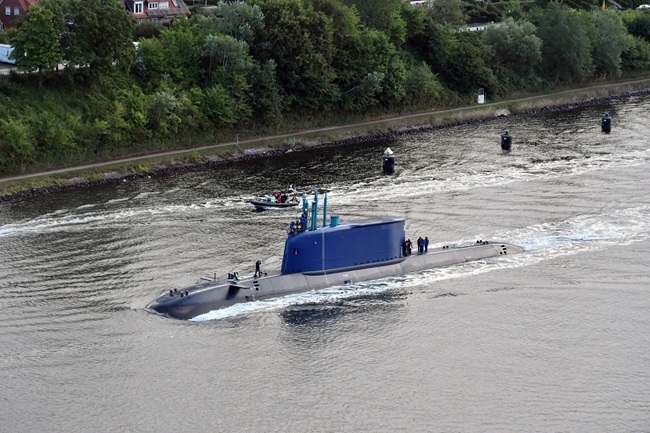
The submarine DRAKON, 3rd and final unit of the DOLPHIN II class, has been formally delivered to the Israeli Navy. The transfer of ownership from German shipbuilder ThyssenKrupp Marine Systems (TKMS) was completed during a closed ceremony held at the Kiel shipyard on July 31, 2026.
During the ceremony, Zeev Landau, Deputy Director General of Israel's defense procurement directorate, signed the acceptance protocol on behalf of the State of Israel. Attendees included Vice Admiral Harel (Commander-in-Chief of the Israeli Navy), Rear Admiral Amir Chimney (head of the Israeli Navy's Technology, Logistics and Materiel Command), Ron Prosor (Israeli Ambassador to Germany), Vice Admiral Jan Christian Kaack (Chief of Staff of the German Navy), and Oliver Burkhard (CEO of TKMS). The day after the ceremony, DRAKON conducted her maiden voyage off Kiel flying the Israeli Navy ensign. After completing her final sea trials, a farewell ceremony on August 31, 2026 marked DRAKON's departure for Israel; arrival at the Haifa naval base is expected in the coming weeks.
DOLPHIN II-class boats are longer than the earlier DOLPHIN class — 68.6 m versus 57.3 m — with a submerged displacement of up to 2,400 t. The increase in size is driven by the addition of an Air-Independent Propulsion (AIP) system based on fuel cells. The hull is built from non-magnetic steel and features a prismatic midship section with a smooth fairing into the sail, designed to reduce the boat's signature.
The DOLPHIN IIs also incorporate a wet-and-dry compartment for special operations forces — coinciding with the trunk leading from the control room to the bridge — who can also employ a Dry Dock Shelter (DDS) mounted on the casing aft of the sail. The sail itself is DRAKON's most distinctive feature: it is longer than those of her predecessors, TANIN and RAHAV. As previously reported by RID, this elongation has fueled considerable speculation. The leading hypothesis points to an undisclosed number of vertical launch tubes for cruise and/or ballistic missiles (potentially fitted with nuclear warheads), though the use of underwater and aerial drones, anti-helicopter missiles, and intelligence-gathering systems cannot be ruled out.
The lengthened sail and the internal arrangement of the launch tubes have increased DRAKON's overall length to approximately 73 m, with a corresponding rise in submerged displacement. It is also likely that the external structure enclosing the upper portion of the launch tubes — the section housed within the sail — was fabricated using composite materials under an ongoing German-Israeli industrial collaboration. According to available information, DRAKON is equipped with 10 launch tubes arranged in 2 rows of 5. The 6 inner tubes are 533 mm in diameter and are likely intended for torpedoes and/or anti-ship missiles compatible with that caliber, namely the DM-2A4 SEEHAKE and the UGM-84 HARPOON. The 2 outer pairs are 650 mm tubes designed for long-range cruise missiles such as the POPEYE TURBO, capable of carrying nuclear warheads for a second-strike deterrence role. Alternatively, the 650 mm tubes allow the deployment of underwater drones, special operations personnel, or mines larger than those deliverable through the 533 mm tubes.
The ability to launch POPEYE TURBO missiles — 6.25 m long with a credited range of 1,500 km — from the 650 mm tubes makes the use of the vertical tubes for ballistic or cruise missiles with significantly greater performance all the more plausible, giving DRAKON considerably more operational flexibility than TANIN and RAHAV. DRAKON's sail configuration may also serve as a proof-of-concept demonstrator for technology intended for the future DAKAR-class submarines, still in the design phase and slated to replace the DOLPHINs in the next decade.




Privacy Policy

Powered by © Mobilbyte s.a.s. Information Technology