



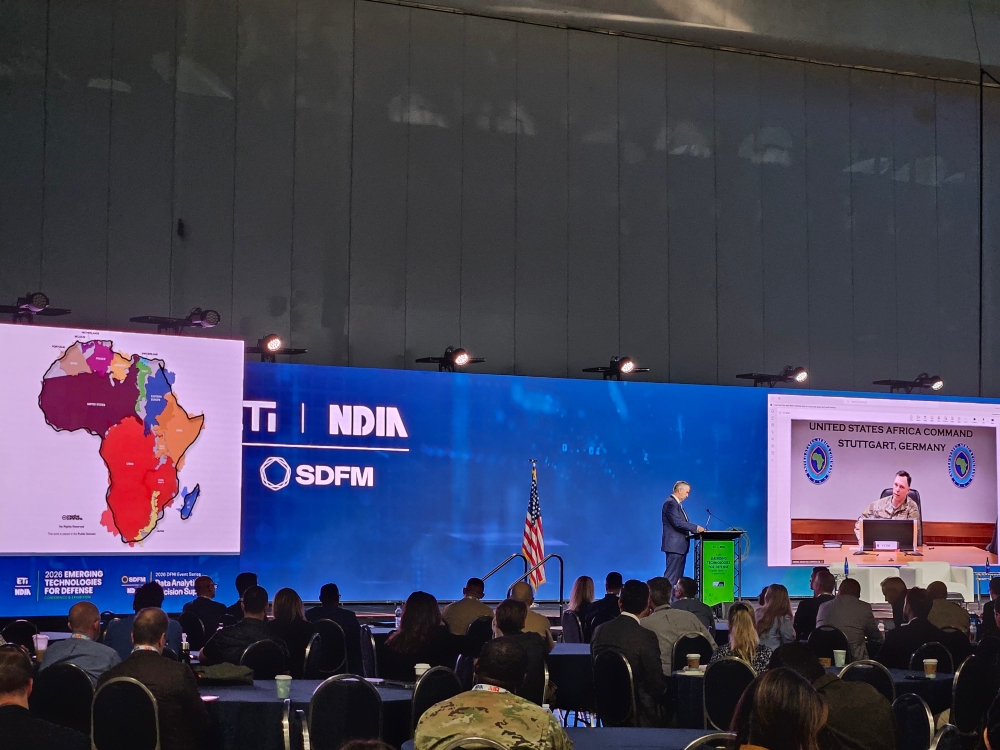
Several discussions about US Africa Command (AFRICOM) were held at the recently concluded Emerging Technologies for Defense Conference & Exhibition in Washington, DC, along with a virtual presentation by General Dagvin Anderson, AFRICOM commander. The General and other personnel (military and civilian) assigned to AFRICOM explained this Combatant Command’s requirements and future.
General Davidson explained that “the future of Africa impacts the future of the world,” and highlighted that actors like China and Russia are present across the continent. At the same time, terrorist movements like ISIS and Al Qaeda and even Mexican cartels are active in various regions, specifically the Sahel and West Africa, and in countries like Somalia and Nigeria. Government changes (coups) have made US military operations more challenging across the continent, as the US relies on forward operating locations rather than permanent facilities. Moreover, regime changes mean US aircraft (crewed or not) cannot fly across certain countries, which makes fuel consumption and the tyranny of distance even more challenging.
What equipment does Africa Command, based in Stuttgart, Germany, require to perform its mission better? The AFRICOM commander mentioned the need for new long-range intelligence, surveillance, and reconnaissance (ISR) capabilities, both crewed and uncrewed, as well as long-range sensors and acoustic sensors. These platforms must also be able to become armed “to face threats in the Sahel and North Africa,” he explained.
Given the lack of permanent bases and the threats US troops face, new technology is necessary specifically for expeditionary forces. For example, counter-UAS systems that can be deployed in “austere environments” via containers, in other words, equipment that is “easy to deploy and take out.”
During a media briefing, FW MAG asked a US government spokesperson about AFRICOM’s current aerial capabilities. The spokesperson explained that the Combatant Command operates “several uncrewed platforms,” including the MQ-9 Reaper and some crewed aircraft (contracted assets) as well as MQ-1 Predator and Reaper drones (government-provided assets).
Looking ahead, AFRICOM plans an operational assessment of the MQ-22 SWIFT (VANILLA) platform “this coming fiscal year.” The spokesperson added that “we are looking at other long-endurance ISR platforms,” but also “we are looking at low-cost, attritable capabilities that meet our requirements.” While AFRICOM will continue to use crewed aircraft, the spokesperson highlighted the need for non-traditional ISR systems to “fill in intelligence gaps in West Africa.”
There is also a requirement for more modern and effective systems for casualty evacuation and frontier medicine when troops are injured in battlefields, and it is difficult for aircraft or helicopters to land. “We are working on a test with a terrestrial asset [meaning an uncrewed ground vehicle] to evacuate” an injured person, FW MAG was told during the briefing, without providing further information. The spokesperson also highlighted the need for drone and counter-UAS payloads in the expeditionary model, meaning they are easy to transport, deploy, and retrieve.
“A limited force posture and limited resources force us [AFRICOM] to be creative and drive a culture of innovation,” the US government spokesperson told FW MAG and other media representatives during the briefing.
Given Africa's vast size, the Command also requires “long-range mobility,” the AFRICOM commander said in his remarks. Moreover, General Davidson called for better Artificial Intelligence for Large Language Models (LLMs) for a very unique challenge: to translate “obscure languages” that terrorists operating out of Africa are utilizing to communicate with each other, languages that U.S. troops are not familiar with.
General Davidson also highlighted one success: the establishment in Morocco of the Africa Multidomain Training and Experimentation Center (AMTEC), where US industries can test new technologies across a broad landscape, including kinetic and non-kinetic weapons. “We can experiment with emerging technologies like Counter-UAS systems to help the joint force and partners,” the AFRICOM commander said. Tests are already occurring there. Morocco has emerged as a critical partner for AFRICOM, and the Command wants to replicate the M-TEC facilities elsewhere in Africa (like Ghana) to test new technologies in other, more challenging environments.
Finally, the AFRICOM commander highlighted the importance of arms sales in securing and cementing partnerships in his area of responsibility, which is even more important given the changing political dynamics across the African continent. He explained that China and Russia are actors in Africa. Moreover, countries like Israel and Turkiye also sell drones to African militaries, as they are “more affordable” and can be delivered faster. General Anderson called for U.S. foreign military sales to move faster and for US defense industries to be ready to “fill capability gaps” that African militaries have, “or China or Russia will.”



Privacy Policy

Powered by © Mobilbyte s.a.s. Information Technology