



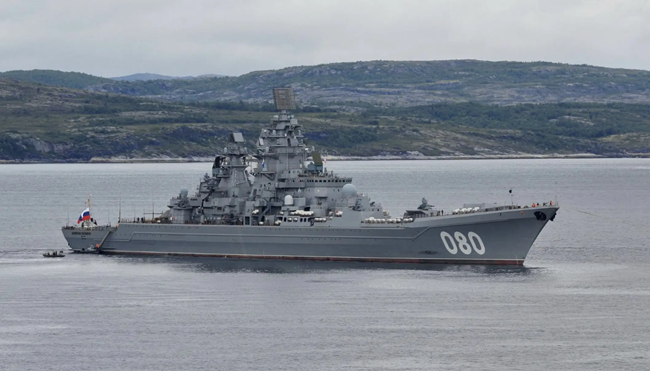
ADMIRAL NAKHIMOV, the first unit reactivated under the program to return the KIROV-class nuclear-powered battlecruisers to service, has completed sea trials and is expected to enter active service with the Northern Fleet by the end of 2026, according to the Commander-in-Chief of the Russian Navy, Admiral Alexander Moiseyev.
The ship was refloated on July 25, 2025 and moved under her own power for the first time in 28 years the following month, entering the final trials phase on June 1, 2026 and returning to Severodvinsk on July 21 for post-modernization acceptance trials.
At 251 m in length and with a full-load displacement of roughly 28,000 t, she remains the largest and most heavily armed surface combatant in service and represents the most ambitious naval modernization program of the post-Soviet era. Propulsion rests on a CONAS (Combined Nuclear And Steam) system: 2 KN-3 pressurized water reactors (PWR), paired with 2 conventional auxiliary boilers, drive steam turbines for a combined output of about 140,000 SHP and a top speed close to 32 knots in combined mode. On nuclear power alone, speed falls to roughly 20-25 knots, but refueling cycles disappear, allowing extended deployments. The air group, with capacity for up to 3 naval helicopters of the Ka-27 family, provides a vertical replenishment option independent of port access.
Air defense and strike armament is the most significant element of this reactivation. Air defense capability comprises 96 launch cells for long-range surface-to-air missiles, whose exact nature remains unconfirmed: some sources point to a naval variant of the S-400 system, others to the FORT-M system, the naval derivative of the S-300. Either configuration makes the ship a self-contained area air defense platform. Strike capability rests on 80 VLS (Vertical Launch System) cells for cruise missiles, including the ZIRCON hypersonic anti-ship and land-attack system.
The timeline of the reactivation is indicative of Russian industrial capacity. Contracted in 2013 with an initial completion target of around 2018, the work turned into a near-total rebuild: combat systems, sensors, electronics, wiring and most internal machinery were replaced outright. Costs rose several times over, and the absorption of industrial and financial resources across more than a decade forced the cancellation of the parallel modernization planned for sister ship PYOTR VELIKIY. The NAKHIMOV reactivation should therefore be read as an isolated prestige effort rather than the start of a broader recapitalization of the KIROV class: no surface combatant of comparable capability is expected from Russian yards for several decades.
(Image: A. Guryev via Russian Navy News VKontakte)



Privacy Policy

Powered by © Mobilbyte s.a.s. Information Technology