


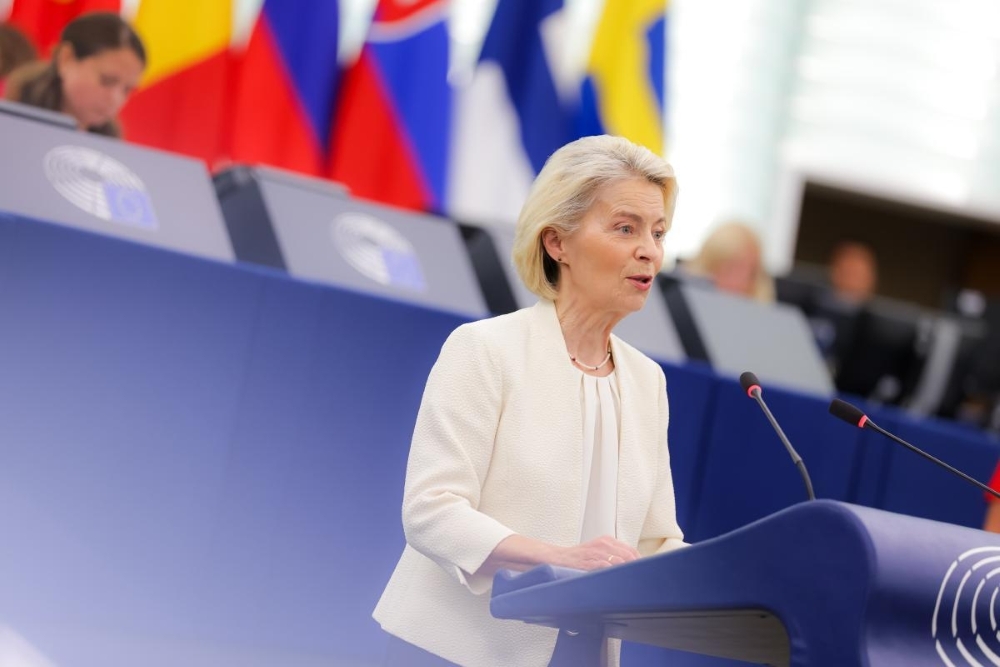
A European Security Council, a new emergency mechanism inspired by NATO’s Article 4, joint military capabilities and deeper integration with Ukraine. Commission President Ursula von der Leyen’s State of the Union address was, above all, an attempt to redraw the way Europe approaches security - from how it identifies threats to how it takes decisions and builds a response.
Delivered on 16 September, the speech came as Europe faces a more uncertain security environment, from Russia’s war against Ukraine and intensifying hybrid attacks amid uncertainty over the future of transatlantic relations.
“The urgency is clear,” von der Leyen told MEPs in Strasbourg. “Peace is threatened. Russia's war of aggression on Ukraine rages on, and threats are mounting on our soil.” She also put particular emphasis on hybrid threats. The message was that Europe’s existing security architecture may no longer suit the environment it now faces. “We need to consider if our systems are still fit for purpose,” she said.
Her first proposal is a European Security Council, a new leaders’ format bringing together the EU’s 27 member states and key partners, including Canada, Norway, Ukraine and the UK.
“For a long time, we have discussed a leaders' format focused on the security of our continent,” von der Leyen said. “This is even more urgent now, given the nature and scale of the risks at play. We will set out our ideas to make a European Security Council a reality.”
The aim is to create a faster political forum for responding to crises, putting shared security interests ahead of formal EU membership. The idea is not entirely new - different versions of such a body have circulated for years, particularly under French President Emmanuel Macron, including during the debate over European strategic autonomy. Defence Commissioner Andrius Kubilius has also backed a more flexible format for European crisis response.
More recently, the debate over the need to do more has become intertwined with questions over how much political weight should sit with EU institutions such as the European External Action Service. A proposal to create a task force had been put forward in recent weeks, but was blocked by some member states concerned about shifting responsibilities towards the EU.
EU’s Article 4
A second important proposal from von der Leyen is more operational: a European Emergency Security Protocol for incidents that fall below the threshold of armed aggression but still threaten national security, inspired by NATO’s Article 4.
Under NATO’s Article 4, an ally can request consultations if it believes its territorial integrity, political independence or security is threatened. It does not automatically trigger military intervention, as Article 5 does.
Von der Leyen wants a similar mechanism for the EU. “I believe it is time for Europe's own Article 4,” she said. “When triggered by one Member State, all Member States would convene. To coordinate a European response. To deter further escalation. And to mitigate the impact.”
The mechanism would target threats such as sabotage, cyberattacks, drone incursions and other grey-zone operations. Reportedly, it could also help coordinate EU-level logistical support, strategic reserves and temporary flexibility in state-aid and VAT rules during a crisis.
In addition, the plan would reportedly establish EU-level logistics coordination, provide access to strategic reserves of fuel, ammunition and medical supplies, and permit temporary exemptions from state-aid rules and VAT to speed up industrial surge capacity. The protocol would form part of a broader European security strategy, including a new counter-hybrid playbook aimed at reaching a common understanding of how to respond to hybrid threats.
Both the Security Council and the Protocol proposals raise questions about Europe’s relationship with NATO. Von der Leyen stressed that the new structures would complement the Alliance. But with many of the same countries involved, questions over duplication, coordination and authority remain.
Military side
But the overhaul cannot stop at institutions. Europe also needs the military capabilities to back them up. In her speech, von der Leyen proposed a European Instrument for Strategic Enablers, focusing on capabilities such as air and missile defence, strategic transport, air-to-air refuelling, space, cyber, intelligence and command systems.
“The war in Ukraine has shown us the importance of strategic enablers,” she said. “These are the critical support assets and force multipliers that any credible defence relies on.”
According to reports, the instrument would be supported by a new €20bn guarantee facility running from 2027 to 2030 to support these capabilities. They fit into the priorities of the EU’s Readiness 2030 defence agenda, which seeks to close critical gaps and strengthen Europe’s defence-industrial base.
For decades, European countries have maintained fragmented forces and relied heavily on the United States for some strategic capabilities. The new approach seeks to build more of those capabilities within Europe.
Like the newly proposed political instruments, the Strategic Enablers initiative inevitably overlaps with NATO defence planning, even though EU officials insist that the goal is to strengthen the European pillar of the Alliance, not duplicate it.
Ukraine in
According to the Commission president, Ukraine is also being drawn deeper into Europe’s emerging defence-industrial architecture - not only as a recipient of weapons, but increasingly as a partner whose battlefield experience and defence industry can contribute to European capabilities.
The clearest example is Freya, the emerging European-Ukrainian effort to develop an affordable, modular ballistic missile-defence capability. The broader objective is to diversify Europe’s defence supply chains while bringing Ukraine into the continent’s industrial planning.
The project follows the launch of a ten-country coalition to accelerate work on shared ballistic missile defence. Its significance goes beyond one weapons system: Europe is increasingly looking to combine Ukrainian battlefield experience and defence technology with European industrial capacity.
Meanwhile, Von der Leyen also announced new joint projects with Ukrainian companies using remaining SAFE funds, and said the EU approved the first purchase of US Patriot interceptor missiles. Taken together, the proposals unveiled by von der Leyen link political decision-making, crisis response, military capabilities and defence production more closely than before. While more details will be disclosed in the coming weeks, their implementation will now depend on how these new instruments are designed, funded and coordinated with NATO.



Privacy Policy

Powered by © Mobilbyte s.a.s. Information Technology