



Riding the wave — let's be honest, a partly emotional one — of events unfolding daily in Ukraine, a widespread notion is taking hold: that the Main Battle Tank (MBT) is no longer useful, or nearly so.
On a battlefield dominated by low-cost drones, where armored/mechanized movements on the ground are immediately detected, tracked, and then neutralized through a convergence of effects, the MBT appears to be losing the centrality it has held since World War 2, relegated to secondary roles or, worse, "parked" in the rear. But is that really the case?
First, a premise: the Ukrainian theater has its own specificity, one that may not necessarily be found in other theaters. It is characterized by the substantial absence of Air Power — as understood in the Western (read: American) "way of war" and doctrine — as a battlefield shaper. In essence, neither the Russians nor, even less so, the Ukrainians had, or have, a real Air Power doctrine and capabilities comparable to those of the United States/NATO. This has effectively created a significant gap in classical combined arms operations. The failure of the Russian offensives on Kyiv in 2022 and of the Ukrainian counteroffensive in the summer of 2023 amply demonstrated this.
That said, the MBT remains the only ground platform capable of delivering mobility across all terrain types, protection, and firepower — and through which forces can conduct deep operations, provide cover and fire support to infantry not only in urban and "confined" environments, but also shore up defensive strongpoints. In short, the MBT is a multi-role system, and it is precisely this versatility that must be leveraged to change the philosophy and the design concepts behind it. Saying the MBT is no longer needed is wrong: it "merely" needs to evolve as a platform.
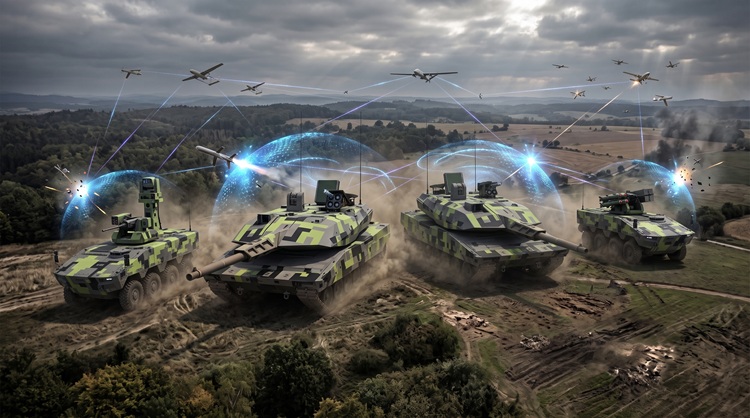
Today, therefore, the tank must become a multi-role ground combat platform, fully connected within the system of systems and the multi-domain tactical bubble, capable of managing Unmanned Ground Vehicles (UGVs) and Unmanned Aerial Vehicles (UAVs), equipped with a launcher for loitering munitions, and fitted with a main gun able to fire with precision at extended range (in this regard, Leonardo's development of the 120 mm VULCANO projectile is a truly apt choice). A platform whose protection is the result of passive systems and active protection systems — the latter capable of neutralizing the increasingly lethal drone threat — but also of superior situational awareness and the ability to detect and preemptively neutralize potential sources of attack. The resulting combination of passive and active protection is a fundamental aspect, one on which weight reduction and, ultimately, the reduction of logistic and life-cycle costs depend.
At the tactical level, this new multi-role platform will be employed to support increasingly dispersed maneuver formations and dispositions, operating no longer en masse but in "mixed" platoons composed of a pair of MBTs escorted by a pair of wingman UGVs — each tasked with roles ranging from counter-drone to Intelligence, Surveillance, and Reconnaissance (ISR) and fire support — and protected from above by sub-tactical aerial drones. Then, when conditions on the ground allow — namely, temporal windows in which the intensity of the adversary's reconnaissance-strike cycle decreases — the platoons must be able to regroup and operate in larger formations to exploit initiative in depth, following the logic of combined arms operations.
The MBT, in the final analysis, is not dead. It needs to be rethought, along with its employment doctrine.
Follow us on Telegram, Facebook and X.
(AI-generated image)




Privacy Policy

Powered by © Mobilbyte s.a.s. Information Technology