



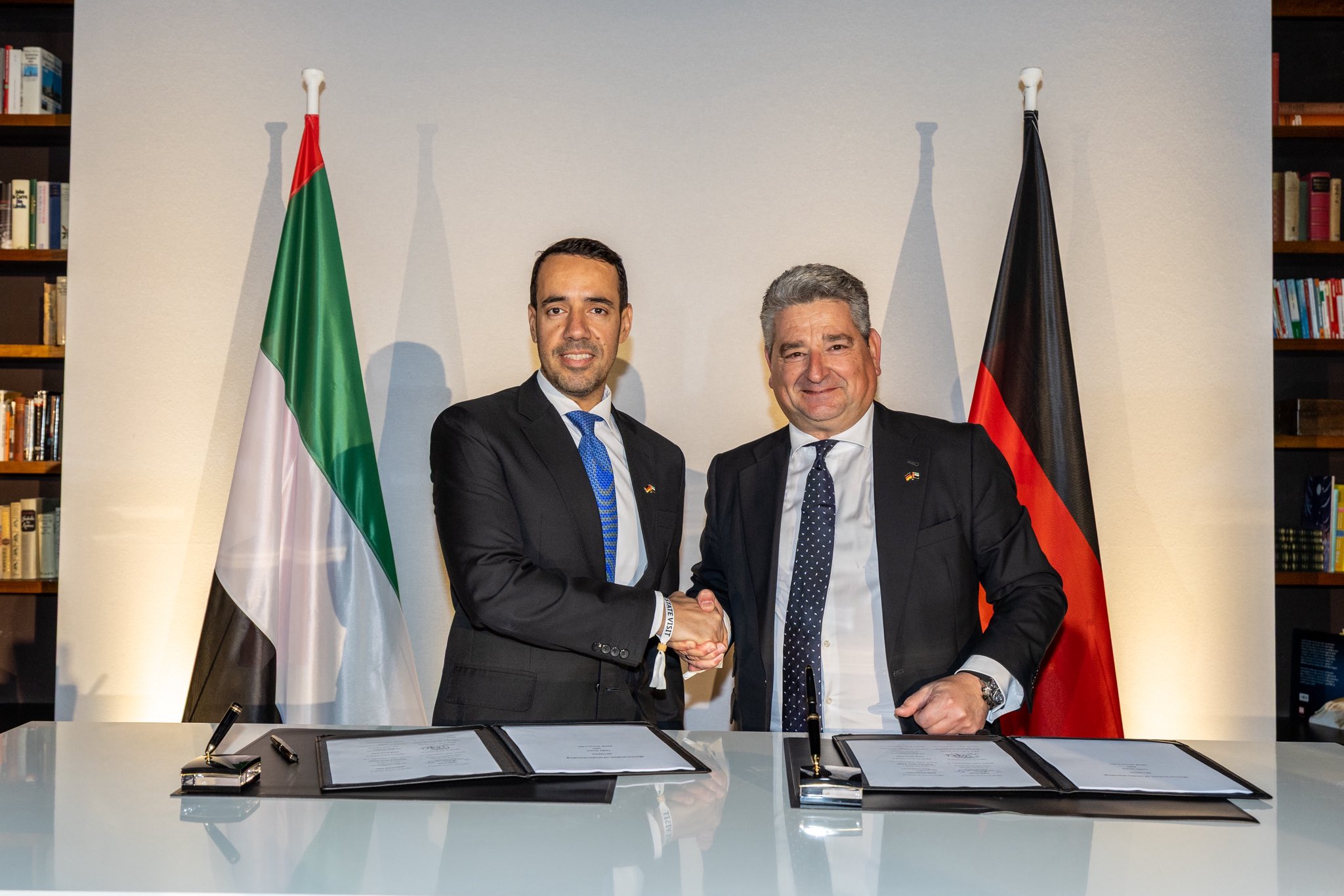
EDGE Group’s new Memorandum of Understanding with Germany’s TKMS is adds a German industrial stakeholder to an increasingly dense UAE naval ecosystem that already includes major partnerships with Italy’s Fincantieri and France’s CMN NAVAL. Together, the three relationships indicate that EDGE is attempting to become a sovereign naval prime capable of designing, building, integrating, supporting and exporting a broad range of maritime capabilities.
Signed on 25 September, the TKMS–EDGE MoU concerns the possible joint development of underwater surveillance and protection capabilities. The companies say they will explore an integrated, multi-system approach intended to establish a comprehensive picture of the underwater domain. No specific platform, sonar, unmanned vehicle, contract value, customer requirement or programme schedule has been disclosed - this is therefore an option-creating agreement.
Nevertheless, its rationale is clear. The UAE has major maritime interests to protect, including commercial shipping, ports, naval facilities, offshore energy infrastructure and the sea approaches linking the Gulf to the wider Indian Ocean. The threat spectrum includes mines, submarines, divers, sabotage, uncrewed underwater vehicles and clandestine activity around ports, cables, pipelines and offshore installations. Addressing such risks requires persistent surveillance and data fusion rather than a single vessel or sensor.
TKMS has a strong maritime-electronics and hydroacoustic base through ATLAS ELEKTRONIK, whose portfolio includes sonar, acoustic sensors, command-and-control systems, communications, naval weapons, mine-warfare systems and uncrewed maritime technologies. This makes TKMS potentially relevant not only as a platform provider but also as a supplier of the detection, classification, tracking and command layers needed to create underwater-domain awareness.
EDGE, for its part, can bring local systems integration, autonomous technologies, secure communications, digital tools and domestic industrial capacity. Its maritime portfolio already includes the 17.4-metre 170 M-DETECTOR, a craft that can operate in manned or unmanned configuration and incorporates retractable 3D multibeam forward-looking sonar for navigation, seabed mapping and environmental assessment. EDGE also markets the 12.8-metre 120 USV for ISR, mine countermeasures and anti-submarine warfare missions, with significant payload capacity for mission equipment.
A future TKMS–EDGE solution could therefore involve USVs, future UUVs, deployable acoustic sensors, fixed seabed or port-security systems, shore-based command posts and crewed naval assets. In this scenario, EDGE would provide the sovereign UAE integration and autonomy layer, while TKMS could contribute selected sonar, acoustic-processing, C2 and underwater-protection technologies.
The German agreement must, however, be placed beside two more established European partnerships. The first is MAESTRAL, the Abu Dhabi-based joint venture between EDGE and Fincantieri. Controlled 51% by EDGE and 49% by Fincantieri, MAESTRAL was created to pursue naval design, engineering, construction, sales and lifecycle-support activities. It has already secured a five-year UAE Navy in-service-support contract worth about €500 million, underlining that it is a functioning industrial entity rather than merely a memorandum of intent.
MAESTRAL’s remit is also relevant to the undersea domain, as EDGE and Fincantieri announced in 2024 that the joint venture would support the design, development and construction of manned and unmanned underwater systems in the UAE. Fincantieri itself brings submarine expertise, naval design capability and a strengthened position in underwater weapons and systems following its acquisition of Leonardo’s former Underwater Armaments & Systems business (WASS).
The second relationship is the March 2025 agreement between EDGE and CMN NAVAL, which created the Abu Dhabi-based AD NAVAL joint venture. Like MAESTRAL, AD NAVAL is majority controlled by EDGE, with the Emirati group holding 51%. Its focus is explicitly on high-value small- and medium-sized naval vessels, namely corvettes, offshore patrol vessels, high-speed interceptors, trimarans and landing craft. The venture is supported by an existing non-NATO commercial pipeline stated at approximately €7 billion.
CMN NAVAL brings long-standing naval shipbuilding credentials, a global supply chain, integrated logistics-support tools and experience across 48 navies. It has also been associated with UAE naval programmes, including the BAYNUNAH corvette. EDGE intends to combine CMN’s shipbuilding and engineering competence with its own autonomous air and sea systems, smart weapons, radars, cyber capabilities and combat-system integration. AD NAVAL’s stated purpose is clearly export-facing, and designed to develop UAE-built vessels integrating EDGE systems for markets where CMN has an established presence, including Africa.
In principle, the three relationships might be complementary. AD NAVAL could develop and export the surface platforms; MAESTRAL could provide naval engineering, construction, local support and future underwater-platform work; TKMS could supply specialist sonar, acoustic-processing or surveillance technologies; and EDGE could preserve UAE control over system architecture, autonomy, secure networks, weapons integration and commercial strategy.
Yet there are obvious potential frictions. Fincantieri and TKMS overlap in submarines, naval systems and underwater technology. CMN, Fincantieri and EDGE’s own ADSB shipyard all have interests in surface-vessel design and construction. A future UAE requirement for a UUV, mine-countermeasures system, anti-submarine package, underwater infrastructure-protection network or corvette combat system could therefore trigger competition over design authority, sensor selection, platform integration, local workshare and export rights.
For now, EDGE appears to be deliberately avoiding dependence on any single foreign naval prime. Rather, its strategy seems to assemble a portfolio of European partners while retaining majority ownership of the industrial vehicles, control over local integration and the ability to combine foreign technology with its own autonomous systems, weapons, sensors and digital capabilities.
The TKMS MoU is consequently best understood not as a stand-alone deal, but as the latest German component in a wider UAE effort to build a diversified, sovereign and exportable naval-industrial ecosystem.




Privacy Policy

Powered by © Mobilbyte s.a.s. Information Technology