



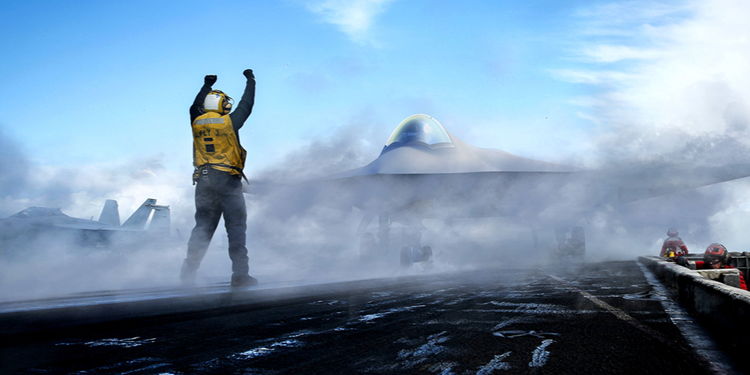
In a somewhat surprising outcome — most observers expected Northrop Grumman and a "TOMCAT-like" design — the US Navy has selected Boeing to develop its next carrier-based fighter under the F/A-XX program. The new aircraft will replace the SUPER HORNET and GROWLER, operating alongside the F-35C.
The Seattle-based company, whose military division is rooted in St. Louis — the historic home of McDonnell Douglas — has now won both next-generation fighter competitions, having already been awarded the US Air Force's 6th-generation fighter contract with the F-47 under the Next Generation Air Dominance (NGAD) program. Boeing has thus secured a monopoly over the development and production of future US tactical fighters for the coming decades, leaving Lockheed Martin with only the F-35 and confining Northrop Grumman to specialized bomber production.
This amounts is a genuine political-industrial revolution. Just 2 years ago, the future of St. Louis's military production looked bleak, with the F-15EX program running out of steam. Yet Boeing, evidently leveraging a privileged relationship with the current Administration, has staged a dramatic comeback. It now faces the opposite problem: managing 2 extraordinarily large and complex next-generation fighter programs in a supply chain environment that is already under severe strain. At the same time, there is significant potential for synergies, optimization, and technology de-risking across the 2 programs.
The Pentagon's decision is genuinely unexpected, not least for its consequences on the US defense industrial base. Concentrating 6th-generation fighter production in a single industrial hub leaves competitors with room only in the Collaborative Combat Aircraft (CCA) segment, where the established sector player General Atomics and newcomer Anduril currently dominate.
As for programme specifics, the US Navy has awarded Boeing an initial contract worth $20 billion, covering development and prototype production for the test phase. As noted, the F/A-XX will operate alongside the F-35C in carrier air wings, presumably serving as a long-range fighter for fleet defense while the F-35C takes on more of a tactical strike role.




Privacy Policy

Powered by © Mobilbyte s.a.s. Information Technology