



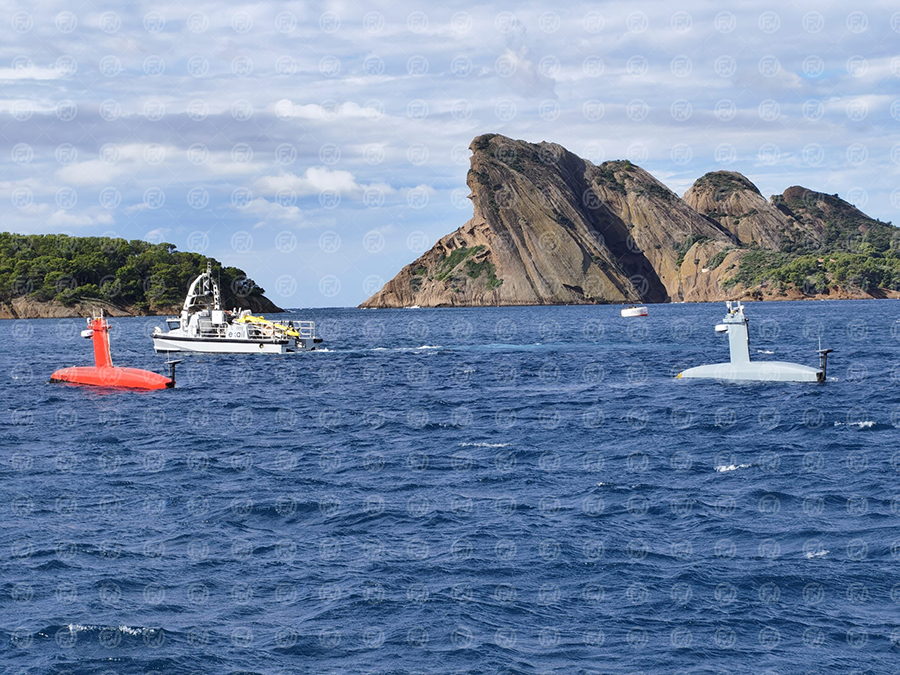
On October 7-8, 2026, France’s naval drone industry staged back-to-back demonstrations for a select group of defense journalists as part of the Euronaval Press Tour, first in the waters off Toulon and then off La Ciotat, roughly 25 km to the west. Over 2 days, Naval Group (through its subsidiary Sirehna) and Exail showcased a range of Unmanned Surface Vessels (USVs) and integrated unmanned concepts that illustrate the breadth of French capabilities in the naval drone domain.
Day 1 - Naval Group’s SEA QUEST S
The October 7 demonstration centered on the SEA QUEST S, a USV developed by Sirehna — part of the Naval Group ecosystem — in collaboration with shipyard Couach-CNC, which handled the conventional hull and propulsion package. The SEA QUEST S performed a series of dynamic demonstrations, including the intercept of another USV.
The vessel is approximately 9 m long and features a foldable mast; these 2 design choices allow it to be deployed and recovered from the stern ramps typically found on surface combatants - on French and many other navies’ ships, these ramps are sized for Rigid-Hulled Inflatable Boats (RHIBs) of comparable length.
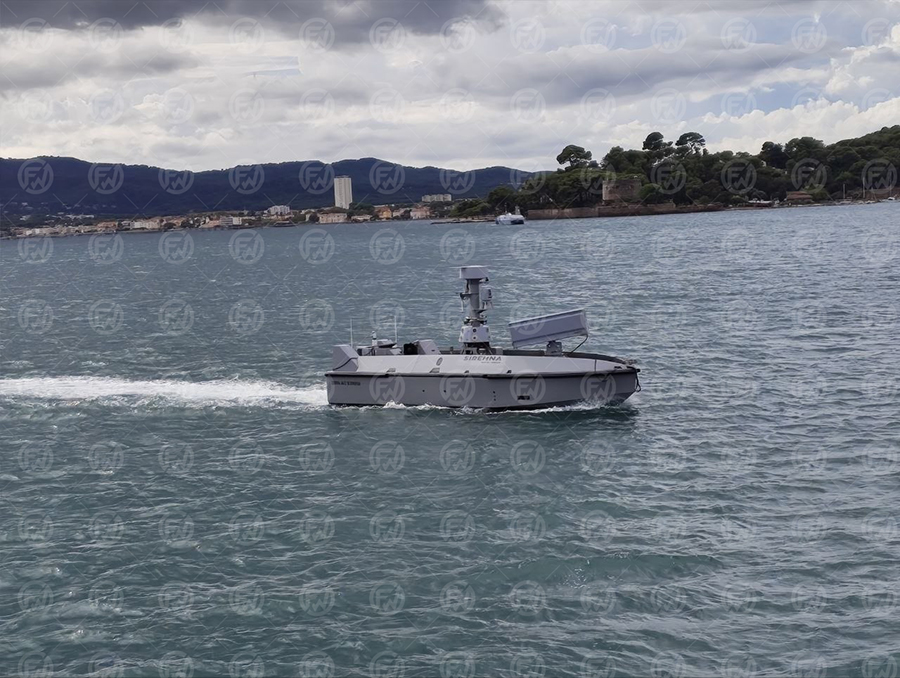
The SEA QUEST S can operate in 2 distinct profiles: low-speed, long-endurance missions and high-speed runs exceeding 30 knots, enabling it to escort naval units at maximum speed. Its modular mission package can include a rocket launcher (for Thales-made guided munitions), an Electronic Warfare (EW) suite, a sonobuoy dispensing system, and UAV launch systems - 2 different launchers for 2 UAV models have been integrated so far.
In France, the SEA QUEST S was the first USV in its class to receive navigation certification. It has already participated in NATO exercises in 2024 and 2025 and is essentially ready for serial production and export. Naval Group is also developing 2 larger variants, the SEA QUEST M and SEA QUEST L, whose details are expected to be unveiled at Euronaval 2026 in Paris this November.
Day 2 - Exail’s USV Portfolio and the NEPTIS Concept
The October 8 event featured Exail, a company formed in 2022 from the merger of ECA Group (robotics) and iXBlue (inertial navigation and photonics systems). Exail brought 3 USVs to sea: the military-oriented INSPECTOR 125 and 2 civilian-derived DRIX H-8 units.
The INSPECTOR 125, 12.5 m long, is one of Exail’s solutions for mine countermeasures. The system is currently being delivered to the Belgian and Royal Netherlands navies as part of the joint rMCM (Replacement Mine Countermeasures) program, within a comprehensive capability package.
The 2 DRIX H-8 USVs — one gray, one red, underscoring their dual-use potential — have a vaguely submarine-like profile, though they share nothing with actual submarines.
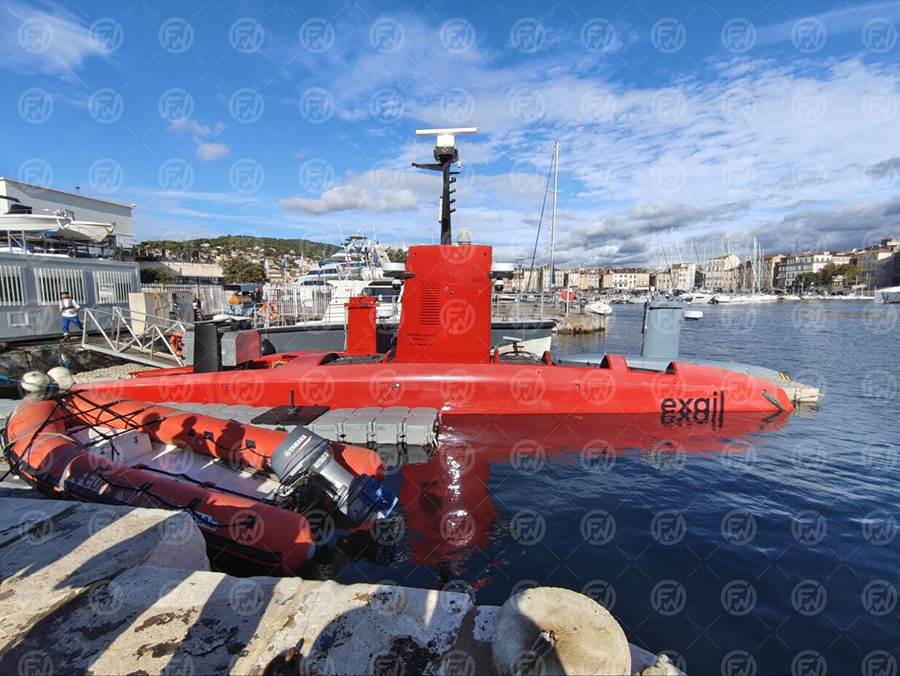
Primarily designed for surveillance, the DRIX H-8 is approximately 8 m long, displaces around 1.5 tons, and is powered by a diesel engine driving a single propeller. It has 2 larger siblings: the H-9 and the O-16. The latter, at roughly 16 m and approximately 10 tons displacement, combines diesel and electric propulsion (a conventional propeller, an azimuthal pod, and a bow thruster) and offers significantly greater capacity — its substantial payload can accommodate towed sonars, UAVs (currently tethered, with free-flying capability planned), and a variety of other sensors and equipment. The H-9, while smaller, also packs considerable capability: it has been acquired by the US Navy — fitted with US-sourced sensors — for use with Task Force 59 and the 4th Fleet (Caribbean, Central and South America).
Building on the DRIX family (all built with fiberglass and carbon-fiber hulls), Exail previewed the NEPTIS concept, an integrated unmanned maritime surveillance system. NEPTIS revolves around the ORYX USVs, a more militarized evolution of the DRIX platform — particularly the 16 m variant, but covering all 3 sizes — designed to complement traditional naval units. The system is intended to provide persistent Intelligence, Surveillance and Reconnaissance (ISR) as well as critical undersea infrastructure protection and Anti-Submarine Warfare (ASW) capabilities.
As an illustration of what the larger platform can deliver, in 2025 a DRIX O-16 successfully participated in Exercise REPMUS in Portugal. To reach the exercise area, the O-16 navigated autonomously — under human supervision, in line with the “supervised autonomy” concept — from France’s Mediterranean coast to Portugal, transiting the Strait of Gibraltar, a demonstration of the system’s operational robustness and endurance. The O-16 is rated for 30 days of continuous autonomous operations.




Privacy Policy

Powered by © Mobilbyte s.a.s. Information Technology