



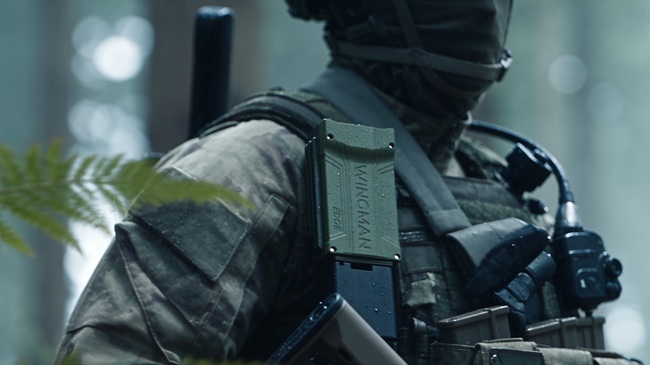
At the Association of the United States Army (AUSA) exhibition, the Defense industry showcased new equipment to protect tomorrow’s soldier. In a more integrated and complex battlefield, dismounted soldiers (infantry squads, reconnaissance units, special forces, mortar teams, snipers) require not just better weaponry, but also equipment that helps them operate better.
During AUSA, FW Mag had an exclusive chat with Bill Ostrowski, CEO of MyDefence North America. The company produces wearable counter-UAV (C-UAV) systems like the WINGMAN, designed for dismounted troops. At AUSA, the company announced updates on the next generation of the WINGMAN, called WINGMAN EDGE. This wearable detector will include an AI-enabled system, “which will allow us to detect systems and cycle through four times faster than before.” The system is still at the prototype stage, with testing forthcoming. “We’re [aiming for] the first production units to come off the production line in March 2027,” the company CEO explained.
FW Mag also asked whether WINGMAN EDGE can work together with other C-UAV systems that a dismounted infantry squad will have, for example fire control systems like SmartShooter’s SMASH 2000L, which FW Mag has written about previously. Ostrowski confirmed: “We are working with that system. We send a standardized message format out,” adding that “we are compliant with ATAK, Maven, Lattice and SAPIENT for the European [systems] and also several others.”
The idea is to create a mini-network among systems that a dismounted squad can carry: the WINGMAN EDGE is the collector, while the company’s PITBULL system is the jammer. The two systems can be paired with a soldier’s ATAK (Android Tactical Assault Kit), which can in turn send information to other effectors, like the fire control systems carried by other soldiers.
Ostrowski added that MyDefence’s new WINGMAN EDGE is 17% lighter than the original WINGMAN, which is very important for any soldier. “We’re able to make it small enough to be radio-sized, and it’s hands-free,” making it more convenient than a handheld device.
Another company that showcased systems for dismounted troops was Kopin. Before AUSA, FW Mag had an exclusive interview with CEO Michael Murray, who explained that the company has developed the SENTINEL headset for first-person-view (FPV) drones; a demonstrator was shown at AUSA. The new headset has “better resolution,” and the executive confirmed that previous versions of the company’s headsets are already supplied to “5 or 6” of the top 15 companies that have participated in the U.S. Army’s drone dominance programs.
The CEO confirmed that there are already orders for the new SENTINEL FPV: a contract worth $3.5 million was announced earlier this year, and Murray confirmed to FW Mag that deliveries have started. “We are expecting other orders” for the SENTINEL FPV.
The company does not sell the headsets directly to the U.S. Army: it supplies them to companies developing drones for the service, and Kopin’s headset is sold as part of the package. “There is an approximately 20-to-1 ratio in terms of drones to headsets,” Kopin told FW Mag.
Finally, at AUSA, L3Harris announced a $55 million award from the U.S. Army to support the Binocular Night Observation Device (BiNOD) program, specifically for the company’s NOVA night-vision goggle system, allowing the program to “move directly into full-rate production of the system.” NOVA provides day-and-night, all-weather situational awareness for soldiers.
Much has been written about the eternal challenge of adding more equipment to a soldier to improve performance, protection, and lethality. However, as a human, a soldier has limits on how much they can physically carry. A 2025 commentary by Master Sgt. Matthew M. McLemore for the NCO Journal correctly argues that “while lighter equipment and weapons are highly desirable, evolving threats and emerging capability requirements make achieving this balance complex”; therefore, “managing Soldier load requires leaders to understand doctrinal recommendations, assess their formations, and implement changes to improve combat effectiveness.”
The obvious problem with adding new, light systems to a soldier’s load is that the weight eventually adds up. “Excessive loads increase the risk of injury and fatigue, which impair cognitive and physical performance,” Master Sgt. McLemore explained.
Companies like Kopin, L3Harris and MyDefence are designing systems to make dismounted soldiers more effective and lethal, while also protecting them from incoming threats. However, new threats and new technologies will also affect the basic composition of a 9-soldier U.S. Army infantry squad, for example. Some soldiers may be tasked with carrying C-UAV systems, electronic warfare (EW) systems, or advanced observation devices. Another option is to expand the size of the squad so the new technologies and equipment can be divided among more people. The U.S. Army is experimenting with new technologies through the Soldier Borne Mission Command (SBMC) program, of which Kopin is a part; the Army has awarded Kopin $15.4 million to build a full-color microLED display for programs like SBMC.
New threats and new technologies will continue to affect dismounted soldiers, including infantry squads (arguably the cornerstone of any army), in terms of tactics, numbers, and the equipment they must carry in the field.




Privacy Policy

Powered by © Mobilbyte s.a.s. Information Technology