



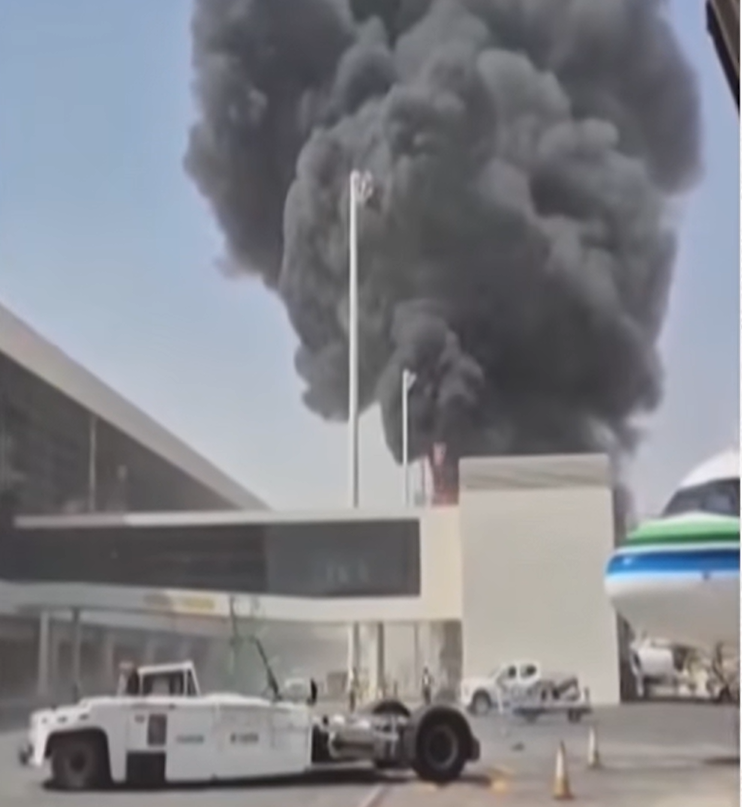
The military campaign waged by the Houthis against Saudi airports saw a significant escalation in the first half of October 2026, in parallel with the resumption of Saudi operations in Yemen. Strikes against the airports of Riyadh and Abha (in the country’s southwest) demonstrated the Yemeni group’s ability to hit strategic infrastructure deep inside Saudi territory.
The October 10 attack on King Khalid International Airport in Riyadh was particularly notable: it caused numerous casualties and injuries and led to the suspension of all airport operations. The strike reportedly opened with drones, followed by cruise and ballistic missiles. King Fahd International Airport in Dammam - in the eastern al-Sharqiyya region, the world’s most oil-rich area - and Abha International Airport were also hit.
The Houthi strategy follows a logic of air interdiction and political-economic coercion: rather than pursuing the outright destruction of infrastructure, Ansar Allah aims to compromise its security and operational continuity, forcing Saudi authorities to halt connections and reroute commercial traffic. Airports are particularly sensitive targets whose neutralization, even if temporary, produces economic and reputational consequences that far exceed the material damage. The campaign also seeks to pressure Riyadh into scaling back its support for the Presidential Leadership Council (PLC) forces and its operations along the Red Sea coast. However, the air attacks are not confined to Saudi Arabia: on October 7, in response to the government counteroffensive, the Houthis struck Aden airport with ballistic missiles and explosive drones, forcing the diversion of a flight arriving from Cairo. The campaign echoes the 2025 operations against Israel’s Ben Gurion airport in Tel Aviv and Ramon airport in Eilat, on the Red Sea, confirming the centrality of air transport in the group’s regional pressure strategy.
The Houthi offensive capability rests on a heterogeneous inventory of ballistic missiles, cruise missiles, and drones. Ballistic delivery systems include the Iranian-derived BURKAN-2H/3 and the longer-range ZULFIQAR and PALESTINE-2 (up to approximately 2,000 km); however, the “hypersonic” label the Houthis have attributed to the PALESTINE-2 has not been independently verified. These are complemented by QUDS-family cruise missiles for land-attack missions and expendable UAVs such as SAMAD-3, QASEF, SHAHED, and WAEED-2.
The group also benefits from a partially localized production and assembly pipeline: the Houthis manufacture simple drones and some short-range rockets and missiles domestically, while complex ballistic systems, propulsion units, and critical guidance components continue to come largely from Iranian supplies. Nonetheless, the dispersal of these resources helps sustain availability and maintain the threat despite ongoing strikes.
For its part, Riyadh fields state-of-the-art air defence systems including PATRIOT batteries — both PAC-2 and PAC-3 variants — and THAAD units (since 2025) for high-altitude missile defense, but it faces a threat with unconventional characteristics that pose serious detection, tracking, and interception challenges. The simultaneous use of multiple delivery system types and the high number of munitions employed per operation increase the load on surveillance and command systems, saturating detection capabilities, while the need to protect a vast territory forces the distribution of inherently limited defensive resources. Compounding these difficulties are the poor operational integration among Saudi military branches, historically marked by a rigid hierarchical structure; limited combat experience in air defense; and training heavily dependent on Western advisors. All of this hampers the ability to respond promptly and jointly to a multilayered threat like the Houthis.
The attacks thus demonstrate how Ansar Allah, which certainly does not match Riyadh’s firepower, can impose significant costs on a militarily superior state adversary without achieving traditional air superiority. Whether the disruption of civilian air traffic will yield real political concessions, however, remains uncertain: it may instead accelerate or even intensify the Saudi response.




Privacy Policy

Powered by © Mobilbyte s.a.s. Information Technology