



Expeditionary forces require very specific equipment: it must be easy to transport, often in a container that can be airdropped by parachute from a C-130 or carried by helicopter, and it must be just as easy to assemble in the field as it is to pack up when the mission concludes. At the Association of the United States Army (AUSA) expo in Washington, DC, FWMag noticed a pattern of new equipment specifically designed for expeditionary operations.
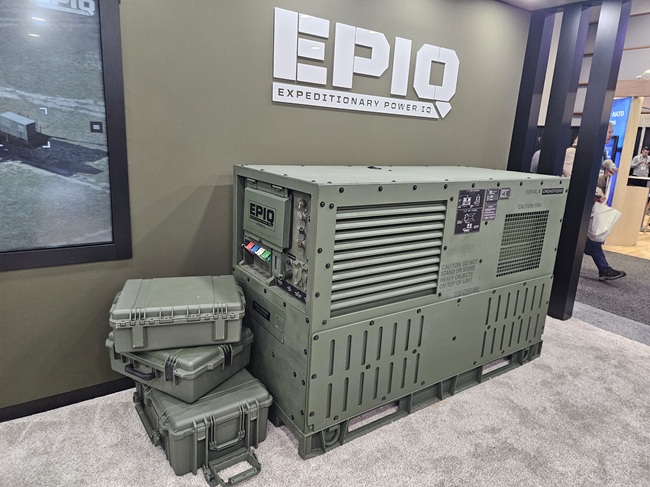
Power is critical for expeditionary missions: after all, any technology requires energy to operate. To that end, GM Defense unveiled the EPIQ HYBRID demonstrator, an integrated, transportable power concept combining a 60 kW/100 kWh battery baseline with “an appropriately sized generator aimed at lowering fuel demand and signatures in austere environments.” FWMag spoke exclusively with Jim Riley, Energy Business Development, GM Defense, about the system.
Riley confirmed that EPIQ HYBRID is in “early prototype” and that the company aims to have a functional prototype for demonstrations in late 2027 or early 2028. The baseline EPIQ system has already completed a Defense Innovation Unit (DIU) prototyping effort and is available for procurement through an Other Transaction Authority (OTA) pathway. The company is “not announcing a specific bid for EPIQ HYBRID at this time”; however, the new system is designed to meet expeditionary power needs in a smaller package.
Riley explained that EPIQ HYBRID is an “integrated package that can provide resilient power with reduced fuel consumption, logistics, acoustic and thermal signatures,” and can be easily transported. As for how many systems it can power simultaneously, Riley explained that the main EPIQ system was demonstrated with 5 x 60 kW units in parallel, leveraging the same power electronics to deliver 300 kW. “We intend to match this functionality,” Riley concluded about EPIQ HYBRID.
Among the systems EPIQ HYBRID could power are satellite communications terminals. Lite Coms produces satellite communications (SATCOM) terminals and Communications-on-the-Move solutions. During AUSA, FWMag spoke with CEO Robert Jacobson, who explained that the company displayed the GT3 for the first time: a ruggedized, low-profile Communications-on-the-Move terminal designed to extend high-throughput Low Earth Orbit (LEO) connectivity. Jacobson confirmed that the company will continue “to focus on reducing size, weight and power” while also providing operators “access to resilient connectivity across multiple networks and operational environments.”
FWMag asked about SATCOM solutions for expeditionary forces. Jacobson explained that the LITE SAT 1.3A “is specifically designed as an expeditionary flyaway system.” The system can be transported in 3 airline-checkable cases and can typically be assembled and acquire the satellite in under 10 minutes. “Our systems are designed with expeditionary transport in mind, including movement by military aircraft such as the C-130,” the company executive added.
Another system designed for expeditionary missions is Northrop Grumman’s Ground/Air Task Oriented Radar (G/ATOR), a “highly mobile” expeditionary radar providing 360-degree coverage. During a media briefing ahead of AUSA, FWMag asked Paul Weaver, Director of Business Development, Land and Maritime Sensors, about it. Weaver explained that G/ATOR can be carried aboard a C-130, externally by a CV-22 OSPREY, or towed by a tactical vehicle. “It can be in place and operational in under 10 minutes by a 4-person crew,” Weaver added. At under 9,000 lb (about 4,000 kg), “it is the lightest radar in its class.”
Weaver added that the system can be deployed in the “high north, deserts, the Western Pacific” or in US Africa Command (AFRICOM)’s area of operations. He confirmed that 43 G/ATORs have been delivered and that the company is on track to deliver 60.
AFRICOM’s modus operandi is based on expeditionary forces, while US Southern Command (SOUTHCOM) has a growing presence in Latin America to combat drug-trafficking networks operating in jungle environments. In both cases, transportability is a critical requirement for any equipment troops will operate.
Expeditionary forces require specific equipment: lightweight, easy to transport, and easy for small teams to set up in the field. Companies like Northrop Grumman and Lite Coms are developing radars and satellite communications terminals to support these troops, while GM Defense showcased at AUSA a transportable power demonstrator that could supply this kind of equipment. As warfare evolves and autonomous systems emerge, expeditionary forces will need additional equipment to protect troops from drones and other autonomous threats, as well as to maintain communications.




Privacy Policy

Powered by © Mobilbyte s.a.s. Information Technology