



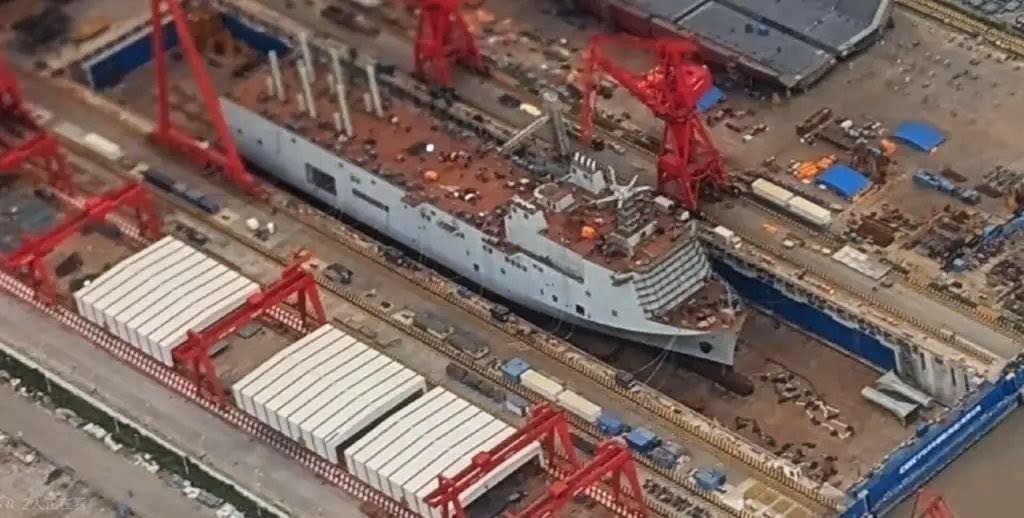
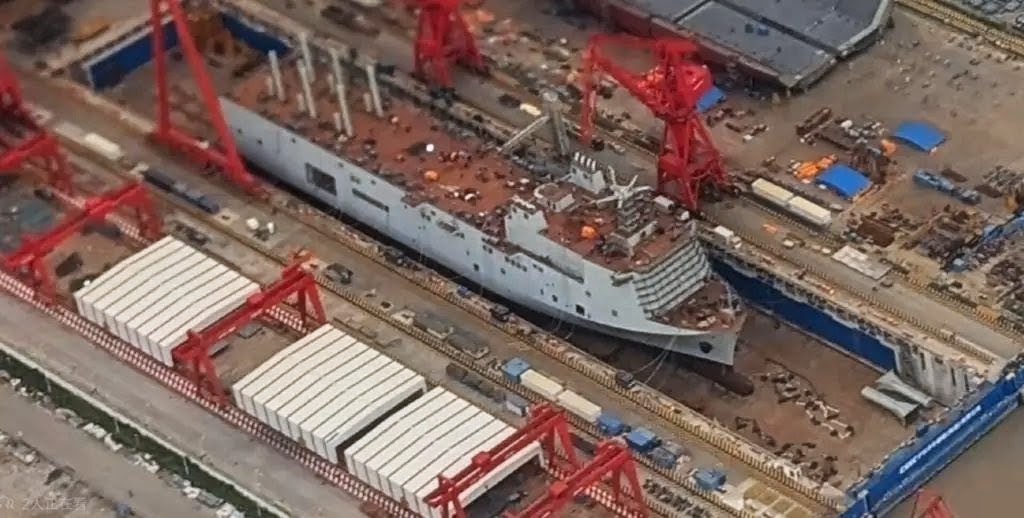
Satellite imagery has revealed a new unit under construction at the HUDONG-ZHONGHUA shipyard in Changxing, Shanghai, where amphibious ships and frigates for the Chinese Navy (PLAN) are normally built. The hull was initially interpreted as a new LPD, 205 m long and 30 m wide — dimensions similar to the existing TYPE 071 — but unusual design features have since emerged.
The vessel carries 12 large hydraulic lifting pistons that protrude vertically from the stern structure. On a conventional LPD they would raise and lower the well deck; here they operate a free-standing module that incorporates the aft portion of the keel and acts as a “cradle” for a large underwater vehicle. The arrangement effectively functions as a floating dock built into the ship. Propulsion is provided by 2 azimuthal pods on either side of the dock.
Cross-referencing available imagery, the “dock” measures roughly 55 m by 13 m. When raised, it aligns with a 95 m by 17 m internal hangar, allowing the vehicle to be transferred to dry conditions via overhead crane or towed platform. The configuration can accommodate more than one underwater vehicle at a time, keeping one or more in the “dry” hangar and another in the “mobile” dock. The deck above the hangar is configured as a flight deck, with the superstructure — bridge, accommodation, engine intakes and exhausts, and possibly a helicopter hangar — positioned forward.
The PLAN is currently evaluating at least 3 types of XXLUUV (Extra-Extra Large Unmanned Underwater Vehicle) in the 42-45 m range. During the September 2025 Victory Parade, a torpedo-shaped XLUUV 18 m long was also displayed. For comparison, the US Boeing ORCA XLUUV measures from 15.5 to 26 m depending on whether a modular section is installed, while a conventional U-212A submarine is 56 m long (the Italian TOTI-class boats were 46 m).
A dedicated mothership for vehicles of this size supports a wide spectrum of missions, from “dual-use” and technical-logistic support to operational employment. XXLUUV platforms can damage underwater infrastructure, lay mines or sensor fields, conduct anti-submarine patrols, and run surveillance missions. A mothership extends their range of action and simplifies in-theater maintenance and resupply. The same design philosophy had already appeared, on a much smaller scale, on a civilian underwater support vessel launched in 2025 — effectively the commercial counterpart of the new mothership.
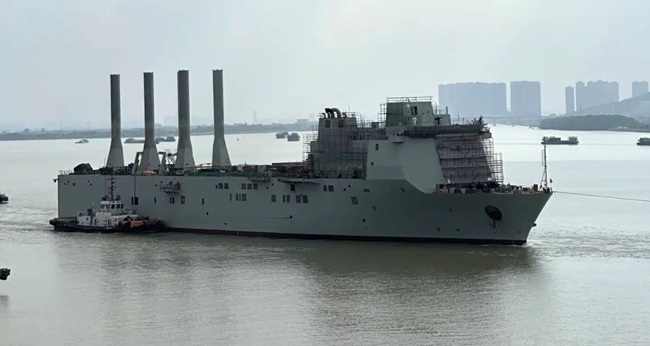
Only days after the Shanghai unit was identified, satellite imagery flagged a second, very similar vessel at the COMEC-GSI shipyard in Guangzhou. It is smaller and uses only 4 lifting pistons (2 pairs) to actuate the stern “cradle” that houses the underwater vehicles, against the 12 fitted on the HUDONG unit. Superstructure, funnel arrangement, stern dock, and internal hangar appear otherwise identical or very close. The two ships are almost certainly prototypes intended to let the PLAN mature experience before committing to series production — a reasonable approach, given that no other navy has pursued this configuration.
The PLAN has followed this pattern repeatedly: build prototypes or small batches, run operational trials, refine requirements, and then — once results are satisfactory — launch large-scale production exploiting the enormous capacity of Chinese shipyards. The sequence played out with the TYPE 054 frigates (2 units, followed by 42 TYPE 054A) and with the TYPE 052C destroyers (6 units, followed by 38 TYPE 052D).
COMEC-GSI has delivered several other notable programs that have drawn attention from regional neighbors and from the US Navy. In 2004, 3 self-propelled barges fitted with lifting pistons entered service to form a long pier for transferring armored vehicles from RO-RO and amphibious ships to shore. The yard also launched a small carrier used for drone trials and training. Two of the 4 large TYPE 901 fleet replenishment ships (240 m long, 31 m wide, 45,000 t, 4 gas turbines for 150,000 hp, 25 knots) supporting the carrier force are currently being built there. For comparison, the US JOHN LEWIS class measures 227 m by 32 m with a top speed of 20 knots.
Chinese authorities remain discreet on construction plans and on the characteristics of new units. Satellite imagery nevertheless shows 2 additional replenishment ships under construction at COMEC-GSI — the largest in the world, 270 m long, 37 m wide, with an estimated displacement of 65,000 t.
Chinese shipbuilding capacity, combined with an aggressive development plan, is rapidly bringing the PLAN to a level of operational capability that is striking against the dominant position the US Navy has long held over the oceans.




Privacy Policy

Powered by © Mobilbyte s.a.s. Information Technology