



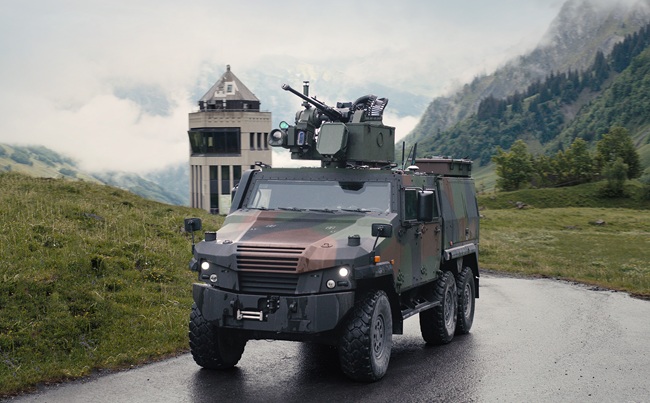
Drones, loitering munitions, and one-way attack drones. The sky is now full of aerial threats that ground forces need to be protected from. At the Association of the United States Army (AUSA) expo in downtown Washington, DC, several industries displayed new Counter-Uncrewed Aerial System (C-UAS) solutions to address these threats.
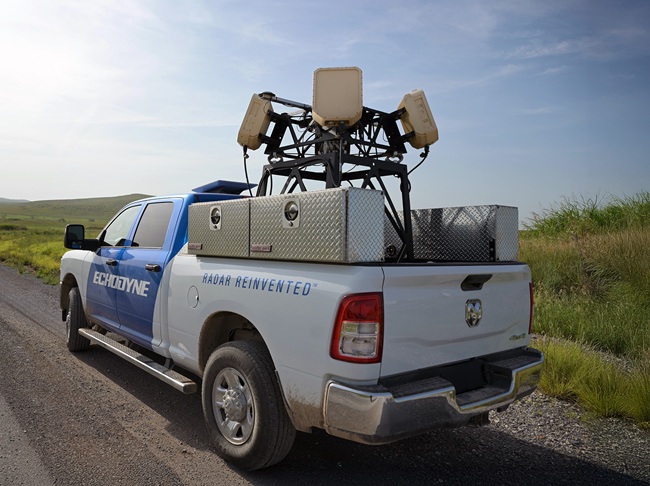
Echodyne was among the companies drawing attention. Before AUSA, on 30 September, the company announced an indefinite-delivery/indefinite-quantity (IDIQ) contract supporting the Joint Interagency Task Force 401’s (JIATF-401) DOMESTIC SHIELD program with a USD$250 million ceiling and an ordering period of up to 36 months. Specifically, the company’s MESA radars will be available via JIATF-401’s Marketplace for U.S. military units. MESA is a medium-range radar that delivers persistent, high-quality tracks at a 10 Hz update rate.
In an exclusive interview with FW Mag, Echodyne CEO Eben Frankenberg said, “we design every MESA radar as a software-defined system, so firmware on the radar and software around it can continue to improve performance over time.”
The CEO declined to discuss new orders, but noted that domestic manufacturing capabilities have been expanded to “a flexible production line capable of producing up to 30,000 radars per year.”
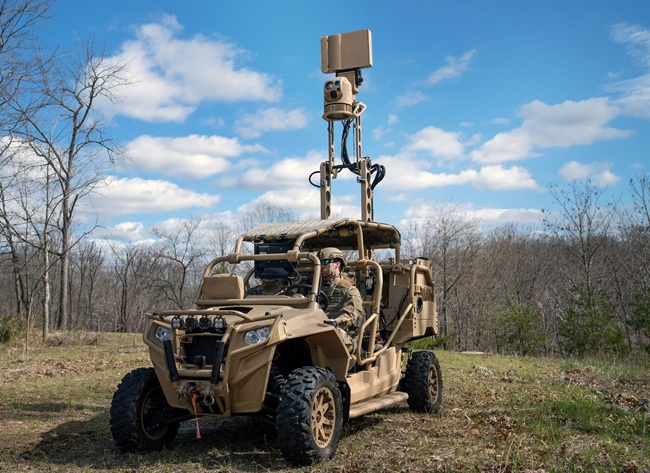
Meanwhile, L3Harris develops the VAMPIRE C-UAS system, which has already been deployed to Ukraine. Moreover, deliveries of VAMPIRE have commenced for the U.S. Army, part of a USD$106 million order for the service first announced in June.
During a media briefing at AUSA, Chris Aebli, L3Harris President of Communications & Spectrum Dominance, confirmed that deliveries have commenced: 12 systems were delivered in September, and deliveries will continue monthly until December. A total of 35 systems were ordered.
Moreover, the executive confirmed a “much larger order” from an international customer for an undisclosed number of VAMPIREs. The order “is 5 times larger in terms of value” than the U.S. Army order, and “we will provide them on pickup trucks.”
While VAMPIRE is designed to defeat drones, other companies are designing systems to locate them. Case in point, at AUSA, Teledyne FLIR Defense launched RANGER R10-3DX, which the company defines as a mid-range C-UAS radar for “advanced drone detection and tracking capabilities. “Using advanced digital beam-forming technology, the R10-3DX provides continuous wide-area coverage,” the company explained in a press release.
RANGER can detect micro-UAS targets at ranges exceeding 3 km, pedestrians beyond 6 km, and vehicles beyond 14 km. Moreover, the system’s AI-based target classification algorithms help the operator “distinguish between drones, aircraft, birds, pedestrians and vehicles” to avoid false alarms.
A company executive chatted with FW Mag at AUSA about the new RANGER, which will be “available in Q1 2027.” Up to 4 panels can be linked together to provide 360° coverage with a 60° elevation. The Ranger can track “more than 500 targets simultaneously,” as it was “designed with swarms in mind,” FW Mag was told. Tests and demonstrations continue to successfully integrate various systems to create the ideal, multi-layered response for C-UAS systems.
At AUSA, Aebli from L3Harris said the company has participated in exercises and test events like LIGHTNING SURGE, PROJECT CONVERGENCE 6, and OPERATION JAILBREAK. The company assured the media that they can integrate their products “into the data layer that the U.S. Army is putting together almost in a plug-and-play fashion.” Similarly, Echodyne’s Frankenberg told FW Mag that “layered response remains central to counter-UAS operations, but the demands on each part of the chain are changing.” For Echodyne’s CEO, radars must have 3 capabilities to be efficient in the detect-to-decide-to-defeat cycle: deliver precise and actionable data at a high update rate, the ability to be integrated within a wider system, and continuous evolution and improvement to evolving threats. Finally, Teledyne also noted that the RANGER can be easily integrated with other systems.
The war in Ukraine, the ongoing wars across the Middle East, and other conflicts around the world demonstrate that having robust, multi-layered C-UAS solutions is mandatory to protect ground troops, equipment, and installations. The goal of militaries and industries - like L3Harris, Teledyne FLIR Defense, and Echodyne - is to ensure these systems work in harmony to reduce cognitive overload for operators and provide continuous, total domain awareness and defense capabilities against drone threats.
Follow us on Telegram, Facebook and X.




Privacy Policy

Powered by © Mobilbyte s.a.s. Information Technology