



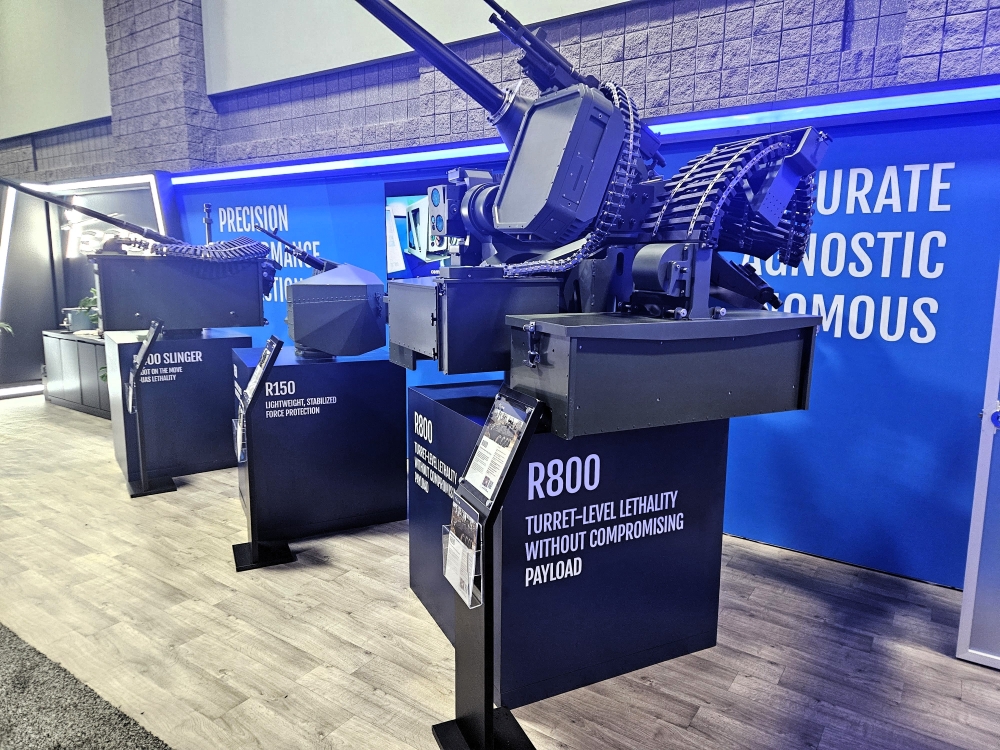
While the revolution in autonomous technology is well underway, soldiers will continue to fight tomorrow's battles, and new technologies are needed to protect them. At the Association of the United States Army (AUSA) exhibition in Washington, DC, several companies displayed systems to protect armored vehicles.
One company that unveiled a new system for the first time in the US is Maris-Tech. The DIAMOND ULTRA V2 can fuse up to 12 synchronized day and thermal sensors into a single real-time operational picture, providing 360° coverage and true 3D spatial awareness. The system has AI capabilities for real-time analysis, detection, and tracking. Each of the cameras consists of three thermal and HD cameras; 4/5G and GPS capabilities are also included.
In an exclusive interview with FW Mag, Israel Bar, CEO of Maris Tech, explained that the DIAMOND ULTRA V2 is already on the market and, while the company is “not bidding for any contract,” at the time, “we’ve identified such a gap when demonstrating our previous generation to the US Army.” The CEO did confirm there are orders for the system but declined to discuss them or delivery times.
Maris Tech’s press release on the DIAMOND ULTRA V2 explained that it can be integrated with “onboard weapons and fire-control systems.” The company’s CEO confirmed to FW Mag that the system has already been tested “on tanks and Light Tactical Vehicles.” The system can provide any remote weapons system (RWS) with the azimuth, elevation, and estimated distance of a target within the field of view of an integrated camera. “Currently, we’re in the process of integrating the platform with an RCWS for counter-drone missions, he added.
Designing remote weapons systems for counter-UAS missions to protect vehicles, especially large armored vehicles or tanks, is a priority. At AUSA FW Mag spoke with a Kongsberg executive who explained that the “armored vehicle of the future will need to have some self-defense capabilities against drones.” The company produces a well-known family of remote weapons systems for a variety of missions, including protecting vehicles from drone threats.
The executive told FW Mag that the company participated in Exercise Flytrap in Lithuania earlier this year, and the RS6 system engaged drone targets. Similarly, the Common Remotely Operated Weapon Station (CROWS), a variant of the company’s Protector RS4, was also tested this year aboard an Abrams tank for counter-UAS training.
Looking ahead, Kongsberg is experimenting with smaller systems for lighter vehicles so they can also have counter-UAS capability. “We are entering the PROTECTOR RS2 into competitions,” the executive explained. The RS2 is a new remote weapons system designed for a 7.62 mm or 12.7 mm rifle.
The company also believes that future armored vehicles will have to work together to defeat threats, including drones. “We foresee multiple vehicles working together in collaborative engagement,” the executive told FW Mag, meaning operating “in formation and sharing data [regarding incoming threats]. Our weapons systems have done work like that.”
Similarly, FW Mag spoke with a spokesperson from EOS, who discussed the next-generation SLINGER, a counter-UAS optimized variant of the company’s R400 remote weapons station. The spokesperson explained that the SLINGER already exists and is manufactured by EOS Australia. Still, the system has been updated and modernized for use in the US – it will be manufactured in Alabama by the end of the year or early 2027, and the company expects to have “a steady rate of production by mid-next year.” The company confirmed that “a US Army customer” has ordered the next-generation Slinger, without further elaboration.
EOS has fielded “over three thousand” of its family of remote weapons systems globally, some of which are “very active in Ukraine” for counter-UAS missions. The spokesperson highlighted that its family of RWSs can be integrated into any type of system, including tanks, Strykers and other armored vehicles, particularly the R400, which can operate a 30 mm cannon while also being lighter overall than RWSs from other providers.
Looking to the future, the company spokesperson believes that new payloads will be added to remote weapons systems. “There is interest in different configurations of rockets; to achieve a combination of guns and missiles.” EOS told FW Mag that “we have done that” configuration in the past, but it is becoming “very common and needed for Army platforms.” The spokesperson also added that more advanced sensors are needed to detect threats.
The era of autonomous systems means threats to vehicles can come in the form of aerial drones, loitering munitions, or uncrewed ground vehicles. Hence, vehicles need not only weapons systems to defeat human adversaries but also machines. Additional domain awareness capabilities like Maris Tech’s DIAMOND ULTRA V2 offer soldiers aboard a vehicle a better understanding of their surroundings; meanwhile Kongsberg and EOS will continue to produce remote weapons systems with new capabilities, giving operators more options to face an incoming threat. On the battlefield, a vehicle makes an attractive target, so it requires additional defensive capabilities.
Follow us on Telegram, Facebook and X.




Privacy Policy

Powered by © Mobilbyte s.a.s. Information Technology