



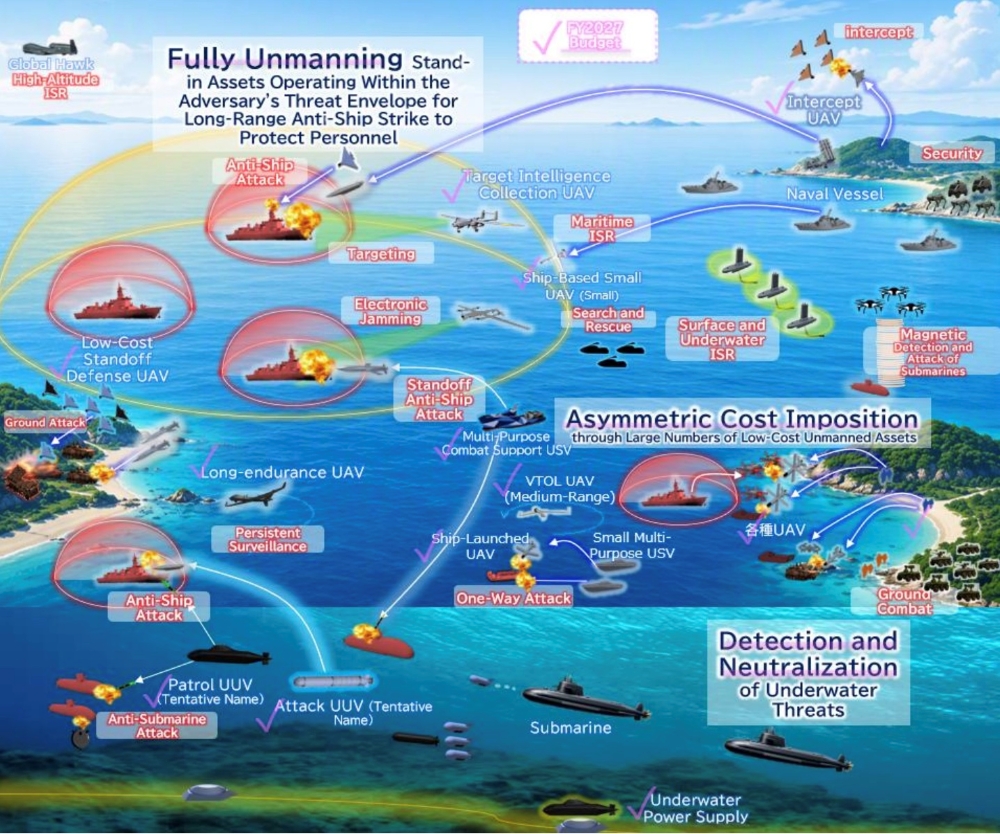
Japan is seeking to expand its use of unmanned systems across the air, maritime and land domains, with its Ministry of Defence’s (MoD) FY2027 budget request covering long-endurance surveillance aircraft, small attack UAVs, fighter-linked collaborative aircraft, interceptor drones and counter-drone defences.
Japan is eyeing the induction of new unmanned assets not only supplement but also replace functions currently performed by manned systems. The MoD said the unmanned assets would improve the efficiency of missions that were traditionally performed by the Japan Self Defence Forces (JSDF) with manned systems.
The use of unmanned systems would “minimize personnel losses while securing asymmetric advantages on land, at sea, underwater, and in the air.” In the maritime domain, the Japan Maritime Self Defence Force (JMSDF) plans to utilise its unmanned assets in the case of a maritime invasion, to “absorb” adversary attacks.
Japan’s FY2027 budget request emphasises the expansion of unmanned capabilities, including the acquisition and development of unmanned aerial vehicles (UAVs), as well as research into unmanned underwater vehicles (UUVs). Planned procurements include low-cost interceptors for defence against adversary drone attacks and counter-strike drones.
The major unmanned programmes listed in the FY 2027 budget request include UAVs for intelligence, surveillance, reconnaissance (ISR) missions, targeting and attack. Research on a stand-off missile launch module for UUVs and development of a Compact Modular UGV will also be undertaken.
To strengthen airborne Intelligence, Surveillance, Reconnaissance and Targeting (ISRT) Functions, the MoD has requested ¥292.2 billion for 17 MQ-9B long-endurance UAVs and follows earlier budget provisions for two and four aircraft. The Japan Maritime Self-Defense Force (JMSDF) is to acquire 23 MQ-9Bs with deployment scheduled to begin in FY 2027.
A budgetary request of ¥9.7 billion has also been made for the R&D for UAVs that will operate alongside Japan’s next-generation fighter aircraft being developed under the Global Combat Air Programme (GCAP) with the UK and Italy. The MoD intends to accelerate the development of these UAVs which will also be capable autonomous decision-making and undertake electronic warfare missions.
The MoD is pursuing the acquisition of several types of strike UAVs including ship-launched variants capable of attacking enemy ships and other targets. It is also pursuing the integration of strike capability on modular UAVs. The MoD has placed a ¥36.3 billion budget request for acquisition of small attack UAVs, which will be capable of rapidly engaging personnel, vehicles, and other targets and also being capable of loitering around the target. The strike UAVs will comprise of three distinct designs - Type-I, Type-II, and Type-III small attack UAVs.
Interceptor drones are also being acquired. Japan’s Acquisition, Technology & Logistics Agency (ATLA) entered into a mass production contract with the Japanese firm Terra Drone in August 2026 for interceptor-drone systems.
Terra Drone’s TerraB1 was selected over competition from Portugal’s Beyond Vision BVQ404, Germany’s QS Interceptor from Quantum Systems and the IonStrike from US-based DZYNE Technologies. Terra Drone had earlier in May 2026 won a public tender from ATLA for 300 units of its domestically produced Modular UAV (General-Purpose), Training Model.
Alongside its plans to acquire unmanned systems, Japan is pursuing additional capabilities to counter hostile drones. The MoD’s FY2 2027 budget request includes the development of a Close-Range Air Defense System (CRADS) which will combine missiles, guns, and lasers to counter a wide range of aerial threats, including low-cost mass-produced UAVs launched during swarm attacks. Budget requests have also been placed for performance verification testing of a shipboard laser system along with the demonstration of High-Power Microwave (HPM) equipment for counter-UAS operations.




Privacy Policy

Powered by © Mobilbyte s.a.s. Information Technology