



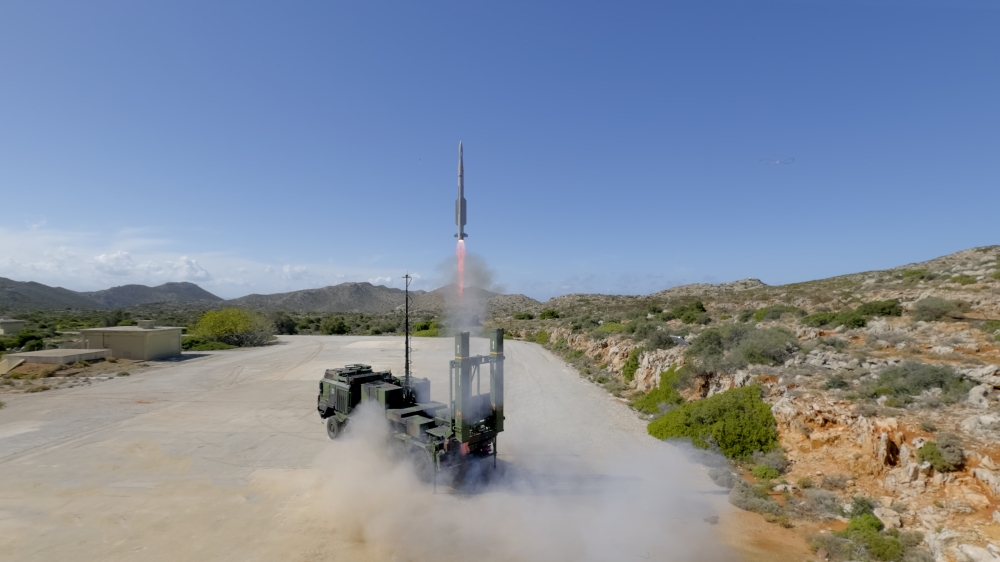
On October 14, in Crete, Germany proceeded with the planned handover of SHORAD capability back to the Army, while also validating the IRIS-T SLM batteries of the Luftwaffe with the first live launches.
Around 650 personnel from various german units took part in the live fire exercise at the NATO Missile Firing Installation (NAMFI) in Crete, together with forces from Sweden. PATRIOT, IRIS-T SLM and STINGER live firings were carried out.
For the german IRIS-T SLM, these were the first live launches, critical for validation.
As for the SHORAD component, symbolically the Luftwaffe carried out its last shots with the LEFLASYS system (armed with STINGER missiles) before the Army took over and carried on its first launches.
LEFLASYS is a system which entered service in June 2001, originally to the Army. It went to the Luftwaffe in 2012 when the Army Ground Based Air Defence component was dissolved. Now that arrangement is being reversed, with a newly established Army GBAD component centered on the Lüneburg base. The build up of the new GBAD component is to lead to 2 anti-aircraft battalions by 2028.
LEFLASYS is a lightweight, highly deployable SHORAD solution using the WIESEL 2 light tracked carrier vehicle. The target acquisition vehicle carries a radar for surveillance on a 20 km radius; the fire unit has 4 STINGER missiles ready to fire, with an EO/IR tracking system. The fire unit vehicle is known as OZELOT.
The WIESEL 2 is a very compact vehicle weighing just 4.3 tons with a speed of up to 70 km/h and a range of some 550 km. It can easily be airlifted even by CH-53 heavy lift helicopters.
LEFLASYS is the legacy system and currently the only SHORAD solution available to the German army, but a major capability build up is underway. The ARGE NNbS team, formed by Rheinmetall Electronics, Diehl Defense and Hensoldt Sensors, is to develop two new SHORAD versions of the 8x8 BOXER: one specifically designed for command and control of the SHORAD mission (FltPz vehicle), operating in close support of manoeuvre forces, and the other armed with a launcher for IRIS-T SLS missiles (FLAKRAKPZ vehicle).
The IRIS-T Surface Launch is essentially the same missile known from its well-established air-to-air role. Infrared-guided and highly manoeuvrable, it is expected to enable engagements at ranges of around 10 km. Graphics released so far show the new BOXER fitted with a turret carrying four missiles and a 40 mm GMG grenade launcher, useful not only for self-defence but also for engaging drones at very short range.
The command-post variant, equipped with a Remote Weapon Station for self-defence, will be able to coordinate operations even while the vehicle is on the move. A prototype of the pair of vehicles is expected in 2028.
The complete SHORAD system will comprise these 2 BOXER variants plus 3rd one, intended for closer-range protection and fitted with the SKYRANGER 30 turret mounting a 30x173 mm Oerlikon cannon (FLAKPZ vehicle). An order for an initial batch of 19 vehicles (16 operational and 2 for training and development) is already in place although deliveries have been delayed by many months. Originally, a qualification test vehicle had been expected already in October 2024 but is now not due before December at the earliest. The first series-production vehicles are now not expected before August 2027 and the full maturation of this first batch of 19 systems might take to 2029.
The Luftwaffe ground-based air defence component, the 61 Surface-to-Air Missile Group (FlaRakGrp 61) based in Todendorf, loses the SHORAD mission but carries on as the user of the IRIS-T SLM batteries.
Six IRIS-T Surface Launch Medium Range (SLM) batteries are being delivered, with the first system commissioned already in 2024 and completion of deliveries due by mid 2027.
Each IRIS-T SLM system includes a command post, a Hensoldt TRML-4D radar and 3 launcher vehicles, each with eight missiles ready to fire. The contract also included 216 live missiles and 72 training rounds, plus options for a further 665 missiles.
The TRML-4D is a C-band radar with a single flat-faced AESA antenna offering a 100° field of view; the antenna rotates to provide 360° coverage. It has an instrumented range of 250 km, although actual detection and tracking ranges naturally vary depending on the target and conditions.
The IRIS-T Surface Launch Medium Range (SLM) was first tested in 2014 and differs significantly from the air-to-air IRIS-T from which it is derived. The SLM uses active radar guidance rather than infrared guidance and, while retaining the same aerodynamic concept, employs an enlarged missile body that extends the range to 40 km.




Privacy Policy

Powered by © Mobilbyte s.a.s. Information Technology