



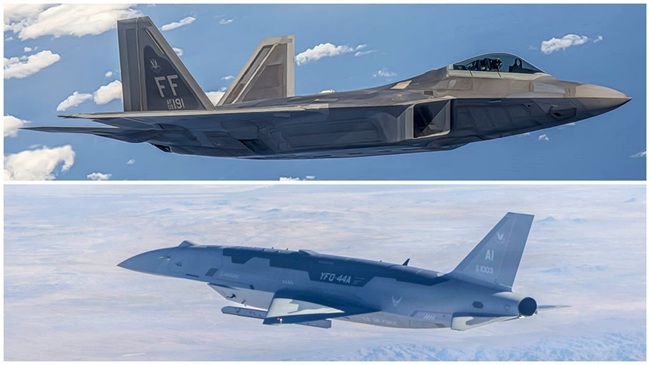
On October 5, in the training range of Edwards Air Force Base, a pilot of an F-22 RAPTOR air superiority fighter of the USAF controlled in flight a pre-production YFQ-44A FURY Collaborative Combat Aircraft (CCA).
According to the official statement, the F-22 pilot acted as a “quarterback” for the YFQ-44, issuing tactical directives of varying type and complexity through tactical datalink, without taking over the aircraft’s flight controls. The FURY’s onboard software interpreted and executed those orders in real time, autonomously performing dynamic flight maneuvers and simulated combat tasks.
Although on this occasion the F-22 controlled a single YFQ-44, the goal is to allow each fighter pilot, in the future, to manage multiple CCAs operating in formation, thereby expanding combat mass and reach. The mission, which lasted several hours, was a success and reflects the pace of progress toward the fielding of an operational CCA fleet. The choice of the RAPTOR is not accidental, as the F-22s are set to serve as the first “operators” of these unmanned aircraft once in service.
The USAF stated that the data collected during the test will be essential for future software integrations, experimentation activities, and the development of new operational concepts tied to CCAs. The test involved personnel from several units, including the 412th Test Wing at Edwards, the 422nd Test and Evaluation Squadron at Nellis Air Force Base, the 309th Software Engineering Group at Hill, and the CCA Experimental Operations Unit at Creech Air Force Base.
Already in November 2025 and in February and May 2026, the USAF had conducted flight tests using a “surrogate” drone — General Atomics’ MQ-20 AVENGER — to simulate a CCA, controlling it from F-22s and F-35s, in the latter case with the aircraft on the ground while the AVENGER was in flight.
The USAF aims to field 500 CCAs by 2032, with the ultimate objective of reaching a fleet of at least 1,000 units, intended for a range of missions (air-to-air, air-to-ground, ISR, or EW/EA). This first generation of platforms (Increment 1) — which includes General Atomics’ FQ-42 and Anduril’s FQ-44 — is focused on air-to-air missions. The service plans to acquire additional CCAs — potentially of entirely different types — through a subsequent phase, designated Increment 2.
The USAF has set a maximum cost of $20 million per aircraft, a figure that excludes the cost of sensors, weapons, or other equipment the CCAs may carry. Although the program has focused primarily on the integration of manned aircraft with unmanned systems, the USAF is also working on a capability that would allow personnel to command CCAs from ground stations, one of which — designated Portable Command and Control Enclave — was tested last August by the 178th Wing of the Ohio Air National Guard at Springfield Air National Guard Base.
As for the F-22 used, neither the Air Force nor Anduril have provided details on the aircraft’s configuration for this test. Recent budget documents referred to the need to integrate tablets, cabling, and related equipment on the RAPTOR for this purpose. Regarding drone-control interfaces inside the cockpit, the solutions disclosed so far have focused mainly on the use of touchscreen tablet-like devices — an option that, while workable, raises concerns about a possible increase in workload for single-seat fighter pilots. No details have been provided on maximum communication range, latency in command response, autonomous mission completion rate, or the number of interventions required from the pilot.
Regarding the other CCA that will be acquired by the USAF, the current plan to demonstrate the F-22’s ability to control the FQ-42A in flight is not clear. However, both FURY and VENGEANCE will make their debut during the large-scale exercise EMERALD FLAG scheduled for next December, providing a further opportunity to test them in a more operationally meaningful setting, alongside manned aircraft.
Operationally, the advantage offered by combat air systems controlled by fighters lies in the ability to further distribute weapons and sensors without involving a larger number of aircrews. For example, an F-22 armed with 6 AIM-120 missiles and controlling 2 FQ-44s each carrying 4 AMRAAMs would field 14 medium-range missiles, increasing its nominal missile load by 133%, should the FURY’s planned 4-missile configuration become operational.
As confirmed by Shushnar, VP of Anduril’s Autonomous Airpower division, the USAF’s CCA program is at a significantly more advanced stage and is progressing more rapidly than similar US Navy and Marines programs, and will be the first to field operational aircraft.




Privacy Policy

Powered by © Mobilbyte s.a.s. Information Technology