



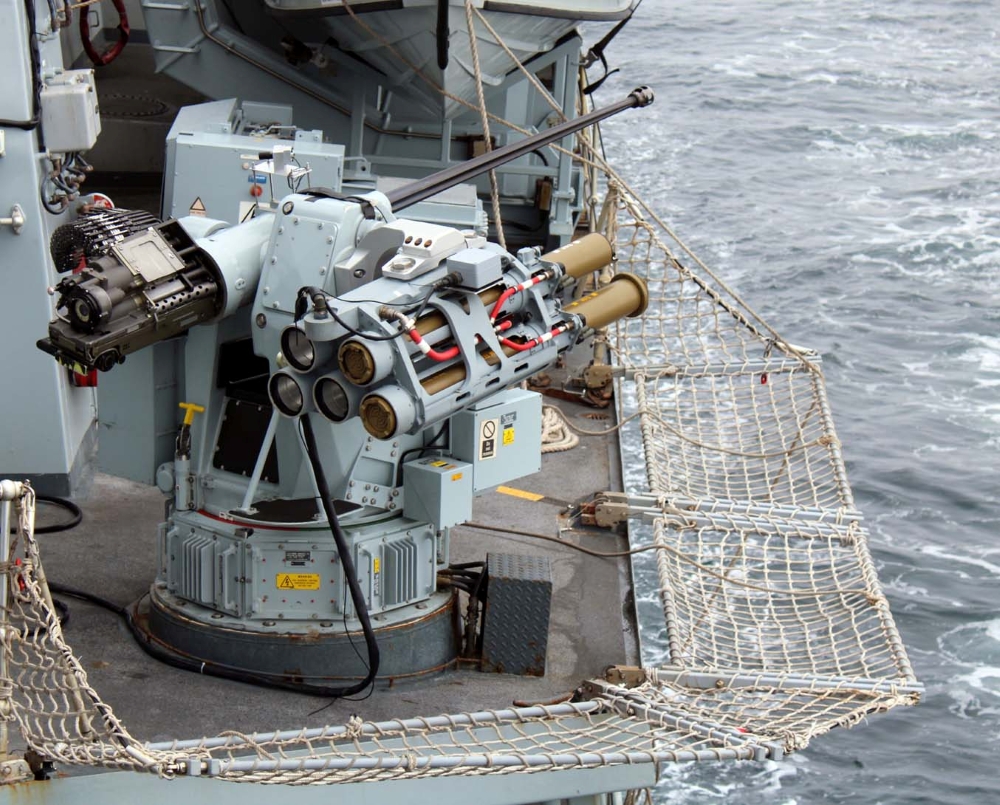
In August, Indra was assigned the leadership of the development of SILAEM (Shipborne Launcher System), a new vSHORAD solution for the Spanish Navy. Thales Spain was soon identified as a partner in development, and subsequent agreements have been concluded with Thales UK to integrated the Lightweight Multirole Missile (LMM, MARTLET for the Royal Navy) into the system.
SILAEM is the first vSHORAD point-defence solution to be designed in Spain, according to Indra, which will in particular supply the high precision fire-control radar for the system.
SILAEM is meant to include its own X-band radar, sensors and a Spanish-developed command and control system. The 51 million Euro contract to Indra covers the development of 2 SILAEM configurations: one stand-alone and one meant for full integration with SCOMBA, the Spanish Navy’s domestically developed management system.
The LMM missile is, at least in its current form, a laser-beam riding SHORAD missile, highly accurate and resistant to most countermeasures. With a range of some 7 km, it flies at circa Mach 1.5 and is a fundamentally dual-purpose missile with a blast-fragmentation warhead originally driven by the Royal Navy’s requirement for contrast to Fast Attack Craft-type threats.
The LMM has since gained most of its battlefield praise in the counter-UAS use, however, with thousands of missiles supplied to Ukraine, with ample battlefield validation.
While waiting for SILAEM, the Spanish Navy in September ordered 3 MBDA SIMBAD RC2 systems armed with MISTRAL 3 SHORAD missiles (2 missiles per launcher). The 3 systems equate to 4 launcher units overall: one system (with 2 launchers) will be fitted on the LHD JUAN CARLOS I; two F-80 frigates will receive one launcher each.
MISTRAL 3 is a fire-and-forget, IR-guided missile unlike LMM which, being laser beam riding, requires illumination of the target from the launching unit.




Privacy Policy

Powered by © Mobilbyte s.a.s. Information Technology