



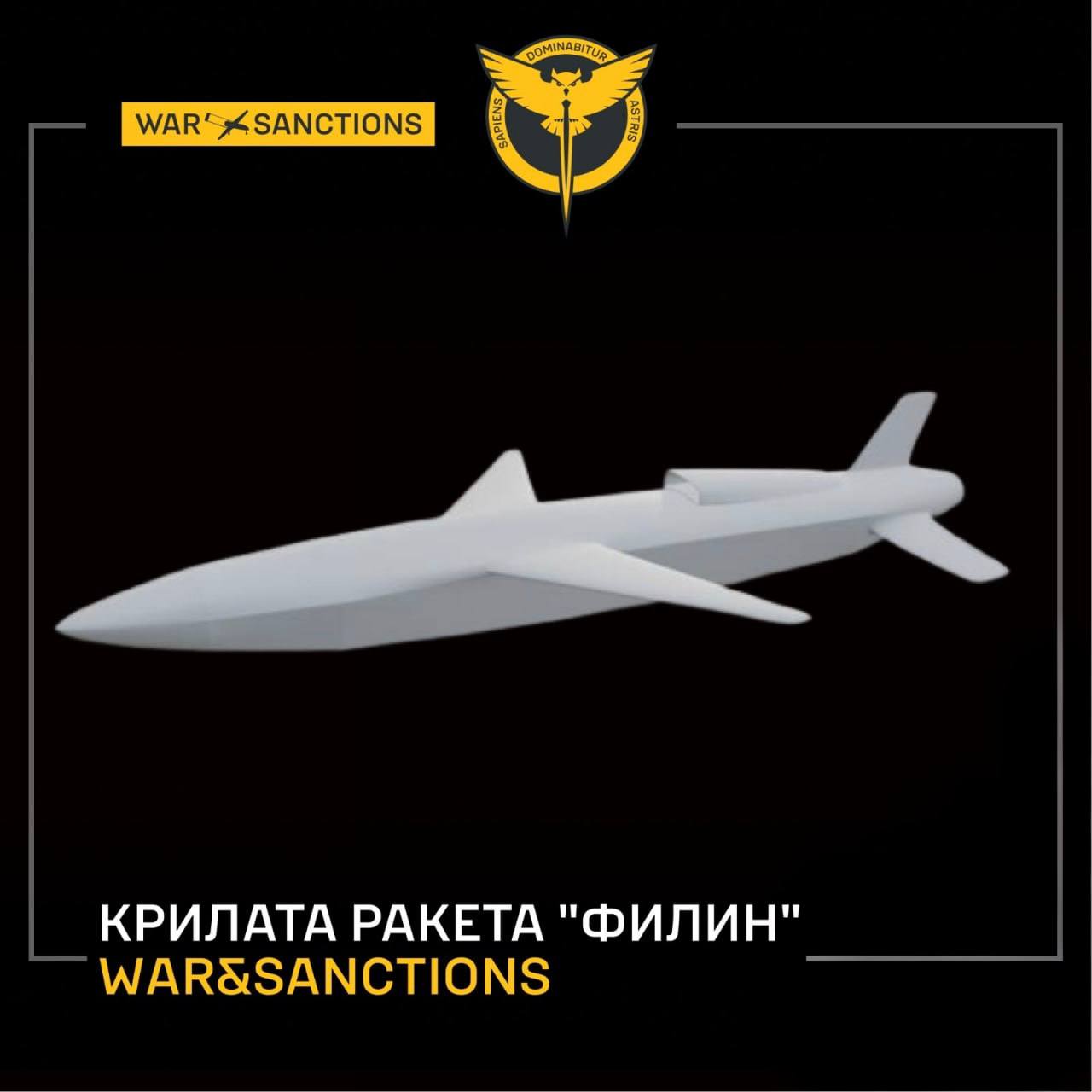
Ukraine’s Main Directorate of Intelligence (GUR) has released new information on the Russian cruise missile FILIN, a long-range, low-cost strike system which, according to Kyiv, has been in service with the Russian Armed Forces since late summer 2026. On October 22, as part of the War&Sanctions project, the GUR published a 3D model of the missile, along with details on its technical characteristics, electronic components, and the companies involved in its production.
The FILIN is developed by NPO Molniya, part of the Tactical Missiles Corporation (KTRV) group, and reflects a broader trend within the Russian defense industry toward relatively inexpensive jet-powered strike munitions suited for mass employment, as an alternative or complement to traditional cruise missiles.
In detail, the FILIN features a composite fuselage (primarily carbon and glass fiber), with a length of 3.5 m and a 3 m wingspan. Some components are produced through 3D printing, a solution that may help simplify manufacturing and contain costs. According to data released by the GUR, the missile reaches a top speed of 800 km/h and a range of 1,200 km, with a flight profile spanning from extremely low altitudes up to 6,000 m. 2 variants have been identified, equipped respectively with 50 kg and 100 kg warheads. Launch takes place from a ground platform via a solid-propellant booster.
The propulsion and onboard electronics architecture is particularly noteworthy, marked by a high degree of standardization with other Russian systems. The FILIN uses the R500 turbojet, manufactured by the Russian company Reynolds and already fitted on the air-launched missiles S-71K KOVER and S-71M MONOKHROM. Avionics are supplied by PLAZ, also involved in the production of the GARPIYA strike drones (derived from the GERAN-2). The guidance system comprises a Chinese-made inertial platform, a satellite receiver, and a 16-channel Russian-made KOMETA anti-jamming antenna for satellite navigation. The GUR’s analysis further identified 35 US-made electronic components and 22 Chinese-made ones.
The development of the FILIN confirms Russia’s shift toward greater diversification of long-range strike systems, prioritizing simplified manufacturing and shared components across different platforms. The aim is to increase strike volume and place additional pressure on Ukrainian air defenses through the combined use of OWA (One-Way Attack) drones and relatively inexpensive cruise missiles.




Privacy Policy

Powered by © Mobilbyte s.a.s. Information Technology