



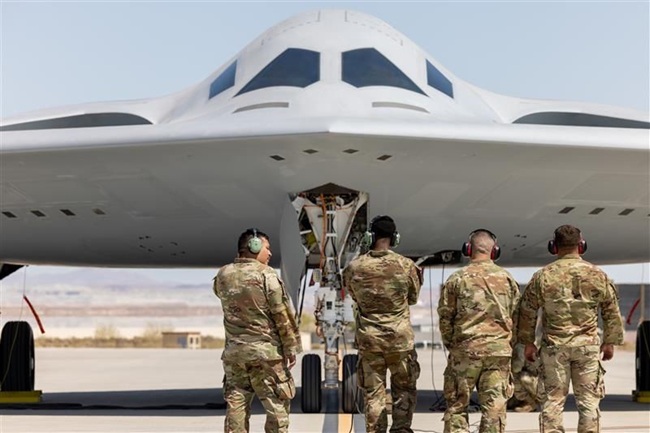
The latest USAF report to Congress about the fighter fleet strength needed by 2035 contains a line confirming that the Service is actively considering an air-to-air role for its bombers.
The report is unclassified material but has not yet been made publicly available in full. However, Aviation Week obtained a copy and was the first to report on the bomber inclusion.
Specifically, “developing air-to-air capabilities on bombers” is one of 3 named “additional recapitalization options” meant to ease the build-up of combat-coded aircraft mass. The other options are “increased reliance on Collaborative Combat Aircraft” and “a new capacity fighter”, which is believed to be a possible procurement of new-production F-16 “G” to exploit the existing production capability for them.
Media reports started circulating days ago following a roundtable on the report with Lt. Gen. David Tabor, the service’s Deputy Chief of Staff for Plans and Programs.
The USAF says that 1,509 combat-coded aircraft are required by 2035 to achieve a “moderate risk” operational profile, aka a steady state force that enables the USAF to respond to crises with only “moderate” difficulties. In order to achieve a “low risk” operational status, the USAF projects a need for 1,723 combat-coded aircraft, but even the lower number is difficult to achieve, primarily due to the budgetary challenges of attempting such a procurement ramp-up.
1,509 combat-coded aircraft are already a very significant jump from the previous target of 1,271.
The primary means to achieve the necessary force structure are the “maximization” of production of both F-15EX and F-35A. By 2035 the split by types is envisioned at 20% composed by F-22 / F-47 as the air superiority specialized force; 40% F-35A, 20% F-15E/EX and a residual 20% of F-16s.
In percentage terms, the share of F-16s reduces (from 38% now) while the other fleets grow (F-22/47 from 10 to 20%, F-35A from 30 to 40% and F-15E/EX from 14% to 20%).
The idea of expanding the roles of the bomber force to cover air-to-air is by no means new and proposals have circled for years. Two platforms in particular would be suited as long-range “missileers”, the B-1 and the B-21. The former, however, is to leave service relatively soon in the 2030s under existing plans, leaving B-21 as the main candidate.
The project to re-activate the B-1’s external hardpoints opens up interesting possibilities, however, and the essential ingredients to enable a bomber’s air-to-air role have all started to appear. Most notably the recent unveiling of the super-long-range AIM-424 MALICE missile represents an obvious potential solution. While the project belongs to the Navy and not the Air Force, that could be fixed quickly.
The interim AIM-174B GUNSLINGER would also be a potential bomber armament, especially given its substantial dimensions, ill-suited to fighters.
Most notably still, in June this year the USAF began to engage industry about future Air-Launched Standoff Weapon variants: the Air Force Life Cycle Management Center’s (AFLCMC) Armament Directorate (EB) specified that it is looking for (potentially) multiple vendors for both an Air-to-Air and Air-to-Surface variants with a “threshold minimum range of 1,000 NM”. The focus is specifically on the A/A solutions, the first that is wanted to achieve Initial Operational Capability.
The interest for such an extremely long-range air-to-air weapon, which is likely to be a large missile, could potentially be connected to plans to have the bombers become flying A/A arsenals.




Privacy Policy

Powered by © Mobilbyte s.a.s. Information Technology