


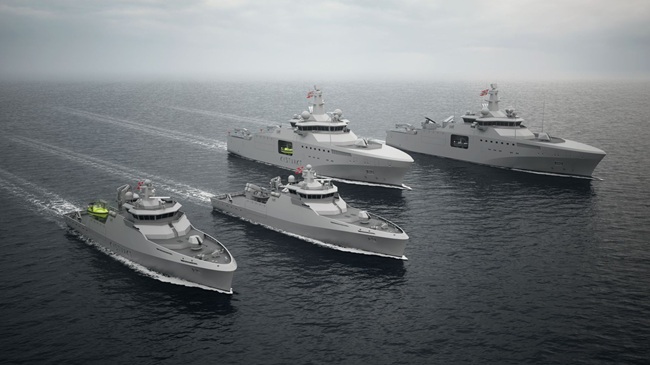
Norway’s Defence Materiel Agency signaled to industry on 20 October its current plan for the procurement of the “Standardized Vessels” for the Navy (and Coast Guard). The project, known as P1118, is a priority for the Navy and an important project for the Norwegian shipyards as well.
The aim of the “Standardized Vessel” is to replace multiple different platform types with new, common “mothership” hulls, kept affordable by making use of commercial solutions where appropriate. The Standardized Vessels will come in 2 formats, a Large and a Medium, although the exact dimensions and characteristics of the ships are not yet publicly known.
It was in March this year that Norway selected the Salt Ship Design AS and Kongsberg Defence and Aerospace AS (Salt & KDA) team to complete the platform design, which is to be “based to the greatest extent possible on civilian standards and commercially available technology, following the principle of ‘as civilian as possible, as military as necessary’”.
With the design mature, the plan is to initiate a competition to determine the companies that will actually build the vessels. As of March, the competition phase was planned to span “Fall 2026 to Spring 2027”.
“The ambition remains” to assign the build contract for the first vessel(s) in 2027, with the first delivery in 2030.
Norway has now specified that the first segment of the program to proceed will be the Large, ocean-going one. This is important because this specific variant has attracted the interest of the United Kingdom and Lithuania, which both need the ships around 2030.
The competition will thus develop on 2 parallel tracks: a first competition will lead to a contract for up to 14 Large vessels of the “Navy” design variant for Norway, UK and Lithuania; with a second competition for 6 more ocean-going hulls, but in Coast Guard configuration, for Norway alone.
The split for the first 14 vessels is 4 naval vessels for Norway, “up to 6” for the UK and “up to 4” for Lithuania.
In the UK, the Standardized Vessel is being acquired first of all for the Mine Hunting Capability (MHC) program. The new hulls will serve as the Offshore Support Vessel ‘motherships’ for the mine countermeasures “toolboxes” of drones currently being put into service.
3 such vessels are planned and have been re-affirmed by last year’s Defence Investment Plan; the inclusion of a second trio is a new development, still not backed by a univocal confirmation by the British Government. The Royal Navy has no shortage of unfulfilled requirements that could be met with a second trio of hulls (the DIP failed to provide a replacement for the survey vessel HMS SCOTT; failed to fund a second Multi Role Ocean Surveillance Ship; provided no line of sight on any replacement for the 3 RIVER Batch 1 OPVs expected to leave service in 2028 and so on) but it is far from clear whether any budget allocation, even deep into the 2030s, actually exists.
The first 3 new vessels are badly needed as soon as possible at the beginning of the 2030s since the remaining 5 HUNT-class and the lone SANDOWN-class HMS BANGOR MCM ships are all due out of service by 2031/32.
The United Kingdom’s procurement of the Standardized Vessels from Norway is also part of the Offsets agreed for Norway’s procurement of the Type 26 frigates for its Navy.
The exact scale of the Offset obligations remains publicly undisclosed by either side but they are very significant. In the UK, Defence Procurement Minister Luke Pollard touched on the topic briefly during a Treasury Committee hearing on July 8, when he revealed the existence of the offset agreement. In his words, the UK committed to “buy roughly the same amount of stuff from Norway”.
Clearly, the exact definition of what qualifies as “roughly the same amount” to a multi-billion frigate purchase is an important and delicate matter and the Norwegian defence industries are clearly not impressed by what they had seen in the 14 months since the Type 26 selection was announced.
In written evidence and in hearings on the topic of the proposed defence budget for next year, the Norwegian Defence and Security Industries Association (FSi) last week delivered a caustic assessment: “it is unfortunately an open question whether the United Kingdom has fully understood what the frigate agreement entails in terms of obligations, within a balanced partnership”.
The Association went on to recommend the Storting government “should not approve that a contract for the purchase of frigates is signed before the United Kingdom has committed to concrete cooperation projects for at least half of the total industrial obligation. In addition, a concrete and credible plan for the rest of the obligations must be presented”.
Going back to what UK Minister Pollard said in July, as part of Offsets the UK is also going to acquire from Norway the future Commando Insertion Craft for the Royal Marines. This has since become a bi-national project with Norway planning a buy of its own, leading to the alternative designation Joint Commando Craft.
No contract is yet in place, however.
The UK is also acquiring NSM missiles for Royal Navy ships (since before the Type 26 selection) but in small quantities and at an utterly glacial pace. Only 3 ships have been fitted with NSM against plans for 11, and of those 3 one (HMS RICHMOND) has ended up removed from service already.
The named programs, still not under contract, have a value in the range of the hundreds of millions, so the distance could still be very large, again depending on how the obligation is exactly quantified.
Lithuania on its part signed a Memorandum of Understanding with Norway at the NATO summit on 8 July, agreeing a “possible purchase of Norwegian vessels for the Lithuanian defence”. No indication had been provided at the time for the number of ships. Norway now discloses the “up to 4” assumption.
Norway, on its part, plans to procure up to another 18 ships, of the “Medium” format, for a total of 28 Standardized Vessels across Navy and Coast Guard.
Follow us on Telegram, Facebook and X.




Privacy Policy

Powered by © Mobilbyte s.a.s. Information Technology