



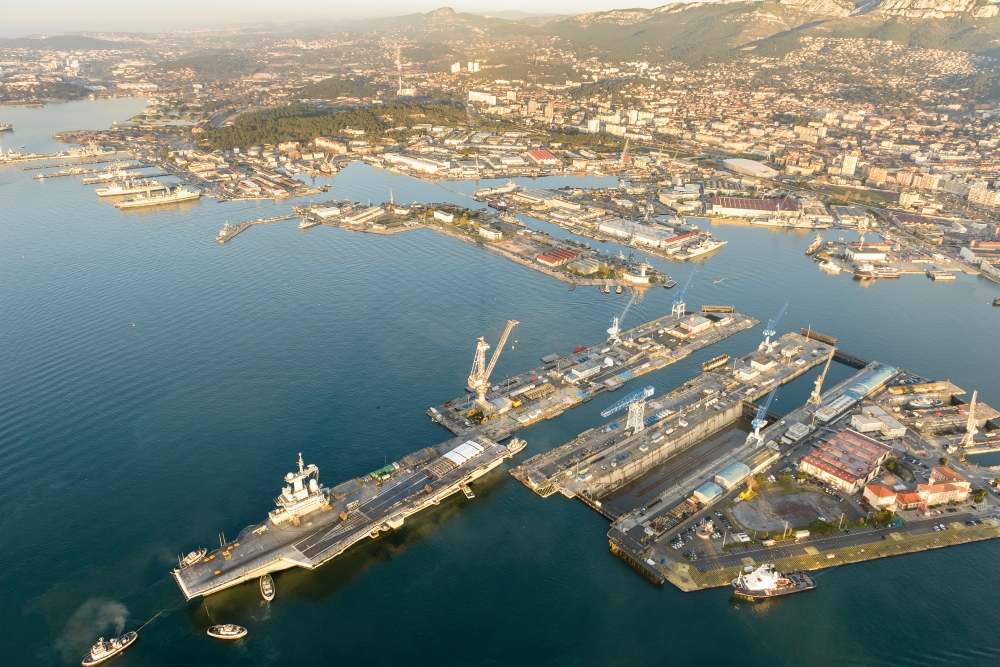
Global naval shipbuilding is expanding as governments prepare for harder-fought wars at sea, protect maritime trade and seek greater industrial independence. Investment is shifting towards submarines, heavily armed surface combatants, logistics vessels and autonomous systems, while the capacity to build, crew and sustain fleets increasingly determines whether strategic ambition becomes operational power. These overlapping pressures underpin the latest EURONAVAL study, compiled by Flottes de Combat and GICAN.
The study places military and paramilitary shipbuilding output in 2024–2025 at approximately 1.47 million tonnes, valued in its country tables at nearly US$124 billion. Its assessment identifies growth of around 50% in both tonnage and value compared with 2022–2023. Nonetheless, combatant commissioning fell from 183 to 136 vessels. These measures cover different populations and milestones, as industrial deliveries include auxiliaries and coastguards, whereas the commissioning figures concern combatants entering service. The distinction matters when assessing the pace of rearmament.
China sets the industrial pace
At the global level, the central competitive relationship remains that between China and the United States. At the beginning of 2026, the US combat fleet retained a substantial tonnage advantage, approximately 3.1 million tonnes against China’s 1.44 million. However, China led by hull numbers, with 418 combatants exceeding 200 tonnes against 283 US vessels (important: these totals include ships unavailable through maintenance or other constraints, rather than measuring immediately deployable strength).
Industrial momentum favours Beijing, as Chinese yards delivered approximately 636,000 tonnes of military and coastguard shipping during 2024–2025, compared with 271,000 tonnes from US builders. The study records 9 Chinese nuclear-powered attack submarine deliveries against 3 US boats, and 10 destroyers against 4. Therefore, China’s expansion extends beyond numerical growth into the complex platforms required for sustained operations and power projection. Worse still, pressure on Taiwan and competition over maritime access provide the strategic backdrop. Carrier aviation, amphibious forces and replenishment ships support a navy increasingly capable of operating beyond its immediate approaches.
Meanwhile, expansion at Huludao strengthens submarine production. Washington’s response centres on rebuilding industrial throughput sufficiently to construct COLUMBIA ballistic-missile submarines alongside VIRGINIA attack boats, thus underlining that the challenge is as much about production capacity as naval architecture.
Submarines and sustained operations
Underwater warfare is attracting particularly strong investment. Nuclear-powered attack submarine deliveries rose from 6 in 2022–2023 to 17 in 2024–2025, representing US$27.3 billion in the study’s valuation. Conventional submarine output increased from 11 to 18 boats, worth US$8.5 billion. Strategic deterrence renewal adds another layer of long-term demand through programmes including US’ COLUMBIA, Britain’s DREADNOUGHT and France’s third-generation ballistic-missile submarines (SNLE3).
Across the Indo-Pacific, these requirements overlap with national industrial ambitions. For instance, India is developing its strategic submarine force while reducing dependence on Russian equipment. Japan continues conventional submarine construction, while South Korea combines underwater platforms with conventional deterrent missiles, and Australia’s AUKUS pathway requires extending the lives of existing boats while preparing for nuclear-powered successors. Different technological choices serve a common requirement for endurance, survivability and credible deterrence.
Sustaining fleets at distance is also becoming a clearer procurement priority. Replenishment vessel deliveries increased from 5 to 12, amounting to approximately 191,000 tonnes. As many as 10 Landing Platform Docks (LPDs) were delivered, twice the previous period’s number. These less conspicuous investments complement combatants, as expanding strike and amphibious forces requires the logistics capacity to keep them operating away from home ports.
Europe (slowly) rebuilds for high-intensity warfare
European naval investment experiences a transition phase from expeditionary operations in relatively permissive waters towards confrontation with technologically capable opponents. The study highlights shortcomings in missile inventories, weapon-carrying capacity and land-attack capability, alongside recruitment difficulties affecting several major fleets. More spending must therefore address both new construction and the effectiveness of existing forces.
Programmes span British Type 26 and Type 31 frigates, French defence and intervention frigates (FDIs), Spanish F-110s, Italian surface combatants and multiple submarine projects. Anti-submarine warfare and air defence feature prominently, while co-operation supports shared requirements. German-Norwegian Type 212CD submarines and Belgian-Dutch mine-countermeasures vessels illustrate how collaboration can connect operational demand with industrial specialisation.
Russia presents a contrasting pattern. Its roughly 149,000 tonnes of deliveries secured third place globally in 2024–2025, but submarines and auxiliaries accounted for much of that output. Large surface combatant renewal remains constrained, including by lost access to Ukrainian gas turbines. Smaller missile-armed vessels provide a partial substitute, demonstrating how industrial limitations can shape fleet composition and limit the level of ambition.
Sovereignty spreads the manufacturing base
Beyond the largest producers, technology transfer is widening the geography of naval construction. Brazil, Colombia, Egypt, Indonesia, Pakistan, Peru and Poland are developing or renewing frigate-building capabilities through foreign designs, licences and industrial partnerships. Submarine construction follows similar patterns, including French-supported work in India and German-licensed production in Turkey. Such arrangements make procurement an instrument of industrial policy as well as military modernisation.
Regional demand remains diverse. For example, Middle Eastern fleets are acquiring more capable surface combatants and offshore protection assets, while Turkey is expanding both indigenous programmes and exports.
Across much of Africa, patrol vessels and interceptors answer maritime policing, piracy and trafficking requirements.
South America combines ageing-fleet replacement with sovereignty patrols, while Canada’s Arctic vessels underline the importance of geography. The 48 offshore patrol vessels delivered worldwide show that constabulary missions remain commercially significant alongside high-end rearmament.
The hybrid fleet takes shape
Autonomous systems are changing what shipbuilders must integrate. Ukraine’s use of maritime drones has demonstrated the vulnerability of conventional warships and accelerated interest in armed surface craft. Mine warfare offers a more established route towards hybrid fleets, pairing crewed command platforms with remotely operated or autonomous systems that reduce personnel exposure. Dedicated or adapted drone-carrying ships extend this transformation into aviation, surveillance and underwater operations. The emerging requirement is therefore to combine platforms, sensors and weapons more effectively. As naval competition intensifies, capacity becomes the decisive industrial measure, namely the ability to deliver sophisticated ships, integrate new technologies and sustain useful fighting strength throughout their service lives.




Privacy Policy

Powered by © Mobilbyte s.a.s. Information Technology