


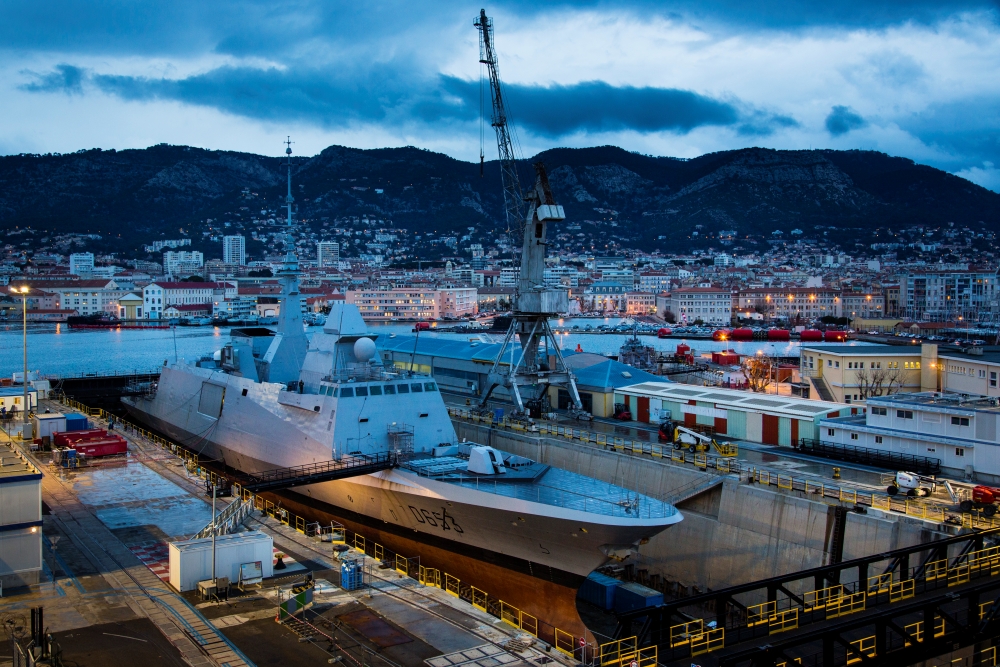
France’s naval strength rests more on industrial breadth than on fleet size. The country’s shipbuilding sector can design, build, arm and sustain platforms ranging from patrol boats to nuclear-powered submarines and aircraft carriers. In a market increasingly shaped by high-intensity warfare, France’s capability to retaining an ecosystem linking shipyards, nuclear engineering, weapons, sensors and robotics is a strategic asset. Nevertheless, its challenge is to translate technological sovereignty into sufficient production capacity, operational availability and affordable combat power.
A global navy, but not a mass fleet
The Marine Nationale occupies a distinctive position among the world’s navies. According to EURONAVAL 2026 rankings compiled by Flottes de Combat and GICAN, France ranks seventh globally by combat-fleet displacement, behind the United States, China, Russia, Japan, India and the United Kingdom. Its baseline of 1 January 2026 records 66 French combat vessels exceeding 200 tonnes, totalling 259,801 tonnes. This makes France the European Union’s largest navy by that measure, although the ranking excludes auxiliaries and does not account for maintenance-related unavailability.
Furthermore, tonnage captures only part of French naval power. France combines an aircraft carrier, 4 nuclear-powered ballistic-missile submarines (SSBNs), 5-6 nuclear attack submarines (SSNs) and three amphibious helicopter carriers (LHDs). Alongside Britain, it therefore belongs to Europe’s leading tier for strategic deterrence and maritime power projection. These capabilities give its industry demanding domestic reference programmes, spanning underwater discretion, carrier operations and complex task-group integration.
Today’s main limitation is depth because of shortcomings in ammunition stocks and weapon capacity relative to comparable US and Chinese vessels. France’s position is consequently better understood as a technologically sophisticated, broad-spectrum naval power than as a competitor in fleet mass. Sustaining that position requires replacing ships rapidly while improving their survivability, adaptability and availability.
Industrial weight beyond tonnage
According to GICAN’s figures, the French naval defence sector generated €11.97 billion in revenue in 2025, encompassed more than 750 companies and supported 46,098 direct jobs. Exports represented 36% of turnover, against 64% from the domestic market. It is important to specify that these are naval defence figures and not totals for France’s entire civilian and military maritime economy. Yet they are sufficient to illustrate an industrial model in which sovereign procurement provides the foundation while overseas business help the sustainability of such an industrial apparatus.
Nevertheless, France is not Europe’s largest producer on every measure. For military and coastguard vessels above 200 tonnes delivered during 2024–2025, French production amounts to 38,460 tonnes, (seventh in rank worldwide), outweighed by Italy’s 53,700 tonnes and Turkey’s 44,216 tonnes. Outside Europe, China produced 636,208 tonnes and the United States 270,509 tonnes.
In fact, French competitiveness is based on the capability of combining complex-platform integration with internationally marketable technologies.
In particular, Naval Group anchors the high-end warship and submarine business, while Piriou, Kership, CMN, Socarenam and Ocea broaden the offer in patrol vessels and medium-sized ships. Chantiers de l’Atlantique brings large-platform construction expertise, including participation in the next-generation aircraft carrier. The resulting ecosystem is wider than a single national champion.
The nuclear submarine enterprise provides a particularly durable industrial backbone. The six-boat SUFFREN-class attack-submarine (SSN) programme maintains expertise in nuclear propulsion, acoustic discretion and integrated underwater combat systems. As of today, four boats have been delivered, and completion of deliveries is scheduled for 2029. Its successor workload includes four third-generation ballistic-missile submarines (SNLE3), with deliveries beginning in 2036. Together, these programmes connect current manufacturing activity with requirements extending well into the next decade.
The next-generation nuclear-powered aircraft carrier (PA-NG) adds another strategic pillar. Scheduled for delivery in 2038, the approximately 78,000-tonne platform brings together Naval Group, Chantiers de l’Atlantique and TechnicAtome. Its industrial significance extends beyond hull construction, as it sustains nuclear engineering, large-ship integration skills and the interfaces linking propulsion, aviation and combat systems. In detail, TechnicAtome’s role across naval nuclear propulsion illustrates once again why the French value chain cannot be reduced to shipyard capacity alone.
Surface combatants provide a complementary source of recurring workload. As many as 5 defence and intervention frigates, or FDIs, are planned for France, with deliveries spanning 2025–2032, while Greek and Swedish orders extend the programme’s international footprint. These ships support platform construction capabilities as well as the integration of sensors, weapons and combat-management functions (activities through which much of a modern warship’s operational value is created).
In addition, conventional submarine exports reinforce this model through different industrial arrangements. Indeed, the Netherlands’ four-boat ORKA programme draws on Naval Group’s conventionally powered BLACKSWORD BARRACUDA design. Similarly, Indonesia’s two SCORPÈNE EVOLVED submarines, incorporating lithium-ion batteries, are intended for construction at PT PAL. Such programmes show how French suppliers can capture value through design, technology transfer, equipment and integration even when the ships themselves are built abroad. They also demonstrate why domestic production tonnage understates international industrial reach.
Sensors, weapons and autonomy
The equipment layer gives the sector much of its technological depth. For instance, Thales supplies radar, sonar, electronic warfare, communications and command systems. Its most successful product in this domain is the CAPTAS sonar systems, 100 examples of which have been ordered worldwide.
MBDA provides missile capabilities spanning air defence, anti-ship warfare, and deep strike. Safran and Lacroix contribute navigation, optronics and protection technologies, while KNDS France participates in naval weapons and artillery. These companies connect French platforms to a broader international equipment market.
Mine warfare is another important technological brick, as Thales and Exail develop combinations of unmanned surface and underwater vehicles, navigation systems and robotics. The Franco-British SLAM-F programme moves mine detection and neutralisation towards remotely operated and autonomous systems, keeping crews farther from danger. Meanwhile, the Belgian-Dutch programme for 12 mine-countermeasures vessels, built by Kership, links French shipbuilding with the wider transition towards unmanned operations.
The next competitive test is therefore industrial as much as technological. This year, the upcoming EURONAVAL 2026 exhibition will emphasise resilient platforms, open architectures, resilient communications and the transition from innovation to operational capability.
For France, success means preserving its exceptional high-end competencies while integrating new sensors, software and autonomous systems faster, and sustaining ships throughout their service lives. The sector’s advantage is the breadth of its value chain, while its main challenge is to make that breadth deliver usable combat power at the required pace.



Privacy Policy

Powered by © Mobilbyte s.a.s. Information Technology