





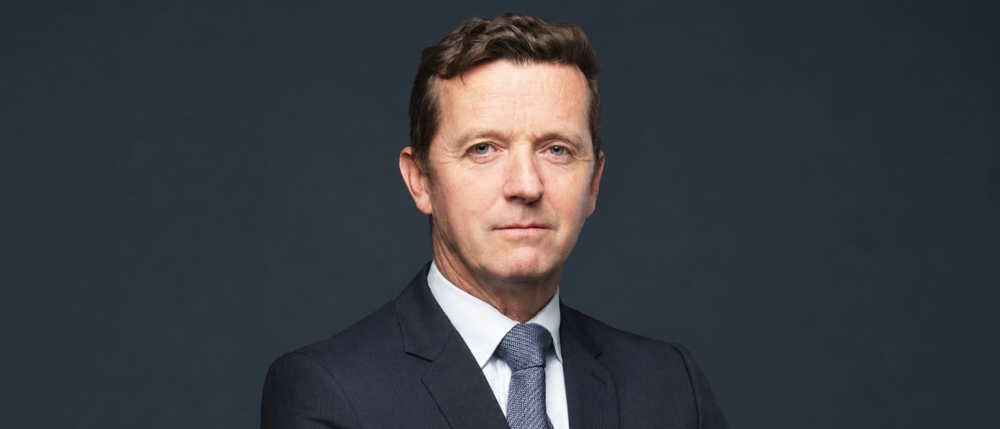
In an exclusive interview published in Future Warfare Magazine 6/2026, Rear Admiral (Ret.) Guillaume Merveilleux du Vignaux, Commissioner General of Euronaval, examines the forces reshaping naval defence, from open architectures and ocean-going drones to seabed security and the difficult passage from experimentation to operational capability.
Naval power is becoming harder to measure by the ships a fleet possesses alone. Increasingly, its effectiveness also depends on how quickly those ships can evolve, the uncrewed systems they can support, the information they can exploit and the industrial partnerships that sustain them.
For Guillaume Merveilleux du Vignaux, this transformation places a particular responsibility on Euronaval. In particular, he deems that the exhibition should look beyond the technologies on display and distinguish emerging possibilities from capabilities that can withstand operational reality.
As the exhibition reaches its 30th edition and marks 60 years of existence, its Commissioner General describes an expanding sector, as rearmament is bringing more exhibitors, larger stands and greater industrial investment. Yet his central message is not about growth. Euronaval must remain a watchtower, attentive to technological change, open to unfamiliar actors and firmly anchored in the needs of navies.
The warship as an evolving system
One of the interview’s strongest arguments concerns the relationship between a ship and its onboard capabilities. Merveilleux du Vignaux rejects any suggestion that the platform itself has become secondary. Acoustic discretion, endurance, survivability, hydrodynamics and power generation remain decisive. Nevertheless, combat-management systems, electronic warfare, communications, software and data processing account for an increasing share of operational value. The consequence is a fundamental change in design philosophy. Delivering a ship whose capabilities remain largely fixed until a major refit is no longer sufficient:
“A ship intended to remain in service until the end of the century cannot depend on a closed combat system frozen at the point of delivery.”
In his view, the future French aircraft carrier illustrates the challenge. Its designers must accommodate technologies that do not yet exist, including drones whose dimensions, power requirements and operating concepts will change. Open interfaces, electrical capacity, connectivity and physical margins therefore become provisions for future combat relevance, rather than optional allowances. The question is not simply what a warship carries at commissioning, but what it can absorb throughout its service life.
Drones must pass the ocean test
On uncrewed systems, the interview offers a useful corrective to technological enthusiasm. There is no universal route towards a more autonomous fleet. Different navies face different pressures: availability constraints may encourage one service to accelerate adoption, while demographic pressures may drive another towards automation. Whatever the motivation, three challenges remain: autonomy, robustness and integration. Decisions about human oversight become particularly sensitive when systems carry weapons. Meanwhile, deploying a drone near a support facility bears little resemblance to sustaining it for weeks in heavy seas, far from maintenance and recovery infrastructure.
“Autonomy does not remove the material challenges, it can simply move them elsewhere” - Merveilleux du Vignaux said.
That observation cuts through much of the debate. In fact, corrosion, energy supply, intermittent communications, mechanical stress and seakeeping do not disappear when the crew does. Furthermore, a successful demonstration alone does not settle how a vehicle should be launched, recovered, protected or incorporated into a fleet’s tactical organisation. Merveilleux du Vignaux envisages a gradual progression towards longer and more distant deployments. Major crewed platforms could increasingly become command, support and launch nodes, with uncrewed systems operating forward. However, this remains conditional on demonstrated resilience and interoperability.
The seabed becomes an operational priority
The same combination of opportunity and constraint shapes his assessment of the underwater domain. Telecommunications cables, energy networks and other installations are increasing the strategic importance of the seabed, while technologies for observing and intervening at depth are becoming more accessible. These capabilities resist neat distinctions between protection and attack. An underwater vehicle that inspects infrastructure or places a sensor may possess functions useful for offensive purposes in another context. Mine warfare, meanwhile, offers an early operational example of the distributed approach: crewed vessels, uncrewed surface craft, underwater vehicles, sonars and neutralisation systems working together. On France’s seabed strategy, his judgement is supportive but demanding:
“A strategy is not enough, and it must be supported by platforms, sensors, drones, crews, industrial skills and deployment resources capable of implementing it over time.”
The implication reaches beyond seabed warfare, as strategic recognition matters only when it produces sustained capability.
The hardest step comes after experimentation
Perhaps the interview’s sharpest passages address acquisition. Software, sensors, artificial intelligence and drones evolve on timelines increasingly at odds with traditional programme structures. Merveilleux du Vignaux challenges the suitability of a lengthy, sequential development process for capabilities requiring frequent adaptation:
“An adversary does not wait for our procedures to be completed.”
He points to closer interaction between French industry and operational users, including experimentation involving civilian engineers and embarked data hubs that aggregate and exploit varied information flows. Such arrangements can shorten feedback loops and bring development closer to actual conditions.
But experimentation is not procurement. Funding a promising system, producing it in volume, integrating it and supporting it over time remain separate hurdles. Operational pressure further complicates the picture: ships and crews committed to immediate missions cannot endlessly accommodate trials. Faster innovation therefore requires more than streamlined procedures; it requires realistic planning and a credible route into service.
Autonomy through cooperation
Merveilleux du Vignaux is equally precise about sovereignty. Rather than treating it as a slogan, he focuses on autonomy and control over critical dependencies. For Europeans, those objectives cannot be achieved through exclusively national approaches in every field.
“Co-operation is therefore not the opposite of autonomy.”
Indeed, industrial partnerships can preserve skills, secure supply chains and increase production volumes. The same openness underpins Euronaval’s engagement with start-ups, digital businesses and dual-use technology providers. Through initiatives including SeaStart and the See-novation area, the exhibition seeks to connect new entrants with users, integrators and acquisition authorities—without pretending that every innovation is immediately ready for deployment.
Ultimately, the role Merveilleux du Vignaux assigns to Euronaval is of a meeting place generating productive “intellectual friction” between operational requirements, industrial offerings and strategic analysis. The interview’s connecting thread is clear: the future fleet will depend not only on invention, but on the ability to integrate, sustain and continually adapt what invention makes possible.



Privacy Policy

Powered by © Mobilbyte s.a.s. Information Technology