



RTX has been chosen by Shield AI as the supplier and partner responsible for the radar and electronic warfare systems to be fitted to the innovative tail-sitting VTOL uncrewed combat jet X-BAT.
No details have been released about the systems that will be embarked. The two companies have announced their collaboration which sees RTX’s Advanced Technology team at work to “mature X-BAT’s mission architecture, integrate advanced sensor capabilities and explore solutions designed to support evolving operational needs”.
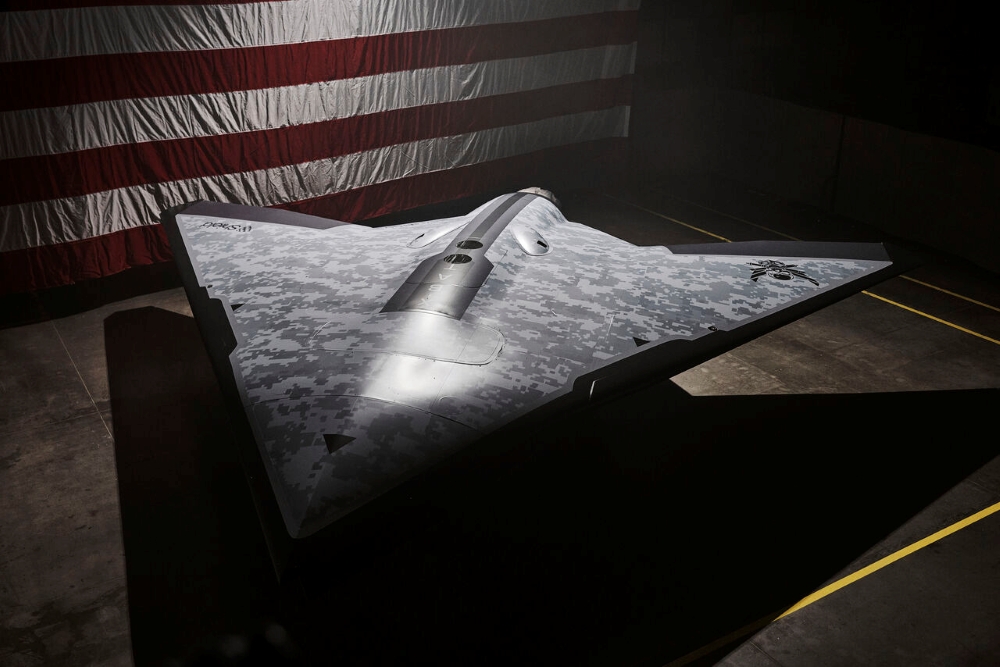
The announcement came only shortly before Shield AI rolled out the first full-scale prototype of the X-BAT, only about 1 year after publicly unveiling the project. The prototype has been built at Shield’s development facility in Frisco, Texas, and is now being moved to their flight test facility in Newton, Kansas.
Here the X-BAT will begin testing towards full demonstration of its most defining characteristic, the tail-sitting, vertical launch and recovery from a trailer-mounted launcher.
The X-BAT does not have a traditional undercarriage, nor does it employ additional, separate sources of lift for hovering and vertical take off and landing. It is powered by a General Electric F110 engine, as found on F-16s and F-15s, but with the addition of an Axisymmetric Vectoring Exhaust Nozzle (AVEN) to sharply vectorize thrust to enable the transition to and from the vertical.
The AVEN nozzle has been adopted for X-BAT, not developed anew: this high-angle vectoring nozzle was first developed in the 1990s and experimented on a high manoeuvrability F-16. Shield AI has been using that original nozzle, taken from storage, as part of development.
The power of the F110, with the help of thrust vectoring, is sufficient to achieve X-BAT’s unusual launch and recovery method, without the extra volumes and weight of something like the F-35B’s Lift Fan. The unveiling of the prototype X-BAT has evidenced vast design changes from what was displayed one year ago: gone is the distinctive cranked delta shape, replaced by an arrowhead shape with straight wing edges.
The X-BAT is remarkably larger and heavier and higher performance than the current Collaborative Combat Aircraft Increment 1 of the USAF. It has deliberately chosen from the beginning to be more ambitious, with a more significant payload and capabilities both in air to air and air to ground.
Shield AI has shown renders showing internal weapon bays containing weapons such as JSOW, with larger LRASM / JASSM payloads possible on external hardpoints under the wings. Key to the X-BAT is the trailer-based launch ramp, which “catches” the aircraft upon vertical landing and can be deployed on land and on ships with a minimal deck footprint.
The test campaign ahead will be crucial to mature launch and recovery. Shield says the initial tests will see the engine running on the launch and recovery vehicle, with the aircraft horizontal. Then the tests will move into the vertical, initially with the assistance of a crane, which will allow the prototype to remain tethered in case engine stall or other issues were to be encountered. Gradually, this will lead to untethered flights.
The aim is to fly the aircraft “fully missionized”, so including its sensors from RTX, already in 2028 in order to be production ready in 2029.



Privacy Policy

Powered by © Mobilbyte s.a.s. Information Technology