



The operational flexibility of the SM-6 BLOCK IA, also designated RIM-174B STANDARD EXTENDED RANGE ACTIVE MISSILE (ERAM) DUAL-II, continues to expand. At sea, the missile provides air defense against aircraft, helicopters, UAVs, and anti-ship cruise missiles, terminal-phase anti-ballistic intercept, and a reasonable capability against hypersonic missiles. As if that were not enough, the SM-6 BLOCK IA has demonstrated the ability to engage surface naval units and land targets, with a hypersonic attack speed that makes interception more difficult for adversary defenses. The cost, it is worth remembering, is about $6 million per missile....
The missile also serves with the US Army, which fields the TYPHON launch system (using the Mk-70, a derivative of the Mk-41 vertical launch system, mounted in a 40-foot container) as part of the Mid-Range Capability Battery (Multi-Domain Task Forces), in the surface-to-surface role. In 2025, units of the Australian Army took part in joint exercises with US forces, testing ground-based TYPHON launchers for the land employment of the SM-6 in maritime interdiction roles.
But Australia did not stop there. During exercise TAIPAN STRIKE 26, held in June, the Royal Australian Air Force tested mobile ground-based DERRINGER launchers (different from the US systems), capable of firing SM-2 and potentially SM-6 missiles for air defense and missile defense. Control was provided by a ground-based version of AEGIS, the VIRTUALIZED AEGIS WEAPON SYSTEM (VAWS), a software-defined version of the well-known combat system, decoupled from traditional naval hardware and able to run on standard commercial servers for installation on mobile platforms. The S-band (search) and X-band (guidance) radars were supplied by CEA and mounted on trailers.
The SM-6 also gave rise to the air-launched version AIM-174B GUNSLINGER, used by the US Navy’s F/A-18E/F Super Hornets, with a range of over 300 km (probably more than 400 km). This version naturally lacks the Mk-72 booster. It has been stated that the AIM-174B can intercept ballistic missiles and hypersonic missiles, and the capability against surface targets has likely been retained.
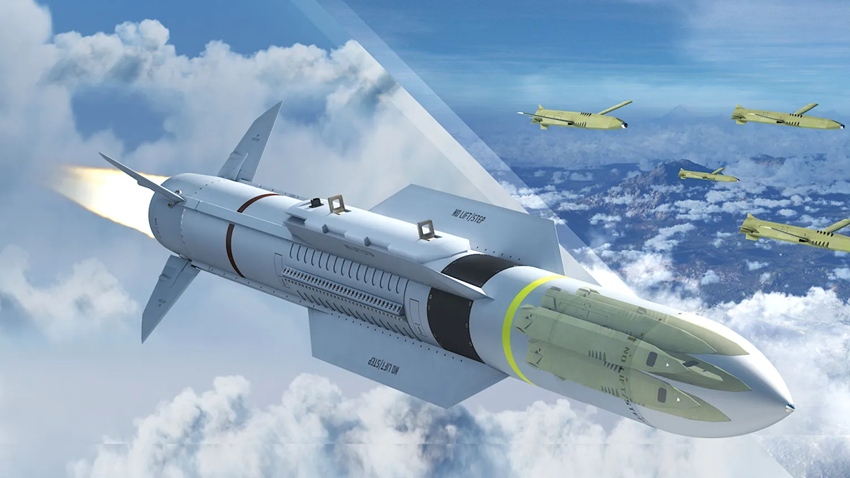
Finally, news from just a few days ago: a variant of the AIM-174B could be adapted to carry a group of VEKTREX glide munitions from General Atomics. The VEKTREX (formerly known as the Long Range Maneuvering Projectile (LRMP)) was originally developed as a long-range guided munition for 155 mm howitzers and 127 mm naval guns. The GUNSLINGER could carry 7 in its nose, without the guidance radar and warhead, releasing them near the target. No precise data has been released, but they are presumed to be able to fly autonomously for at least 100-150 km after release. Given their limited destructive power, due to their small size, this solution could be used as a SEAD-DEAD system.



Privacy Policy

Powered by © Mobilbyte s.a.s. Information Technology