



Representatives from NATO’s Task Force X-Arctic (TFX-Arctic) held a virtual media roundtable on Tuesday, 10 November, to explain the Task Force’s objectives and upcoming demonstrations.
The speakers were Captain João da Piedade of the Portuguese Navy, who currently serves at NATO Allied Command for Transformation as the Head of the Operational Command and Control Branch within the Capability Development Directorate and also as the lead of the Task Force X-Arctic Beacon Project; and João Manuel De Ascensão Alves, the head of the Centre for Maritime Research and Experimentation (CRME) in Task Force X-Arctic as well.
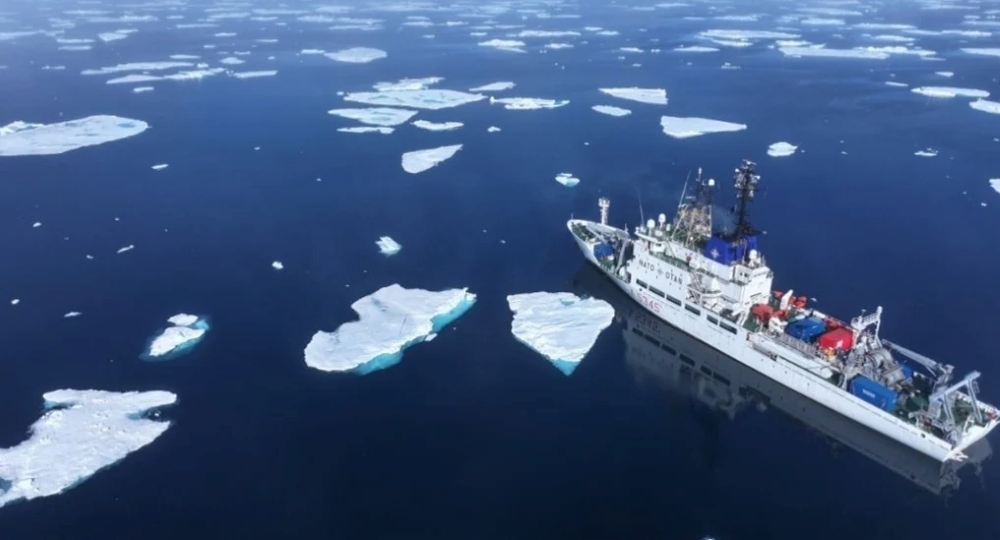
TFX-Arctic was established in June 2026 and has already carried out a variety of exercises, with more planned in the foreseeable future. Initial testing took place in Iceland’s waters aboard the NATO Research Vessel ALLIANCE in June-July, and TFX-Arctic also participated in the REPMUS exercise in Portugal in September.
Looking ahead, a new experiment will take place in late November and early December in Norway, two “small-scale” exercises will occur in the first half of 2027 – including one in February - and the TFX-Arctic’s final demonstration of multi-domain situational awareness capabilities is scheduled for the summer of 2027.
Captain da Piedade explained that the Arctic presents very special operational challenges for NATO, and the Alliance “needs to test and experiment to address new challenges.” For example, Arctic warfare involves operating across “wide distances” and a “harsh Arctic environment” that includes long periods of darkness or daylight, and where there may be “lack of communication [and] lack of satellite coverage.” Hence, the Task Force was established to “experiment with new technologies to tackle those challenges.”
TFX-Arctic’s goal is not to develop new platforms or vehicles, but to address the “problem of integration.” The representatives explained that some of the questions TFX-Arctic is addressing include how to integrate at scale and how to make systems from different nations work together and make decisions automatically, so that military commanders can address other more pressing problems. “We are trying to solve a multinational problem which involves 32 nations,” João Alves explained.
FW Mag asked the speakers about the specific uncrewed systems that have been tested, or will be tested, in Arctic conditions. The speakers told FW Mag that for the upcoming experiment in November, “we will have underwater, surface and air drones with different types of payloads,” focusing on ISR. The types of test missions Task Force X-Arctic is focused on are “all about increasing surveillance.”
Moreover, FW Mag was informed that the Task Force aims to “come up with different operational concepts using ground vehicles over ice” as well as aerial drones. TFX-Arctic will test “all these modalities in November and in February,” as well.
The NATO representatives added that they are already “exploring [uncrewed] ground vehicles to expand the presence on the ice cap.” Specifically, the TFX-Arctic representatives highlighted “uncrewed amphibious vehicles” that can operate from “ice to water and back from water to ice.” These uncrewed amphibious vehicles can be “used to patrol areas and establish communication links” with aerial systems and even “vehicles that may be navigating under the ice.”
In response to a question about the uncrewed amphibious vehicles that Task Force X-Arctic is testing, the representatives explained that “we have been using amphibious vehicles that were originally designed” to be crewed “and we made some modifications to make them uncrewed.” The Task Force is also employing “conventional” ground vehicles for line-of-sight communications and to deploy uncrewed aerial systems across ice terrain.
“We will have more [of those tests] in the next experimental rounds that we will have in Norway,” the NATO representatives said. In the coming experiment, Task Force X-Arctic expects to have “three different types of uncrewed ground systems,” one of which will be amphibious. However, the representatives did not provide further details.
FW Mag has previously discussed NATO and Arctic Warfare during a media roundtable with General Aurelio Colagrande, Deputy Supreme Allied Commander Transformation at NATO, at the Emerging Technologies for Defense Conference & Exhibition in September in Washington, DC.
Regarding participants, the TFX-Arctic’s representatives declined to name specific companies that participated in previous exercises but said they are based in Norway, Denmark, Sweden, Iceland, and Portugal. For the upcoming experiment in Norway, 12 companies are expected to participate. The representatives explained that the first experiments focused on companies demonstrating their capabilities, and future exercises will include militaries and operators as the technologies mature.


Privacy Policy

Powered by © Mobilbyte s.a.s. Information Technology