



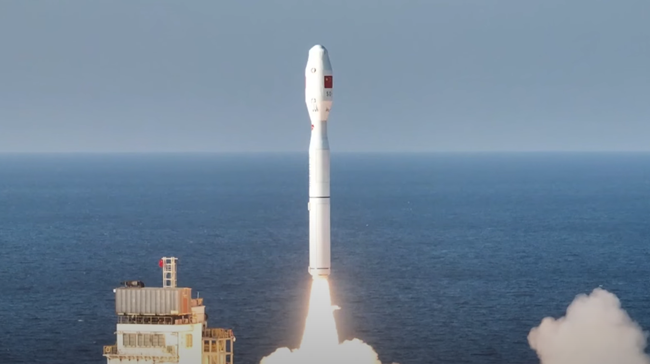
According to a new report by the US Defense Intelligence Agency (DIA), China continues to expand its capabilities to detect, track and target US and allied forces, and has tripled its fleet of ISR satellites since 2018. Beijing has confirmed to be a fully capable space power, and the scale of its effort is now second only to that of the United States. China went from 22 launches in 2016 to a national record of 93 launches in 2025, with only 25 of them commercial. Over the same period (2016-2025), the number of satellites it placed in orbit each year rose from 40 to 384.
The program is directed from the top. The Chinese Communist Party’s Central Military Commission oversees both the People’s Liberation Army (PLA) and the human spaceflight agency, and the PLA works closely with the civil China National Space Administration, so military goals are served by civil activity as well. PLA doctrine treats space as an offensive warfighting domain and as a precondition for winning in every other domain. Its stated aim is space dominance: control of the space-enabled information sphere while denying adversaries their own surveillance and communications from orbit. This thinking was shaped by watching how the United States used satellites in the Gulf Wars, Kosovo and Afghanistan. Under its strategy of “active defense”, which is defensive at the strategic level but offensive at the operational and tactical levels, the PLA sees counterspace operations as a way to deter or prevent external intervention in a regional conflict. Chinese military academics openly describe hitting an enemy’s reconnaissance, communications, navigation and early-warning satellites to “blind and deafen” it. They also argue that space weapons are a more flexible and credible tool of coercion than nuclear weapons. China is meanwhile promoting “non-weaponization” of space at the United Nations.
China’s counterspace capabilities follow a combined-arms approach, so the PLA can choose effects ranging from temporary and reversible to permanent. It operates ground-based lasers able to dazzle or damage satellites in Low Earth Orbit (LEO) and may field space-based directed-energy systems by the late 2020s. It also has ground and space-based jammers aimed at satellite communications, radar and GPS. Cyber operations target every segment of space systems, from ground stations to the links and the satellites themselves. China’s 2007 anti-satellite (ASAT) test produced more than 3,500 pieces of trackable debris, and a 2013 launch to 30,000 km suggests it can reach satellites in higher orbits. In orbit, satellites such as SHIJIAN-17 and SHIJIAN-21 can grapple other satellites and move them. The TJS series, now 27 satellites, has made repeated close approaches to foreign spacecraft, which does not fit their stated purpose as experimental communications satellites.
These weapons are backed by fast-growing supporting systems. By mid-2026 China’s intelligence, surveillance and reconnaissance (ISR) satellite fleet numbered more than 510 units (both military and commercial ones), while its LEO fleet could image any point on Earth within 30 minutes. Geostationary satellites (SIGINT, SAR and EO) provide persistent coverage of the whole Indo-Pacific region. Together they give China the means to track US and allied carrier groups and air wings throughout the region. The BeiDou navigation system has 49 satellites and more than 2 billion users, and it supports PLA troop movements and precision-guided munitions. Large low-orbit constellations such as GUOWANG and QIANFAN are being deployed quickly.
Military-Civil Fusion links all of this together. More than 400 commercial space firms work under laws that can compel them to hand data to the PLA. Beijing has signed nearly 200 intergovernmental space cooperation agreements with more than 50 countries and international organizations. Through the Belt and Road Space Information Corridor, it has also built ground stations from South America to Antarctica, which extends both its influence and the global reach of its tracking network.



Privacy Policy

Powered by © Mobilbyte s.a.s. Information Technology