



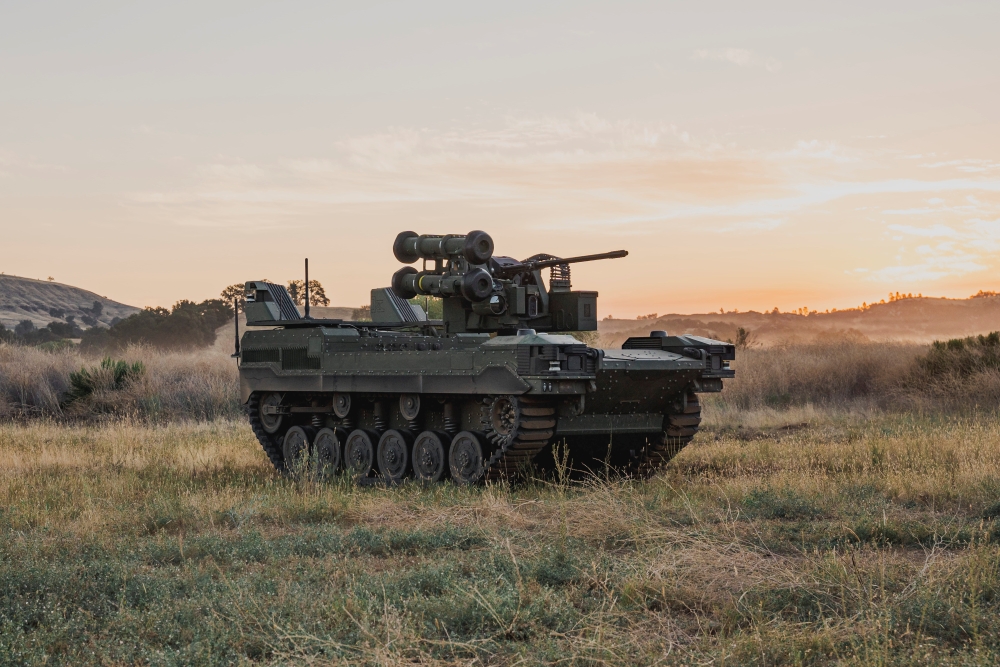
Textron and its subsidiary Howe & Howe announced on 5 November that the US Marine Corps (USMC) has acquired two RIPSAW M3 robotic ground vehicles for the US Marine Corps Warfighting Laboratory (MCWL). Sara Willett, Vice President for Programs at Textron, spoke exclusively with FW Mag about the announcement.
According to a company statement, the M3 uncrewed ground vehicles (UGVs) “will serve as experimentation and integration testbeds,” allowing the USMC to “integrate various payloads and sensors, demonstrate mission sets and inform additional robotics requirements.”
Willett told FW Mag that the two RIPSAW M3S are “scheduled for delivery by the end of the second quarter of 2027.”
The executive confirmed that this is the first sale of RIPSAW UGVs to the US Marines. However, the company has previously delivered RIPSAW M3s to the US Army for mobility testing in support of uncrewed ground vehicle development.
Moreover, “we have also provided RIPSAW M5 vehicles for the DARPA RACER program,” Willet explained, as “they are being used to advance testing and evaluation of autonomous mobility in complex terrain.” RACER, which stands for Robotic Autonomy in Complex Environments with Resiliency, concluded earlier this year and was aimed at creating an autonomy stack, namely a “collection of algorithms, datasets, and neural network models – that could be deployed on any ground vehicle,” DARPA explained in January.
FW Mag has previously discussed the US Marines' interest in UGVs. During the Modern Day Marine 2026 exhibition in June, FW Mag attended a panel by US Marine Colonel Kenneth Jones, Division Director for Science & Technology at the MCWL, who said, “logistics is the goal.” The officer explained that his ambitions for this first stage of autonomy UGV technology are to “put logistics on a flatbed, [aboard] a wheeled vehicle, and move the vehicle from Point A to Point B." He also added that another short-term goal is the ability for one operator to control two or three UGVs.
FW Mag asked Willet about whether the RIPSAW M3 has been tested for logistics missions, given Colonel Jones’ previous comments. The Textron executive explained that the M3 UGV “has been tested in multiple terrain types, including dense vegetation and rocky, desert-like conditions,” and is “undergoing continued evaluation in rugged environments.”
The RIPSAW family of UGVs has already accumulated over 8 thousand miles (12,874 km) in operational and test environments, FW Mag was told.
Textron produces a family of RIPSAW uncrewed ground vehicles. The M3 version has a max speed of 48 kph, a payload capacity of 2,267 kg (5,000 pounds), 10 kW of exportable power, and a modular deck area of 19.2 square meters (63 square feet). The company explained in a fact sheet that the M3 is designed to be transportable, including by aerial platforms like a CH-47 Chinook helicopter. Other RIPSAW versions include the largest platform, namely the M5, and the smallest vehicle, the M1. All platforms operate the CoreMotion robotic control package, which allows communication between autonomy software and vehicle hardware.
At defence exhibitions, industries routinely showcase UGVs with a variety of payloads, particularly remote weapons systems and counter-UAS solutions. While these payloads can be force multipliers and very helpful for troops, UGVs can also transport large quantities of logistics (ammo & weapons, food & water, medicine, and other technologies), lightening the load dismounted troops have to carry. The upcoming Modern Day Marine 2027 exhibition in Washington, DC, which FW Mag will also attend, may include updates on what the MCWL has learned from Textron’s RIPSAW M3 UGVs.



Privacy Policy

Powered by © Mobilbyte s.a.s. Information Technology