



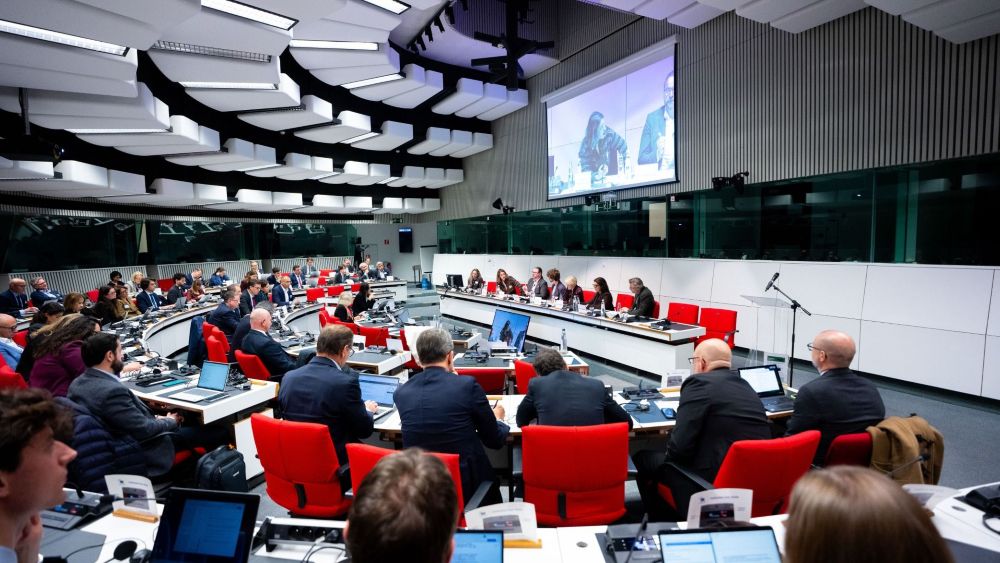
ASD’s high-level dialogue on digital sovereignty and the competitiveness of Europe’s aerospace, security and defence industry took place at the European Economic and Social Committee (EESC) this month in Brussels.
“We don’t want to die sovereign.” Olivier Flous, Thales’ chief technical officer, summed up Europe’s dilemma: control over critical technology matters, but not at the expense of performance. European companies need secure systems they can trust, while remaining competitive with the best products and services available globally.
That trade-off already shapes business decisions. Sometimes, Flous noted, European firms “have no choice but to leverage solutions coming from China or the US” and secure them as best they can.
Europe’s dependence spans semiconductors, artificial intelligence, cloud services and satellites. Around 80% of the cloud technology used in Europe comes from outside the continent, European Commission Executive Vice-President Henna Virkkunen told the conference. Heavy reliance on foreign providers can leave Europe exposed to who controls that data and whether essential services remain available during a crisis.
Industry leaders warn sovereignty isn’t all-or-nothing. For critical defence command-and-control systems, “sovereignty is non-negotiable,” said Benoît Chatelain, Director for Defence and Security at Sopra Steria. Yet for less sensitive data, Micael Johansson, ASD President and Chairman of the Board, and CEO of SAAB, argued that cutting-edge commercial infrastructure can offer better security than homegrown systems.
Meanwhile, Arnaud Bertrand, Senior Vice President and Chief Technology Officer at Dassault Systèmes, argued for a strategy of “and”, not “or”: Europe should combine local and global providers based on risk and sensitivity, not try to do everything in-house.
Europe is still in the AI race
Artificial intelligence is a test of whether Europe can turn that ambition into technological strength. Audrey Herblin-Stoop, Mistral AI’s vice-president for global public affairs and communications, rejected claims that the continent had already lost. “The story that Europe has already lost the race is just false,” she said, warning that defeatism could become a “self-fulfilling prophecy”.
As evidence, she pointed to Mistral’s latest model, trained on around 4,000 graphics processing units (GPUs) — specialised chips that provide the computing power needed to train AI systems. She said it was on a par with leading models in coding and cybersecurity.
Airbus vice-president Nicole Dreyer-Langlet urged Europe to focus on areas where it is particularly strong, such as industrial AI, because Europe “can’t be everywhere”.
Meanwhile, Despina Spanou, deputy director-general at the Commission’s DG CONNECT, pointed to the AI Act’s safeguards and planned AI Gigafactories - large-scale facilities intended to give companies and researchers access to advanced computing power. But Europe also needs investment and customers to help its AI companies scale up.
What Europe builds vs what it buys
Europe’s challenge is not simply to develop competitive technologies, but to create a market for them. “Europe does not have an innovation problem. It has mainly a deployment problem,” said Rosanne Serrano, chair of ASD’s Digital Transformation Commission, pointing to a “paradoxical gap between what we build and what we buy”.
Public procurement is central to closing that gap. Fragmented national rules make it harder for companies to sell across borders, while tenders often prioritise the lowest price or require the track record and scale of established suppliers. Smaller European firms can struggle to win their first major contracts, even when they have competitive products. Their technologies risk remaining at the prototype stage instead of reaching public authorities and large customers.
Public procurement can therefore act as industrial policy, creating demand and giving companies the confidence to invest and expand. As Virkkunen put it, “For a company, it is always better to have a customer than a grant.”
To address these barriers, the Commission’s proposed Public Procurement Act would update the rules governing public purchases. Among other things, it would shift the focus from the cheapest bid to the “best price-quality ratio”, allowing buyers to consider strategic, environmental and social criteria alongside price. It would also make contracts more accessible to smaller firms by splitting large tenders into smaller lots. A proposed “European preference” would take reciprocity into account when assessing suppliers from outside the EU.
ASD Secretary-General Camille Grand said the gap between what Europe builds and buys “is not inevitable, it is a choice”.
The budget test
Turning that ambition into industrial scale will also depend on the EU’s next Multiannual Financial Framework (MFF), which sets the bloc’s spending priorities over seven years. The proposed European Competitiveness Fund (ECF) would bring together 14 existing programmes under a single framework, supporting strategic sectors from research and development to manufacturing and commercial scale-up.
A major component of the fund is a €125 billion window for resilience, security, defence and space. Nathalie Berger, the Commission’s acting deputy director-general for investment and innovation, said the fund was essential to getting member states to “spend together and to spend European”.
But the funding ambitions face a political test. A revised negotiating proposal presented by European Council President António Costa on 21 November would cut the broader competitiveness, prosperity and security budget heading by around 16% compared with the Commission’s original proposal.
EU leaders are due to discuss the next budget at a special summit on 26–27 November. The fund’s ultimate test will be whether it can strengthen the entire European industrial chain, from critical raw materials to the technologies and products the bloc wants to build.
As European Parliament Vice-President Victor Negrescu put it at the close of the event, “alone, each member state can be important, but together we are indispensable”. Europe’s challenge, he argued, is to build genuine “European leadership”.

Privacy Policy

Powered by © Mobilbyte s.a.s. Information Technology