



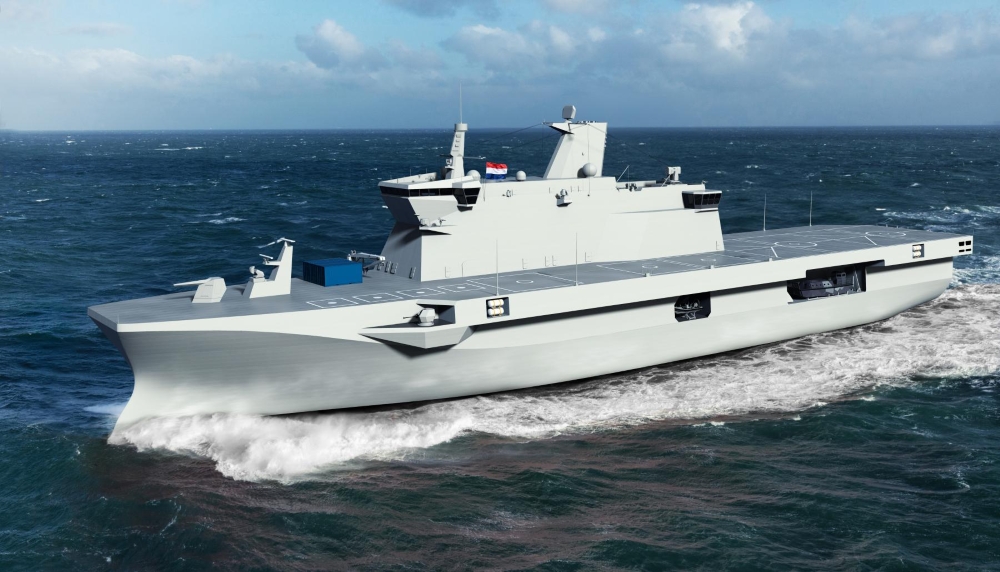
At the NEDS (NIDV Exhibition Defence & Security) annual defence and security trade exhibition in the Benelux region, held at Rotterdam Ahoy on November 19, Damen showcased the most detailed image and model yet of the design of the Amphibious Transport Ship (ATS) for the Netherlands and the UK.
A small anticipation had been provided earlier, on October 6, when the Royal Navy’s 1st Sea Lord Gwyn Jenkins was gifted a small-scale model of the ATS by Netherlands’s Vice Admiral Harold Liebregs at the Venice symposium. The photo, posted on twitter, provided a first look at the refined design.
The configuration of the ship as a through-deck LPD is confirmed, as well as the dimensions, given as 164 meters for between 15 and 16,000 tons.
The ATS is a relatively small amphibious vessel and that forces serious limitations. For one, the deck spots actually capable of operating with crewed helicopters are only the two on the stern. 3 medium-sized spots amidship, to the side of the large island, are primarily if not exclusively meant for drones, and further small spots for drones are available towards the bow.
The front of the flight deck has space and a crane for a number of containers / capability modules. In the Netherlands configuration, there is also a single Leonardo – Oto Melara 76 mm SOVRAPONTE non-deck penetrating gun, with radar on a stand-alone mast.
Another limitation of the design is the very limited hangar space for helicopters: the hull is not high enough to have a dedicate hangar deck and there is instead a frigate-style hangar in the back of the island which can hold up to 2 helicopters, folded, parked abreast. The Royal Navy’s MERLIN HC4 is the largest helicopter than will fit the hangar bays.
A well dock is present, probably for no more than 1 LCU-sized landing craft. Davits are provided for at least 2 smaller landing craft: they will hold LAC for the Netherlands and the future, slightly larger Commando Insertion Craft for the Royal Navy.
There seem to be a lift amidship ensuring some connection between flight deck and vehicle deck, presumably for the movement of air portable loads and vehicles. The ship, shown in Netherlands configuration, has a considerable overall armament and EW fit. Beyond the SOVRAPONTE 76 mm CIWS the ship is also fitted with BAE-Bofors 40 mm MK4 guns at the edges of the deck for close defence. On the top rear of the superstructure, a RIM-116 RAM launcher ensures a close-in missile layer of defence.
The ships are also show fitted with jammers and trainable decoy launchers, as well as a Leonardo LIONFISH TOP RWS with a .50 HMG, fitted to a small sponson high up on the island.
The ship is shown equipped with a Thales Netherlands NS100 multi-role radar as main sensor and a Thales MIRADOR Fireline Radar for fire direction.
The weapons fit is very Netherlands-coded and shows commonality with the planned systems on the new ASW frigates. We fully expect the British variant to be much more lightly armed given precedents, with the SOVRAPONTE and RAM probably immediately deleted. The 40 mm MK4, which are also found on Type 31, are more likely to stick.
While for the Netherlands 4 ATS mark an improvement overall in capability over the 2 current, larger LPDs, for the Royal Navy the capability loss will be pretty severe.
How severe depends on how far back one wants to count the losses. The early withdrawal of the 2 ALBIONs and of RFA ARGUS mean that now Government can pretend it is replacing only 3 BAY-class LSDs (each of which is still considerably longer at 176 meters), but reality is far less flattering.
In addition, the Netherlands are signalling, unsurprisingly for us but perhaps very surprisingly for UK Defence Procurement Minister Luke Pollard, that their ships will be built in the Damen shipyards in Romania.
Pollard had confidently told the Treasury Committee back in July that UK yards would build all 8 ships planned for the joint program. Reality is likely to be far less flattering, but the current British Government is in no hurry to admit it.



Privacy Policy

Powered by © Mobilbyte s.a.s. Information Technology