



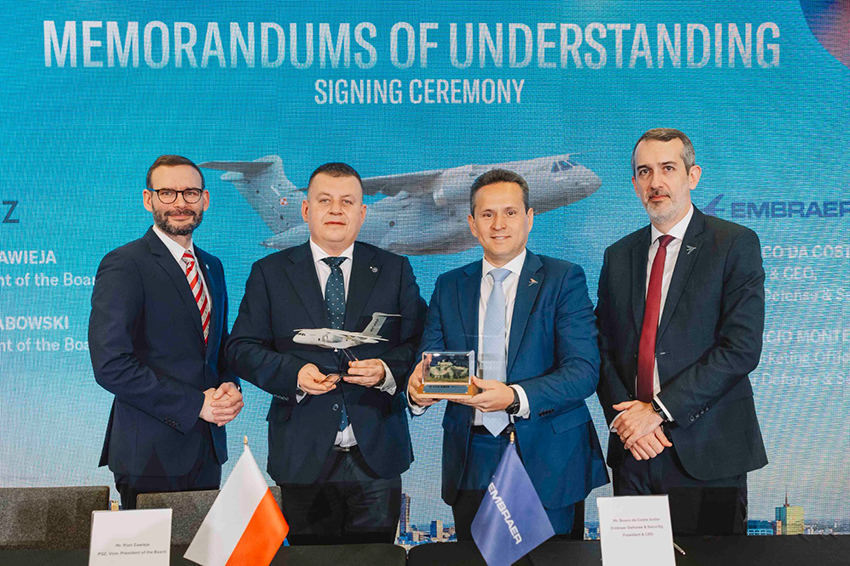
On 2 December in Warsaw, Brazilian aerospace manufacturer Embraer and Poland's state-owned defence conglomerate Polska Grupa Zbrojeniowa signed five Memoranda of Understanding establishing an extensive framework for long-term industrial collaboration across the aerospace and defence sectors. The agreements, which also encompass PGZ subsidiaries WZL-1, WZL-2, WSK "PZL-Kalisz" and WBCKT, lay the groundwork for what Embraer describes as placing Poland "at the centre of the industrial ecosystem we are creating in Europe" around its KC-390 MILLENNIUM multi-mission tactical transport aircraft. The accords represent a significant milestone in Poland's aviation modernisation trajectory and position Warsaw as a potential second European focal point for KC-390 industrial activity, complementing the existing centre at OGMA in Portugal.
Strategic rationale: aligning industrial ambition with operational requirement
The timing of these MoUs is the result of the convergence of Polish defence procurement priorities with Embraer's European expansion strategy. Poland is currently modernising its tactical airlift fleet, having recently acquired 5 ex-USAF C-130H Hercules aircraft to replace ageing C-130E variants, while simultaneously undertaking a €102.7 million standardisation and modernisation programme for its 16 C-295M medium transports. However, Warsaw's requirement for greater strategic lift capacity (particularly as it shoulders increased burden-sharing responsibilities within NATO's eastern flank) has generated sustained interest in acquiring more capable, modern platforms.
Defence sources in Warsaw suggest that KC-390 procurement remains under serious evaluation by the Ministry of National Defence. The aircraft's 26-tonne payload capacity, 470-knot cruising speed and tactical flexibility make it particularly attractive for Poland's operational environment, where the ability to rapidly deploy heavy equipment (including ROSOMAK armoured personnel carriers, WARAN tactical vehicles and HIMARS rocket systems) across NATO territory has become strategically imperative. The MoUs establish a framework for cooperation encompassing operational support, maintenance, repair and overhaul services, component manufacturing, supply chain integration, and design, development, production and testing of aerospace products. Critically, the scope may extend to C4ISR activities, reflecting Poland's growing emphasis on network-centric warfare capabilities.
Jan Grabowski, Vice President of PGZ's Management Board, emphasised that the agreements provide "technology transfer and the acquisition of new competencies in one of the key areas of the modern battlefield". This language signals Poland's intention to leverage the partnership not merely for platform acquisition but to enhance domestic industrial capabilities - a consistent theme in Warsaw's defence procurement strategy.
KC-390 perspectives in Poland and across European NATO
The KC-390 has gained considerable momentum within NATO over the past two years. Portugal, the first European customer, achieved full operational capability with its initial 5 aircraft in 2023 and has since ordered a sixth unit while establishing 10 additional purchase options specifically designed to facilitate NATO partner acquisitions. Hungary inducted its first KC-390 in September 2024, while the Netherlands and Austria jointly ordered 9 aircraft for delivery from 2027. The Czech Republic confirmed 2 aircraft in late 2024, Sweden ordered 4 in April 2025, and Lithuania announced its intention to acquire 3 at the Paris Air Show in June 2025. Slovakia has selected the platform and is advancing negotiations for 3 units. This growing community of NATO operators promises enhanced interoperability, streamlined training and shared logistics support - factors that reinforce the aircraft's attractiveness to Poland.
The KC-390 fleet in service with Brazil, Portugal and Hungary has demonstrated a mission capability rate of 93 per cent and mission completion rates exceeding 99 per cent. These company figures compare favourably with the operational availability of legacy platforms and address a key Polish concern: maintaining high readiness rates in an increasingly demanding security environment.
Embraer's Polish ambitions and the OGMA factor
The industrial dimension of the Embraer-PGZ relationship warrants particular scrutiny, especially given the existing European centre for KC-390 activity at OGMA in Alverca, Portugal. OGMA, in which Embraer holds a controlling 65 per cent stake, has been deeply integrated into the KC-390 programme since 2011, producing sponsons, elevators, wing trailing edge panels and centre fuselage components. The facility serves as the authorised European MRO centre for the platform, providing scheduled and unscheduled maintenance, heavy structural inspections, engineering support, supply chain management and continuing airworthiness organisation services.
Portugal's role extends beyond industrial participation to programme co-development. Portuguese engineers contributed to the aircraft's design, and OGMA was instrumental in integrating NATO-standard equipment and conducting the flight test campaign that enabled the KC-390's entry into service with the Portuguese Air Force in 2023. This deep partnership has established OGMA as the cornerstone of Embraer's European industrial strategy.
Against this backdrop, the Polish MoUs would represent an expansion of Embraer's European footprint. Bosco da Costa Junior, President and CEO of Embraer Defense & Security, explicitly stated that the agreements would "effectively place Poland at the centre of the industrial ecosystem we are creating in Europe", suggesting a hub-and-spoke model rather than a single-centre approach.
The proposed division of labour emerging from the MoUs indicates functional specialisation. WZL-1 in Lodz will focus on metallic and composite parts manufacturing, technology transfer, certification processes and emerging technologies. WZL-2 in Bydgoszcz - which already conducts heavy maintenance on Polish F-16s and C-130s - will explore MRO activities for the KC-390 and provide painting services. This positioning suggests WZL-2 could become a regional sustainment hub serving Central and Eastern European operators, complementing OGMA's broader European mandate.
WSK "PZL-Kalisz" will contribute precision manufacturing, mechanical systems expertise and heat-treatment services, while WBCKT, a technology integrator within the WB Group, will explore joint development of ground support equipment and potential command-and-control applications. The latter is particularly significant, as it aligns with Poland's growing counter-UAS and C4ISR industrial capabilities.
Crucially, Embraer has signalled interest in establishing a KC-390 final assembly line in Poland, following chief executive Francisco Gomes Neto's visit to Warsaw in March 2025. Industry observers estimate that such partnerships could generate $3 billion in value to the Polish economy over 10 years and create up to 5,000 jobs. However, the final assembly proposition remains exploratory, contingent on formalisation of Polish procurement and securing sufficient order volume to justify the investment.
The offset framework is essential to understanding Embraer's Polish proposition. Poland's offset legislation, which entered into force in 2014, mandates solely intangible offset commitments consisting of technology transfer and know-how licensing. Warsaw explicitly expects foreign suppliers to establish domestic production and MRO capabilities, as evidenced by major offset agreements with Raytheon and Lockheed Martin (WISLA PATRIOT programme), GE Aerospace (APACHE engine maintenance) and Airbus (C-295M modernisation).
Embraer's willingness to distribute manufacturing workshare, establish MRO capacity at WZL-2 and explore final assembly in Poland directly addresses these regulatory requirements while providing Warsaw with a credible pathway to industrial participation. This contrasts with the OGMA model, where Portugal's early programme investment secured structural manufacturing roles; Poland's later entry necessitates a different approach focused on sustainment, systems integration and potential final assembly. The relationship between OGMA and potential Polish facilities can be understood through complementary geographic positioning. OGMA would serve Western and Southern European customers, leveraging its Atlantic location and proximity to Lisbon's international connectivity. A Polish hub would naturally serve Central and Eastern European operators - including the Czech Republic, Slovakia, Hungary and potentially Baltic states - offering shorter transit times, regional language capabilities and alignment with NATO's eastern flank logistics.
Moreover, OGMA's existing production capacity is increasingly committed to supporting Portugal's expanded six-aircraft fleet and fulfilling structural manufacturing commitments for a growing global customer base. The addition of Polish MRO and potential assembly capacity would alleviate bottlenecks and provide Embraer with surge capacity to meet accelerating European demand.
Conclusion: a new aeronautic industrial network in formation
The Embraer-PGZ agreements represent a sophisticated (maybe complex) approach to defence industrial partnership. By establishing functional specialisation between OGMA's structural manufacturing and primary MRO mandate and Poland's emerging focus on sustainment, systems integration and potential final assembly, Embraer is constructing a distributed European industrial network capable of supporting a growing NATO customer base.
For Poland, the accords offer a pathway to enhance airlift capabilities while securing substantial technology transfer and industrial participation - core objectives of Warsaw's defence modernisation strategy. The framework aligns with Poland's evolving role as a NATO frontline state requiring robust sustainment capabilities independent of extended supply chains.
For Embraer, Poland provides geographic diversification, access to Central European aerospace expertise and a potential production node capable of supporting regional customers. The theoretically complementary relationship with OGMA suggests a mature industrial strategy designed to scale with European demand.
Whether these MoUs translate into formal procurement remains contingent on Polish budgetary decisions, political will and competing priorities within Warsaw's crowded acquisition pipeline. However, the industrial architecture is now in place to support a Polish KC-390 fleet and position Warsaw as a genuine centre of European tactical airlift industrial capability.




Privacy Policy

Powered by © Mobilbyte s.a.s. Information Technology