



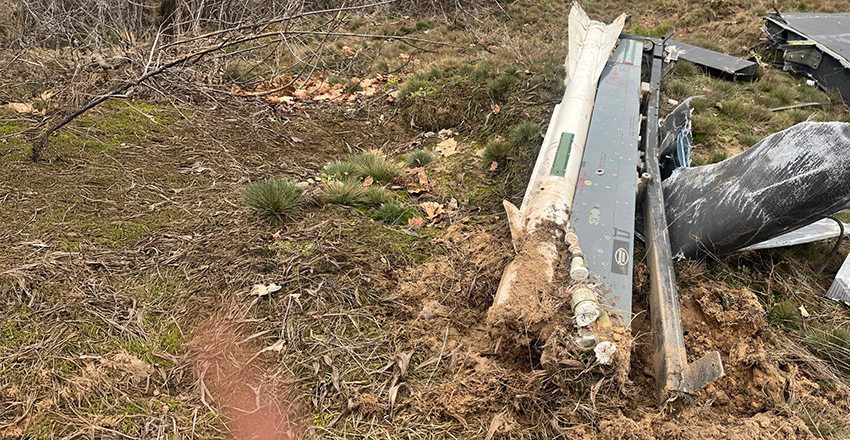
A video released on X on 1 December shows the in-flight interception of a SHAHED-136 (GERAN-2) armed with an R-60 missile. The Russian drone was reportedly shot down by a STING quadcopter interceptor developed in Ukraine by the Wild Hornets Charitable Fund. The footage clearly shows the R-60, known in NATO designation as the AA-8 APHID, mounted on a launch saddle fixed to the upper forward section of the drone’s fuselage. In theory, the infrared-guided missile would allow this UAV to engage Ukrainian aircraft and helicopters, creating a potentially low-cost aerial threat; however, the real effectiveness of such a configuration remains uncertain. The video’s publication was preceded by images circulating on Telegram showing the wreckage of a GERAN-2 equipped with an R-60. These photos, reported above as well, depict the missile still attached to its launch saddle.
The R-60, or AA-8 APHID, is a Soviet-era infrared-guided air-to-air missile whose baseline version entered operational service in the early 1970s. Several variants remain in use in multiple countries today, including Russia and Ukraine. Measuring nearly two meters in length and weighing just under 45 kg, the R-60 is particularly compact for its class: it is shorter and lighter than the R-73, its successor in the Soviet arsenal, as well as Western equivalents in the AIM-9 SIDEWINDER family.
It is worth recalling that R-60 missiles have been used on several occasions as surface-to-air weapons—for example, by Ukrainian uncrewed surface vessels (USVs) and by the Houthis in Yemen. Ukraine has also integrated R-73 and AIM-9 missiles onto its USVs, with the analogous objective of posing a threat to Russian aircraft and helicopters deployed to intercept them. Ukrainian forces also make extensive use of short-range air-to-air missiles adapted for ground-based surface-to-air roles.
The exact way in which the SHAHED-136 employs an air-to-air missile is not currently known. The drone—and thus the weapon—may be operated by a remote pilot, or Russia may have implemented autonomous, AI-based targeting modes.
Russia’s decision to modify SHAHED-136 drones to carry R-60 missiles reflects a deterrence strategy consistent with previous initiatives, though it remains unclear how credible a threat this combination actually represents. Ukrainian fixed-wing aircraft and helicopters play a crucial role in countering drone attacks, and they would have no immediate way of knowing whether the target they are engaging is equipped with an air-to-air missile.
Only time will tell when a Russian SHAHED-136—whose estimated unit cost ranges between USD 20,000 and 50,000—will attempt to engage a Ukrainian aircraft with an R-60, a scenario that could become a game changer in the war in Ukraine. In any case, the mere possibility that a Russian SHAHED-136 may now be armed with an air-to-air missile introduces an additional element of risk that Ukrainian forces will need to consider.




Privacy Policy

Powered by © Mobilbyte s.a.s. Information Technology