



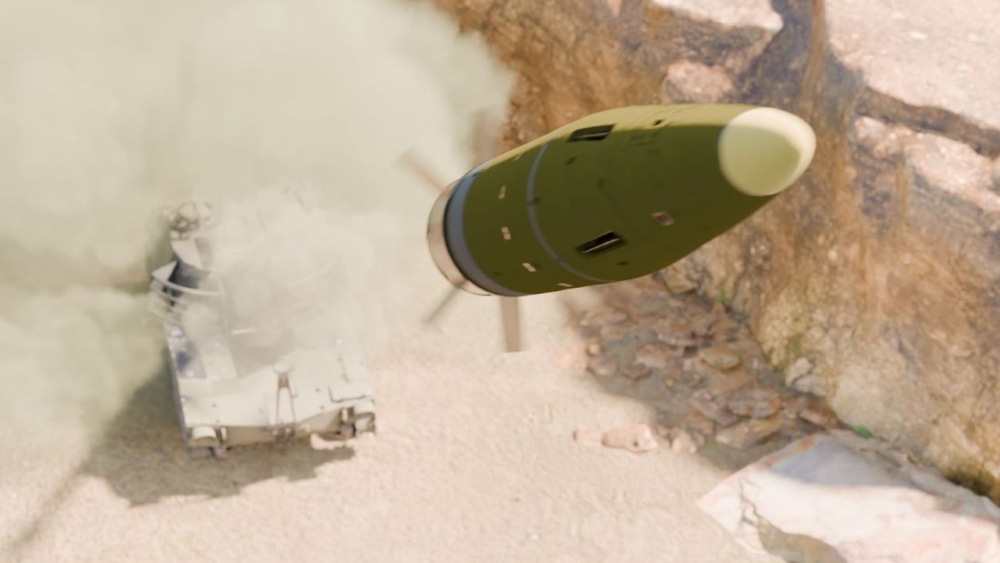
The EXCALIBUR 155 mm precision-guided projectile, co-developed by Raytheon and BAE Systems Bofors, is a proven battlefield solution offering a Circular Error Probable (CEP) of as few as 2 meters from the target. Already exported to multiple Counties and used well over 1400 times in combat, the extended range sell has a range of circa 40 km for 39-caliber barrels and 50 from 52-caliber artillery.
The HTK (hit-to-kill) variant is the most advanced EXCALIBUR development, meant to provide artillery with the capability to engage, in all weathers, moving and imprecisely located threats including armour on the move. In order to achieve this, the shell is to be fitted with a gun-hardened seeker that leverages the tri-mode sensor used on the GBU-53 Small Diameter Bomb II “STORMBREAKER”, and an armour-penetrating warhead.
The shock of cannon launch is particularly tough for a seeker, so passing design verification tests for this crucial component of the new shell marks a major milestone.
Early EXCALIBUR shells, relaying on GPS coordinates of the target, have proven to be vulnerable to enemy jamming and have little to no capability against moving targets or targets for which there is no clear localisation. An EXCALIBUR with laser seeker has also been put forward, but this too requires target “illumination” by a third part sensor / observer.
The HTK variant will be able to actively hunt for mobile / relocatable / moving targets in a target area, hitting individual armoured vehicles for maximum effect in complex scenarios, in the presence of enemy jamming and in adverse weather / battlefield visibility conditions.
Funding for the HTK development were first planned all the way back in 2019 as part of initiatives to increase US Army artillery capability.




Privacy Policy

Powered by © Mobilbyte s.a.s. Information Technology