



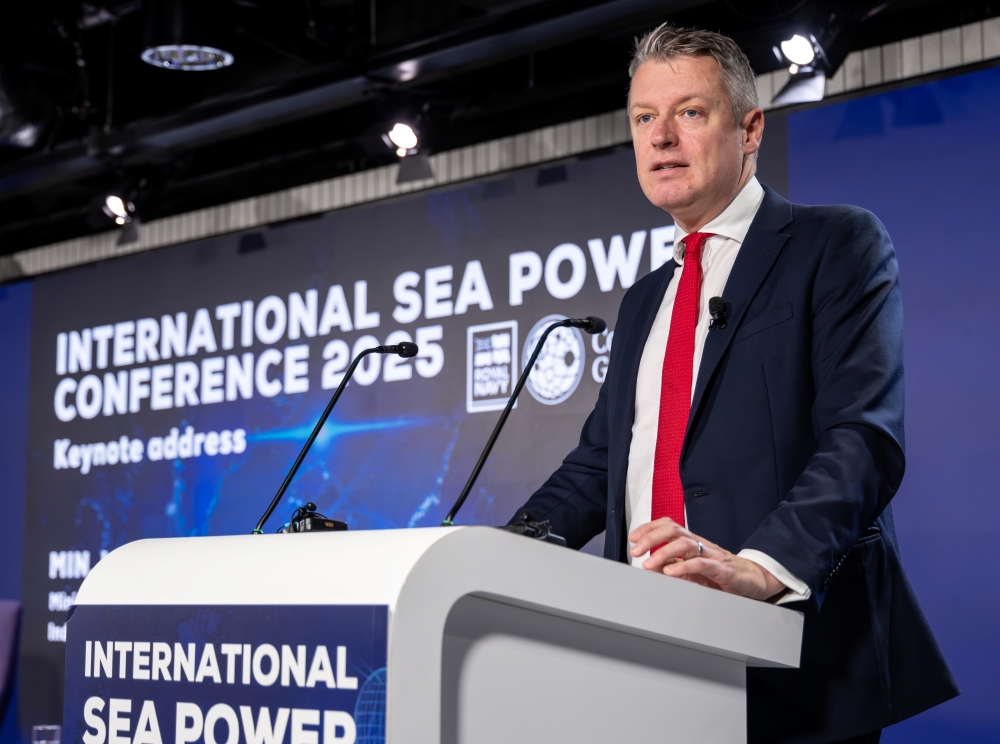
During the Royal Navy’s International Sea Power Conference, the UK Ministry of Defence (MoD) and Royal Navy (RN), in partnership with the Council on Geostrategy, have set out further details on the continuing procurement process for the navy’s ‘Atlantic Bastion’ North Atlantic-focused anti-submarine warfare (ASW) programme.
In a press release on 8 December, and in keynote speeches at the conference, the UK announced that 20 companies – from small-to-medium enterprises, major primes, and ‘tech’ firms – have been showcasing technology demonstration work in support of the ‘Atlantic Bastion’ concept.
Details of ‘Atlantic Bastion’ were first revealed in the UK’s Strategic Defence Review (SDR), published in June. SDR said “‘Atlantic Bastion’ is the RN’s plan to secure the North Atlantic for the UK and NATO against the persistent and growing underwater threat from a modernising Russian submarine force.” Being developed under the Project Cabot acquisition framework, ‘Atlantic Bastion’ is divided into two phases: ‘Atlantic Net’, with uncrewed underwater vehicles (UUVs) deployed in key waters to start building an intelligence, surveillance, and reconnaissance (ISR) sensing network; and ‘Atlantic Bastion’, where crewed and uncrewed platforms in all domains will be networked together and spread more broadly across the North Atlantic region. Such a programme, SDR said, was a key step in the RN’s transformation into a ‘hybrid navy’ – blending high-end crewed platform outputs with uncrewed mass and persistence to expand the navy’s capability and effect.
On 15 October, the MoD issued a tender notice announcing its intent to seek – through invitations to tender – commercial mission partners to support the ‘Atlantic Net’ phase. On the same day, a procurement launch event was held with industry.
In the 8 December press release, the MoD said that through ‘Atlantic Bastion’ “The UK will be more secure from Russian undersea threats in the North Atlantic through a transformation of the RN and its submarine-hunting capabilities.” The concept will combine artificial intelligence (AI)-enhanced autonomous systems and state-of-the-art acoustic detection technology with ships, submarines, and aircraft, plus cutting-edge digital targeting infrastructure, to create a “highly advanced hybrid force” to counter resurgent Russian submarine activity and deter threats to critical underwater infrastructure (CUI). “‘Atlantic Bastion’ will enable the UK to find, track and, if required, act against adversaries with unprecedented effectiveness across vast areas of ocean,” the press release added.
At the conference, Luke Pollard – the MoD’s Minister for Defence Readiness and Industry – confirmed that contracts had been put in place with 20 companies, under an overall investment worth £4 million for the first stages of work. “That will lead to a £35 million investment in the most promising innovations within 12 months,” the Minister said.
The requirement and effect were clear, he added. “‘Atlantic Bastion’ is an important step towards a hybrid Royal Navy, where an AI-powered shield of sensors, autonomous vessels, and traditional naval and air assets come together as a hybrid navy protecting the North Atlantic from surface and sub-surface threats.”
General Sir Gwyn Jenkins – the RN’s First Sea Lord and Chief of Naval Staff – added: “It’s not just technologically innovative: it’s innovative in the way we are conducting procurement.”
“For every pound we have invested, industry has invested four. By our estimation, the technology involved in the demonstrators for ‘Atlantic Bastion’ have involved some £0.5 billion in research and development,” Gen Jenkins told the conference audience.
The new procurement approach is illustrated in the requirements setting process too, with industry tasked with helping the navy tackle a problem set rather than having to respond to a long list of specifications, the First Sea Lord explained. “They’ve stepped up in spades, which is why, next year, we will have our first sensors in the water; we will issue our contracts for ‘Atlantic Bastion’ as a service.”
The MoD’s tender notice, back in October, said the ‘Atlantic Net’ phase will provide an ISR service through a contractor-owned, contractor-operated, naval oversight (COCONO) model.
The MoD press release itself added that the next development and testing phases will involve work being taken forward from the concept stage to the frontline, with 2026 seeing capabilities deployed in the water and further investment injected to accelerate and expand the programme.
On the latter point, the RN is also keen to encourage NATO allies’ participation in ‘Atlantic Bastion’.




Privacy Policy

Powered by © Mobilbyte s.a.s. Information Technology