


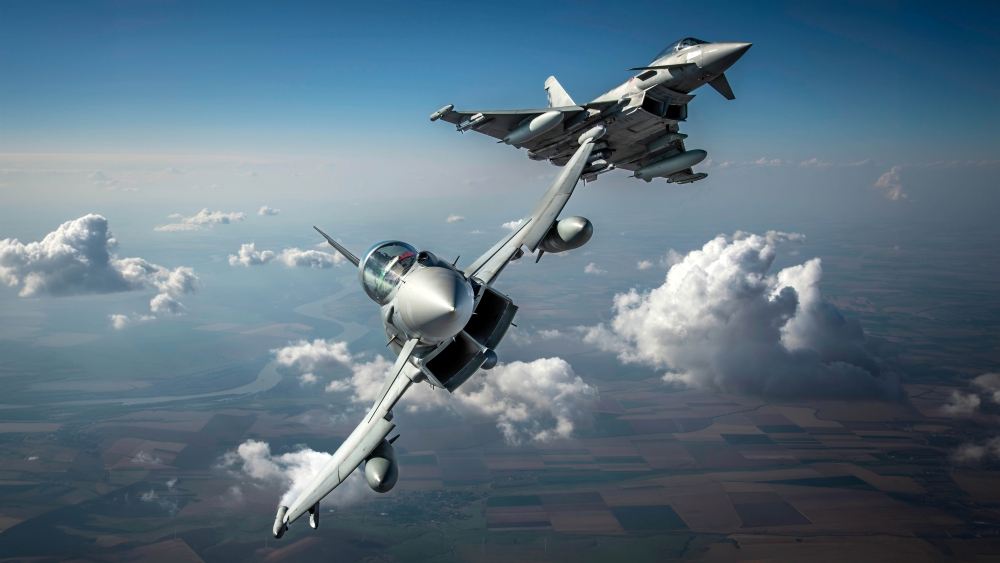
With an official announcement, the Bangladesh Air Force has confirmed signing a Letter of Intent with Leonardo for the acquisition of the Eurofighter TYPHOON fighter aircraft. Further details are not yet available, though the purchase is expected to comprise at least 12 aircraft. Formal contract negotiations will now commence.
Leonardo is leading the Eurofighter campaign in Bangladesh (as well as in Poland and the Philippines), while BAE Systems is leading campaigns in Turkey and Saudi Arabia.
The Eurofighter TYPHOON is experiencing a production and commercial resurgence driven by European defence spending increases and Middle Eastern export opportunities, yet faces persistent structural challenges that constrain its long-term competitiveness.
The consortium is ramping production from 12-14 aircraft annually to 20 by 2028, with potential expansion to 30 units depending on export contract materialization. The consortium is leveraging recent orders: Germany is procuring 58 additional Typhoons (38 under Quadriga plus 20 follow-ons), Spain committed to 45 aircraft through HALCON I and II phases, and Italy purchased 24 units in December 2024. Combined with Turkey's October 2025 order for 20 jets worth £8 billion, the current backlog stands at 157 aircraft, with total orders reaching approximately 769 units and over 613 delivered. CEO Jorge Tamarit Degenhardt describes an additional 134 export opportunities across Austria, Poland, Saudi Arabia, and Qatar.
Despite these orders, the Eurofighter confronts severe headwinds within Europe itself. The F-35 dominates European procurement, with 10 European nations operating the US fifth-generation fighter (even in air defence roles) compared to only 4 countries using the TYPHOON (excluding consortium members).
The TYPHOON has lost successive competitions in Belgium, Finland, Switzerland, Poland, and the Czech Republic to the F-35. By 2030, approximately 550 F-35s will operate across Europe, cementing US dominance in the fifth-generation segment.
The Dassault RAFALE also outperforms the Eurofighter in global exports, securing 322 export orders from 8 countries versus 151 Eurofighter export orders from 5 nations.
The RAFALE's single-nation industrial structure provides faster decision-making and technology transfer flexibility absent in the four-nation Eurofighter consortium, which requires unanimous export approval. Indeed, Germany's restrictive arms export policies pose critical constraints. Berlin vetoed Eurofighter sales to Turkey in April 2025 over human rights concerns before reversing course in July, delaying a $10.7 billion contract. Similar German embargoes previously blocked Saudi Arabian purchases for years due to Yemen war involvement and the Khashoggi assassination, only lifting restrictions in 2024.
These vetoes frustrate UK, Spanish, and Italian consortium partners and weaken the TYPHOON's competitive position against rivals with streamlined approval processes. The consortium is positioning the TYPHOON as a technological bridge to the sixth-generation Global Combat Air Programme (GCAP), scheduled for 2035 operational entry.
A mid-life upgrade (MLU) program will extend TYPHOON service life into the 2060s, incorporating the ECRS Mk2 AESA radar (UK integration targeted before 2030), enhanced electronic warfare systems, and mission computer upgrades. The UK invested £204.6 million in ECRS Mk2 development specifically to maintain industrial continuity and workforce skills until GCAP production begins. This strategy aims to prevent the production gaps that plagued previous European fighter programmes.
To sum up, the TYPHOON's future hinges on converting Middle Eastern opportunities (particularly Saudi Arabia's potential 48-aircraft follow-on order and Qatar's reported 12-unit expansion) into firm contracts while navigating German export politics. European domestic demand remains constrained by F-35 commercial superiority, forcing the consortium to rely increasingly on non-European markets. The consortium's ability to reach the ambitious 30-aircraft-per-year production rate depends entirely on export campaign success, making political alignment among partner nations existential for sustaining production lines beyond 2030.



Privacy Policy

Powered by © Mobilbyte s.a.s. Information Technology