



The precarious peace along the Thai-Cambodian border has collapsed. Just two months after a ceasefire was brokered to end the deadly skirmishes of July, hostilities have erupted with renewed intensity. Following the death of a Thai soldier in the Ubon Ratchathani province earlier this week - attributed by Bangkok to Cambodian ground fire and landmines - the Royal Thai Air Force (RTAF) has launched retaliatory airstrikes, marking a significant escalation in a conflict that threatens to destabilise the wider Mekong sub-region.
As of today, heavy artillery exchanges have been reported near the Preah Vihear temple complex and the 'Emerald Triangle', with as many as 500,000 civilians fleeing their homes. The rapid deterioration of relations between Bangkok and Phnom Penh has drawn immediate concern from ASEAN and international observers, who fear the localized border dispute is spiralling into a broader geopolitical confrontation.
The immediate trigger for this week’s clashes was a kinetic engagement on Monday morning. According to the Royal Thai Army, a patrol in the Buntharik district of Ubon Ratchathani came under fire from Cambodian troops, resulting in the death of one ranger and injuries to several others. In a rare escalation, Thailand responded not just with counter-battery artillery fire but with air power, bombing suspected Cambodian command posts and artillery positions. Cambodian officials have vehemently denied instigating the fight, claiming Thai aircraft struck civilian areas, killing at least four villagers.
However, the roots of this violence run far deeper than a single border patrol gone wrong. Two primary friction points are driving this conflict:
1) Unresolved land demarcation: the 800-kilometre border remains largely undefined, a legacy of the 1907 Franco-Siamese Treaty. Nationalist sentiment on both sides is tethered to the sovereignty of the area surrounding the Preah Vihear temple (awarded to Cambodia by the ICJ in 1962, though the surrounding scrubland remains disputed) and the Ta Moan and Ta Krabey temples.
2) Maritime resources (the OCA): tensions have spilled over from the land to the sea. The 'Overlapping Claims Area' (OCA) in the Gulf of Thailand - a 27,000 sq km zone believed to hold vast natural gas and oil reserves - has become a flashpoint. Recent months saw heated rhetoric over Koh Kood (Koh Kut), an island internationally recognised as Thai but historically claimed by Cambodian nationalists. The stalled negotiations over joint exploration of these energy resources have hardened political resolve in both capitals, making military concessions on land politically impossible.
Asymmetric warfare: a military imbalance
The clashes have starkly exposed the military disparity between the two nations. Thailand possesses one of Southeast Asia's most capable armed forces, with a defence budget of approximately $5.9 billion (nearly seven times that of Cambodia) and maintains a doctrine centred on superior firepower and mobility to overwhelm adversaries. The Royal Thai Air Force (RTAF) represents the decisive asymmetry in this conflict. Thailand's sophisticated fighter fleet includes the Lockheed Martin F-16 FIGHTING FALCON and the SAAB JAS 39 GRIPEN, platforms that provide air superiority entirely absent from Cambodian capabilities. The deployment of F-16s to strike targets inside Cambodia this week demonstrates Bangkok's willingness to exploit its aerial dominance as a tool of punishment for border incursions, a capacity that Phnom Penh simply cannot match. On the ground, the Royal Thai Army (RTA) operates a mix of old M60A3 TIFCS main battle tanks and more modern vehicles including the Ukrainian T-84 OPLOT-T and Chinese VT-4, alongside mobile artillery such as the Elbit/Soltam ATMOS 2000 and KNDS CAESAR 155mm self-propelled howitzer, platforms that proved lethal in previous engagements.
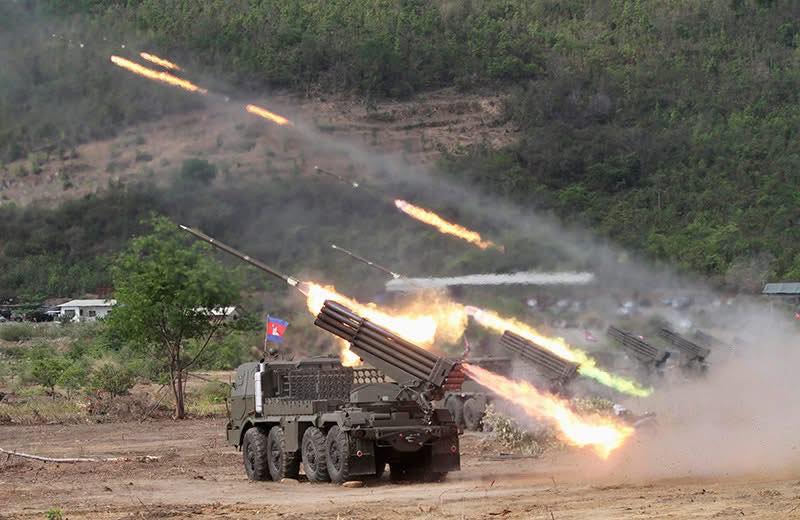
Cambodia, by contrast, operates with a significantly more constrained budget of roughly $860 million and has adopted an area-denial strategy built largely upon massed artillery fire. Lacking a credible air force, the Royal Cambodian Armed Forces (RCAF) depend almost entirely on ground-based fires to contest Thai advances. Their arsenal comprises the Soviet-era BM-21 GRAD multiple rocket launcher system and Chinese-made TYPE 81 and TYPE 90B rocket launchers, saturation weapons designed to inflict heavy casualties on static positions and to suppress Thai mobile operations. These platforms have been used extensively to shell Thai border villages in retaliation for airstrikes. However, the Cambodian military possesses significant asymmetric advantages of its own. Infantry units, particularly the hardened 8th and 9th Infantry Divisions operating in the border zone, are battle-tested and intimately familiar with the difficult jungle terrain. They employ a combination of landmines (such as the Soviet PMN-2) and coordinated ambush tactics to negate Thai technological superiority and inflict attrition on mechanised formations.
Forces committed and systems active
In the current theatre of operations spanning Ubon Ratchathani province in Thailand against the Preah Vihear and Oddar Meanchey regions in Cambodia, both sides have committed significant combat assets. The Royal Thai Air Force has deployed both F-16A/B and JAS 39 fighter jets, likely from Wing 1 or Wing 21, which have conducted multiple sorties dropping ordnance on suspected Cambodian 8th Infantry Division command posts and logistical depots.
Most notably, Thai GRIPEN jets carried out a high-explosive airstrike on the Lim Heng casino complex in O'Smach, situated directly opposite Chong Chom in Surin province, in what Thai military sources described as a lightning strike amid sharply escalating border clashes. According to the Second Army, the casino had been converted into a key military stronghold for Cambodian forces, housing launch points for kamikaze and FPV (first-person-view) loitering drones, concealed BM-21 multiple rocket launchers, and areas for troop concentration and logistics operations. This strike exemplifies Thailand's willingness to target dual-use infrastructure that blurs the line between civilian and military assets - a controversial tactic that has drawn international scrutiny.
Supporting these air operations, the Royal Thai Army's 2nd Army Region, which holds responsibility for the entire northeastern theatre, has mobilised heavy artillery formations and mechanised infantry units. According to reports, the M60A3 TIFCS main battle tanks of the Royal Thai Army are in action and have entered Banteay Meanchey province in Cambodia and would be advancing far beyond the border. Intelligence reports indicate sustained employment of 155mm towed howitzers - most likely the US-made M198 or the Austrian GHN-45 - providing counter-battery fire against Cambodian positions and interdicting supply routes.
The Royal Cambodian Armed Forces, meanwhile, has responded by mobilising its BM-21 Grad rocket batteries, firing salvos into Thai territory in a pattern consistent with suppressive fire against advancing Thai mechanised columns. The revelation that some of these launchers were positioned at the Lim Heng casino underscores Cambodian tactics of embedding military assets within civilian or commercial infrastructure to complicate Thai targeting decisions. Cambodian infantry has complemented this rocket fire with heavy mortars and recoilless rifles, whilst the deployment of kamikaze drones (a relatively novel capability in Southeast Asian conflicts) signals an attempt to develop asymmetric countermeasures against Thai air superiority. Older Soviet T-55 tanks and upgraded Chinese Type 59 variants serve as mobile pillboxes within the dense border jungles, their relatively thin armour compensated for by heavy entrenchment and the difficult terrain that limits Thai armoured exploitation. This commitment of major weapon systems—both modern platforms and legacy equipment, including the introduction of unmanned systems—underscores the seriousness with which both governments regard the territorial stakes at hand.
International impact: a test for ASEAN and beyond
The resurgence of open warfare between two ASEAN member states is a catastrophic blow to the bloc's credibility. The "ASEAN Way" of non-interference is buckling under the pressure of kinetic conflict. Malaysia, the current ASEAN chair, has struggled to mediate. The breakdown of the October ceasefire - notably brokered by US President Donald Trump and Malaysian PM Anwar Ibrahim- suggests that bilateral trust is non-existent. Thailand’s rejection of third-party mediation in favour of bilateral talks (which it dominates militarily) has further isolated Phnom Penh.
Worse still, the conflict risks drawing in external powers. Cambodia is China’s staunchest ally in the region; the RCAF is armed largely with Chinese hardware. Thailand, a US treaty ally, utilises Western platforms like the F-16. While neither superpower wants a war, a prolonged conflict could force them to increase logistical support, entrenching the divide.
In addition, the border closures have severed a vital trade artery worth billion. The proximity of fighting to the Gulf of Thailand threatens the tourism industry - vital for both economies - particularly around the idyllic Koh Kood archipelago. If the conflict expands to the maritime domain, it could disrupt shipping lanes and indefinitely freeze the joint development of the lucrative OCA energy fields, leaving both nations energy-insecure and trigger global prices rise.
As the dust settles from the latest airstrikes, the window for diplomacy is closing. Without immediate de-escalation, the "skirmish" risks becoming a war of attrition that neither Bangkok nor Phnom Penh can afford.
Follow us on Telegram, Facebook and X.




Privacy Policy

Powered by © Mobilbyte s.a.s. Information Technology