



A large part of the Russian Black Sea Fleet has for some time been forced to withdraw to the naval base of Novorossiysk, as the Sevastopol base in Crimea has repeatedly been breached by missile attacks and, above all, by aerial and surface drones.
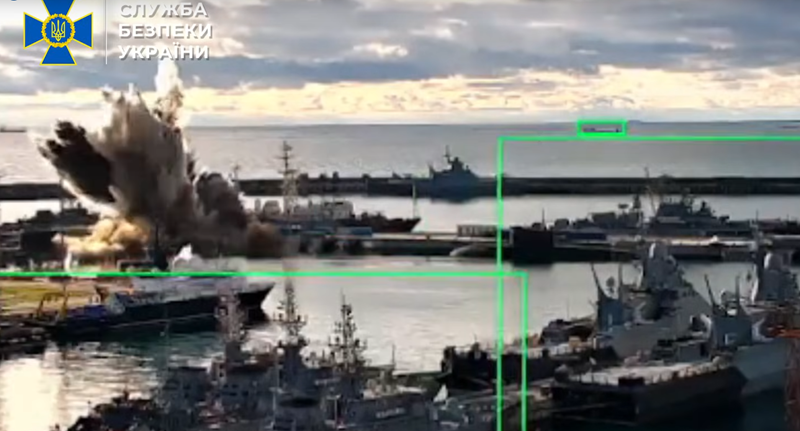
In the afternoon of 15 December, images that quickly flooded the web showed a powerful explosion near the mooring area of a KILO-class submarine (Project 636.3, or VARSHAVYANKA-class in Russian terminology) inside the Novorossiysk base. The Ukrainian Security Service (SBU) released a statement indicating the use of a UUV (Unmanned Underwater Vehicle) to carry out the attack. In this regard, it is worth recalling that in September 2025 the Ukrainians publicly unveiled the Toloka TLK-1000, a large attack UUV resembling a torpedo, 12 m long, with a diameter of about 1 m, a maximum range of 2,000 km and a payload of up to 5 t (although it is plausible that for long-range missions the explosive payload would be reduced in favour of batteries, given that total weight remains a limiting factor). A smaller version, the TLK-400, was also disclosed, albeit without images: 6 m in length, maximum range of 1,200 km and payload up to 500 kg. It is not known whether these systems have already entered service, nor whether they were used at Novorossiysk, but suspicions are inevitable.
That said, many aspects remain unclear, and are likely to do so for a long time…
1) How did the UUV reach Novorossiysk? Unless large UUVs such as the aforementioned TLKs were employed, autonomous navigation can be ruled out given the distances involved (at least 800–1,000 km at sea, depending on the route). One may hypothesize the use of a “delivery” platform, even a fishing vessel, which could have towed the UUV into the area. Another hypothesis involves the use of anti-Russian partisans, who have long been operating behind the lines and conducting sabotage activities. In recent days, for example, the Chernaya Iskra (Black Spark) group reportedly contributed to 3 attacks against oil platforms in the Caspian Sea and 2 ships transporting drone-related material from Iran to Russia. Under this scenario, the UUV - smuggled clandestinely into Russia - would presumably have been assembled and launched from a coastal location not far from the base. This, however, would be an extremely complex and high-risk modus operandi.
2) What is the origin of the released imagery? It cannot be excluded that Ukrainians or “partisans” installed a camera inside the base, but this would have been a very risky activity which, if discovered, could have led to the failure of the operation. It appears more likely that Ukrainian hackers infiltrated the base’s surveillance system (the camera can pan and tilt and presumably runs software capable of identifying and recognising ship and small craft silhouettes, as suggested by the green bounding boxes around moored units and small boats in transit). Indeed, after an initial panoramic sweep, the footage focuses on the point where the explosion would occur, shortly before the attack itself, suggesting some form of Ukrainian “control”.
3) How was the approach to the target conducted once near the port? The media have on several occasions reported the existence of vehicles capable of navigating (at high speed) on the surface before diving near the objective and proceeding (slowly) under electric propulsion. These systems are used to transport combat divers, but it is easy to envisage an unmanned variant designed to carry an explosive charge for torpedo-like attacks, albeit much slower in the terminal phase. Alternatively, a more traditional torpedo-like UUV capable of remaining submerged close to the surface may have been employed. Or, again, one of the aforementioned large TLK-series UUVs.
4) How was the vehicle guided onto the target? UUVs used for seabed reconnaissance typically rely on inertial navigation, with periodic updates obtained by surfacing an antenna to receive GPS signals and/or exchange data with a remote operator via satellite links. However, dead reckoning is not highly accurate and errors accumulate over time. One could therefore hypothesise that, during navigation inside the base, the UUV received position updates through brief surfacing events. The fact that the attack occurred during daylight - rather than at night, as is usually the case - certainly increases the risk of detection during surfacing, making this hypothesis less likely. It is nevertheless worth noting that the Russians probably felt relatively secure inside the base, also in light of the barrier systems at its entrance (effective against surface drones but not against underwater ones, as demonstrated by the attack).
5) What damage was inflicted on the KILO-class submarine? The Russian Navy claims that the attack failed and that no units were damaged. But, as always, one should not ask the innkeeper to judge the quality of his own wine… The Ukrainian SBU, on the other hand, claims that the submarine was put out of action. From the images, the explosion appears to have occurred in the immediate vicinity of the stern (approximately 15 m away), most likely causing severe damage to the hull, propulsion system (propeller and shaft), and horizontal and vertical control surfaces - damage that would render the submarine non-operational for a considerable period. Satellite imagery indicates that the submarine was not sunk and shows damage to the pier near the stern, while the vessel itself does not appear to have been moved. Moreover, a video released by the Russian broadcaster Zvezda shows no visible damage, but the stern area is not shown. A possible transfer of the submarine into dry dock for repairs may provide clearer answers regarding the extent of the damage.
Conclusion
In conclusion, there are no rock-solid certainties surrounding this attack, as is often the case with special operations. It is nonetheless the first time that Ukrainians have conducted an incursion against a naval unit using underwater means (or systems capable of operating both above and below the surface), after such capabilities had long been hypothesised, thereby demonstrating Kyiv’s ability to carry out attacks of this kind. It is also yet another demonstration of Ukrainian ingenuity - and of the lessons that other navies may draw from this new operational reality.




Privacy Policy

Powered by © Mobilbyte s.a.s. Information Technology