



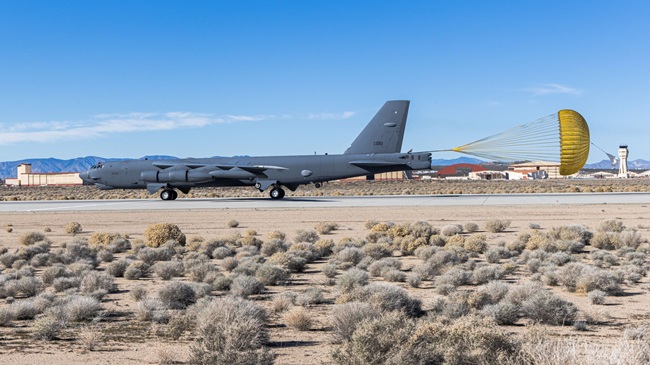
A mixed crew drawn from the 49th Test Evaluation Squadron at Barksdale AFB, Louisiana, and the 419th Flight Test Squadron at Edwards AFB, California, has ferried the first B-52 equipped with the new AESA radar under the Radar Modernization Program from Boeing’s San Antonio facility to Edwards Air Force Base.
The flight was completed on 8 December, and the aircraft’s arrival at Edwards enables the programme to move into its next phase, namely the approach to flight-test activities. According to the FY2026 Budget Request, formal flight testing is expected to begin in June, while the programme plan foresees the declaration of Milestone C as early as August, paving the way for the start of low-rate initial production.
The new AESA radar is produced by Raytheon and is designated AN/APQ-188. Derived from the well-known AN/APG-79—in service on the Boeing F/A-18E/F Super Hornet and EA-18G Growler—it replaces the ageing APQ-166, which is becoming increasingly difficult to sustain due to obsolescence and the growing scarcity of out-of-production components. Boeing is responsible for installing the new radar on the B-52 fleet at its San Antonio plant.
The AN/APQ-188 replaces the control panel, the entire radar assembly, the antenna, and 12 different Line Replaceable Units (LRUs). In addition, two new Display and System Sensor processors will generate symbology for two large 8×20-inch touchscreen displays installed at the navigator and radar-navigator stations. These displays will be paired with hands-on controls in a fighter-style configuration. The new radar features a liquid-cooling system and, in very low-temperature conditions, can alternatively rely on engine bleed-air heating.
The programme’s roots date back to 2017, when the concept was first matured. A request for proposals was issued in 2019, leading to the award of the Engineering & Manufacturing Development (EMD) contract in June 2021. The system passed its Critical Design Review in February 2022 and is now moving toward the production phase. The FY2026 budget includes over USD 130 million to procure Low-Rate Initial Production (LRIP) Lots 1 and 2 in a single block, in order to achieve cost efficiencies. The formal production order is expected in November 2026.
The plan is to retrofit the entire fleet of 76 B-52H aircraft. The first two modified airframes will be used for test and development activities.
Radar replacement is only one of several major upgrades intended to extend the B-52’s operational life out to 2050, but it is undoubtedly the most complex and invasive, alongside the Commercial Engine Replacement Program (CERP). Under CERP, the aircraft will be re-engined, replacing the current TF33-PW-103 engines with a military derivative of the Rolls-Royce F130, of similar size. The CERP programme is scheduled to reach its Critical Design Review in the third quarter of 2026, with delivery of two re-engined aircraft for the test phase planned for the fourth quarter of 2028.
As re-engining progresses, B-52 aircraft will change their designation from H to J. Other modernisation efforts include the introduction of Link 16 via Multi-Functional Information Distribution System – Joint Tactical Radio System (MIDS-JTRS) terminals, upgrades to the Very Low Frequency/Low Frequency (VLF/LF) reception system critical to the nuclear mission, and the “Crypto” programme to introduce secure satellite communications through SATURN and MUOS.




Privacy Policy

Powered by © Mobilbyte s.a.s. Information Technology