



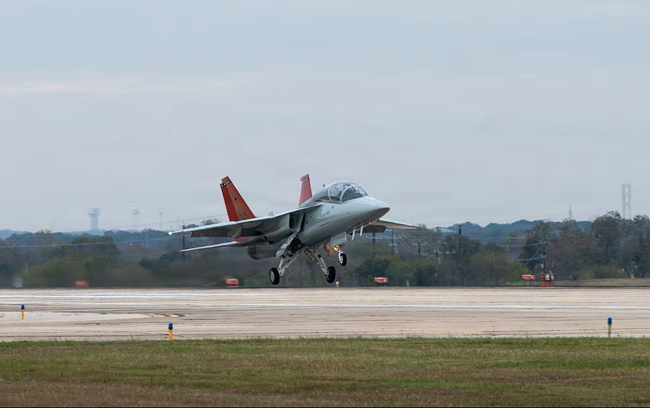
In December, the USAF’s new advanced trainer finally landed at Joint Base San Antonio–Randolph, Texas, where it is set to begin its first operational activities. Specifically, this is the latest pre-production T-7A, designated APT-5, which flew to Randolph rather than joining the other four RED HAWKS at Edwards AFB, California, where they will continue the test and development campaign.
On 5 December, the USAF’s new advanced trainer finally landed at Joint Base San Antonio–Randolph, Texas, where it is set to begin its first operational activities. Specifically, this is the latest pre-production T-7A, designated APT-5, which flew to Randolph rather than joining the other four RED HAWKS at Edwards AFB, California, where they will continue the test and development campaign.
The T-7A RED HAWK, intended to replace the ageing T-38C, takes its name in honour of the Tuskegee Airmen—the historic group of predominantly African-American aircrews trained in Tuskegee, Alabama, who flew combat operations during the Second World War. Reflecting this heritage, the aircraft has been assigned to the 99th Flying Training Squadron RED TAILS, which directly traces its lineage back to the 99th Pursuit Squadron, the first African-American fighter squadron and the first to be deployed for combat operations, notably in the Mediterranean theatre.
The 99th Squadron will eventually operate 14 T-7A aircraft and is scheduled to achieve Initial Operational Capability (IOC) in August 2027. The arrival of the first aircraft represents the first tangible step toward that goal.
The current Program of Record calls for the acquisition of 351 T-7A aircraft, 46 simulators, and the full suite of associated ground-based training systems. The FY2026 Budget Request includes funding in excess of USD 300 million, covering the procurement of the first production batch of 14 aircraft. Looking ahead, annual procurement rates are expected to peak between 40 and 60 aircraft per year, allowing the full acquisition to be completed by 2035–36.
To date, the T-7A programme has experienced delays in reaching Milestone C, which authorises full-rate production. As a result, the initial order was scaled back from a previously planned 23 aircraft to the current 14. FY2026 budget documents indicate that Milestone C certification is now expected in the second quarter of 2026. Deliveries of the Lot 1 aircraft are scheduled to begin in March 2027, at a rate of one—at most two—aircraft per month, with the final two deliveries expected in February 2028.
Under the current plan, aircraft delivered in 2027 will be assigned to units at Columbus AFB, followed by Laughlin AFB in 2032, Vance AFB in 2034, and Sheppard AFB in 2035.
In parallel, Boeing has announced a significant production milestone for the T-7A with the mating of the forward and aft fuselage sections of APT-6, the first airframe fully representative of the production standard. The T-7A is a joint Boeing–Saab programme, with Saab responsible for the aft fuselage section, manufactured at its facility in West Lafayette, Indiana.
Boeing highlighted that, thanks to modern digital design and manufacturing techniques, the alignment and joining of the fuselage sections required only “minutes”, compared to the days that would have been necessary not long ago.




Privacy Policy

Powered by © Mobilbyte s.a.s. Information Technology