



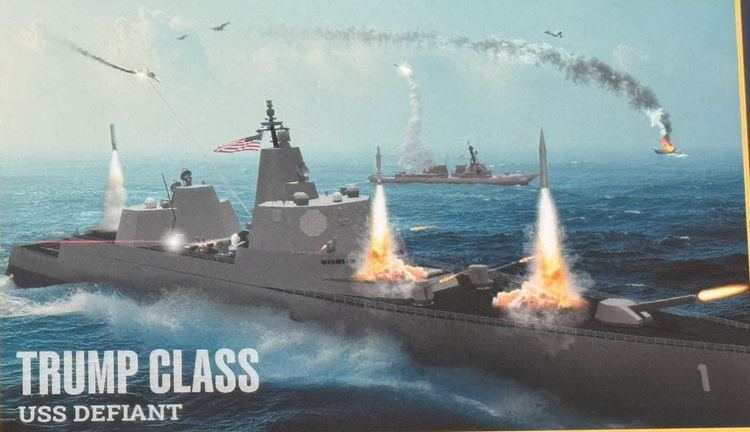
As is well known, Trump certainly does not hold back when it comes to announcements and bold claims. The latest, unveiled with the usual fanfare, concerns a new-generation battleship class designated TRUMP.
According to the President and the Secretary of Defense Hegseth, the objective is to build 2 prototype units followed by an initial series of 10 ships. Trump’s announcement—unsurprisingly framed in emphatic, characteristically Trumpian terms, with references to “never-before-seen” warships—was accompanied by a series of renderings intended to offer a preview of the future design.
These are vessels in the 30,000–40,000-ton range, featuring 2 massive superstructures, one of which is described as “compound”, fixed planar phased-array radars, and 3 vertical launch system (VLS) batteries, 2 forward and 1 aft.
The proposed armament is decidedly robust. It includes Intermediate-Range Conventional Prompt Strike (IRCPS) hypersonic missiles—with ranges exceeding 3,000 km and equipped with a glide body/warhead—an electromagnetic railgun, a pair of 127 mm naval guns, directed-energy laser weapons, surface-to-air and surface-to-surface SM-3/SM-6 missiles, TOMAHAWK cruise missiles, and SLCM-N (Sea-Launched Cruise Missile – Nuclear) nuclear-armed cruise missiles. The latter had been reintroduced during Trump’s first Administration and subsequently cancelled by President Biden in the 2022 Nuclear Posture Review (NPR); however, Congress did not supported Biden’s decision and continued to fund their development.
Trump’s announcement inevitably raises doubts and concerns. First and foremost, in both current and foreseeable future operational scenarios, ships of this size appear to have limited relevance. Concentrating so many capabilities on a single platform would significantly ease adversary targeting, running counter to one of the core principles of distributed operations. Moreover, the role of an “arsenal ship” can already—and increasingly in the future—be fulfilled by much smaller unmanned platforms. In addition, miniaturised modular nuclear reactors promise to address, at least in part, the power-generation requirements of increasingly complex and energy-hungry systems, allowing platform size to be kept under control.
A second major issue concerns the overall condition of the US shipbuilding industry, which is far from healthy, as demonstrated by recent programmes—from the DDG-1000 ZUMWALT-class destroyers to the CONSTELLATION-class frigates. This is a structural rather than a temporary problem: apart from the ARLEIGH BURKE line, the sector suffers from significant shortfalls in workforce and infrastructure, and currently appears capable of producing only nuclear-powered submarines and aircraft carriers. Trump also stated that construction of the first unit would begin “almost immediately” and that it would take around 2 and a half years—a highly unrealistic claim given the present state of US naval shipbuilding.
It would therefore be wiser to set more modest ambitions and focus on less futuristic, and above all smaller, combatants—in the 15,000–18,000-ton range—capable of sustainably replacing, in significant numbers, the venerable TICONDEROGA-class cruisers.




Privacy Policy

Powered by © Mobilbyte s.a.s. Information Technology