



Following the US military operation that led to the capture of Venezuelan President Nicolás Maduro, Donald Trump has once again threatened Greenland.
His statements fit squarely within the National Security Strategy published by the Administration in December, which once again identifies the island as a key node under the so-called “Trump corollary” to the Monroe Doctrine, reviving an interest that emerges in the context of a broader US strategic repositioning worldwide.
For nearly 2 centuries, US interest in Greenland has reflected the geostrategic relevance of its position on the northeastern flank of the North American continent, marked by several (unsuccessful) attempts to purchase the island. Despite this, Washington has consistently maintained cooperative relations and defence agreements with Copenhagen, ensuring a stable presence in the Arctic. US military presence in Greenland was established during the Second World War and the immediate post-war years. At the height of its expansion, in the mid-1950s, 13 US Army bases and 4 US Navy bases were operational; today, only Pituffik Space Base (formerly Thule Air Base) remains. The base, hosting just 150 US personnel, represents a critical infrastructure supporting NATO missile defence and space surveillance. Pituffik hosts the Upgraded Early Warning Radar (UEWR), designed to detect and track intercontinental ballistic missiles along trajectories toward North America, providing real-time data to NORAD (North American Aerospace Defense Command). From Pituffik, the United States can exploit the island’s privileged position, which is also fundamental in the context of the next-generation missile defence shield, GOLDEN DOME. At the same time, Greenland is assuming an increasingly significant role in emerging maritime routes: the Northwest Passage, the Northeast Passage, and the future Polar Route across the Central Arctic will inevitably transform global logistics, further increasing the region’s strategic value. Reinforcing this centrality are Greenland’s rich mineral resources (rare earths, coal, graphite, cobalt, uranium, etc.), which amplify the island’s enormous potential.
In light of these factors, US attention is primarily focused on ensuring that Greenland remains within its security perimeter, strengthening the existing presence. Washington enjoys a privileged military position on the island based on the 1951 Defence Agreement with Denmark (signed before Greenland had its own Parliament and Government), which allows the United States to establish and manage defence areas in Greenland in coordination with Copenhagen and within NATO planning. Articles I, II and III assign operational management of these areas to the United States, including infrastructure, security and logistical support, without formally undermining Danish sovereignty. In practice, this ensures effective military control, making the hypothesis of a formal acquisition more symbolic than necessary. The 2004 update of the treaty, and the associated political declarations, confirmed Thule Air Base as the only official defence area in Greenland, stressing that any significant change is subject to Article II of the original agreement, i.e. requires a new agreement between the parties in the event of new bases being opened. The United States must also consult and inform both the Danish and Greenlandic governments (a key novelty compared to 1951) prior to any major changes in military operations or base usage.
After decades of relative disengagement in the post–Cold War period, in recent years the United States has intensified its focus on Greenland: in 2020 the US consulate in Nuuk was reopened, and operational instruments were defined through 2025 via the Common Plan for US Greenland Cooperation in Support of Pituffik, aimed at consolidating American influence. In June 2025, the Department of Defense decided to shift responsibility for Greenland from US European Command to US Northern Command (NORTHCOM), marking a significant change in the region’s strategic control, consistent with the new US Security Strategy. In parallel, Denmark approved a new Defence Agreement 2024–2033, formally including Greenland and the Faroe Islands among Arctic–North Atlantic security priorities, strengthening the island’s defence and its integration into the NATO system.
Ironically, aggressive rhetoric such as that used by Trump has failed to convince the local population: according to a January 2025 survey, around 85% of Greenlanders oppose the idea of the island becoming part of the United States and reject any forced acquisition by foreign powers. Nevertheless, Greenland today enjoys self-government and aims to become a sovereign state, with the main political parties favouring independence, albeit differing on the timing and modalities of the process. Aspirations for self-determination have strengthened since the former colony obtained greater autonomy and its own Parliament in 1979, and with the 2009 Act on Greenland Self-Government, Greenlanders were explicitly granted the right to proclaim independence. Moreover, under the same Self-Government Act, Greenland acquired exclusive authority over its mineral resources—an element that the Trump Administration could leverage to increase its influence over the island.
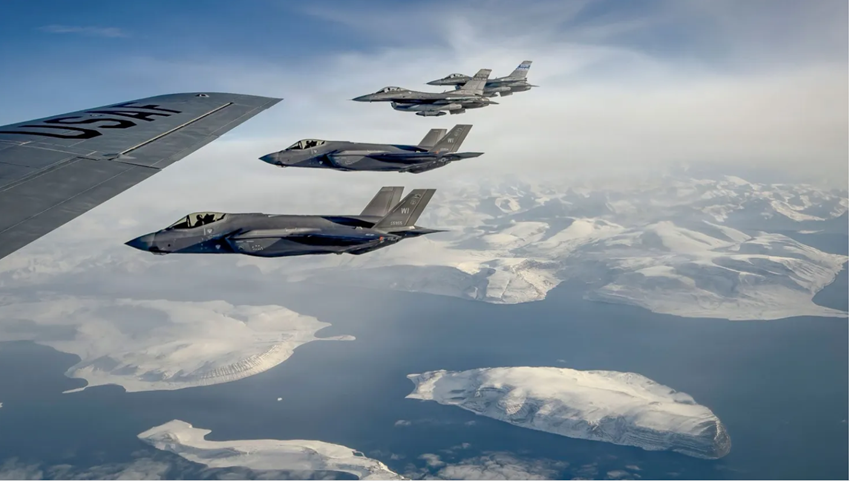
(Photo: F-35 Lightning II aircraft of the North American Aerospace Defense Command with the 115th Fighter Wing of the Wisconsin Air National Guard, F-16 Fighting Falcons with the 169th Fighter Wing of the South Carolina Air National Guard, and a KC-135 Stratotanker with the 128th Air Refueling Wing of the Wisconsin Air National Guard fly over Greenland, 7 October 2025).




Privacy Policy

Powered by © Mobilbyte s.a.s. Information Technology