



An emergency defence council meeting has been held at the Élysée Palace this Thursday, 15 January 2026. Afterwards, Emmanuel Macron delivered his New Year's address to the armed forces, a highly anticipated event as France continues to seek a budget for 2026 amid geopolitical tensions, including transatlantic tensions, and growing military needs.
French President Emmanuel Macron's stark declaration today —"nous sommes prêts à dissuader pour défendre notre sol" (we are ready to deter to defend our territory) - represents a potentially unprecedented signal that France may extend its nuclear deterrent umbrella to encompass European allies facing territorial threats from Washington. Coupled with his assertion that "pour être libres, il faut être craints" (to be free, we must be feared), Macron has articulated a doctrine that treats threats to European sovereignty, including Denmark's control over Greenland, as matters potentially invoking France's nuclear posture.
The language Macron employed merits careful analysis. French nuclear doctrine deliberately maintains strategic ambiguity around what constitutes "vital interests" - the threshold for potential nuclear response. Historically, French strategists have defined these interests geographically (French territory and its approaches) and politically (tied to European construction). By characterizing an US seizure of Greenland as triggering "unprecedented cascading consequences" and explicitly treating Europe as homeland territory worthy of deterrence protection, Macron has subtly but significantly expanded the conceptual boundaries of French vital interests.
This represents an escalation in France's year-long campaign to position itself as Europe's nuclear guarantor amid US strategic unreliability. Since March 2025, when Macron announced France would "open the strategic debate on using our deterrent to protect our allies on the European continent," Paris has systematically laid groundwork for extending nuclear assurances beyond strict territorial defence. The July 2025 UK-France declaration established that both nations' deterrents "can be coordinated" and that "no extreme threat to Europe" would fail to prompt a response from both nuclear powers”.
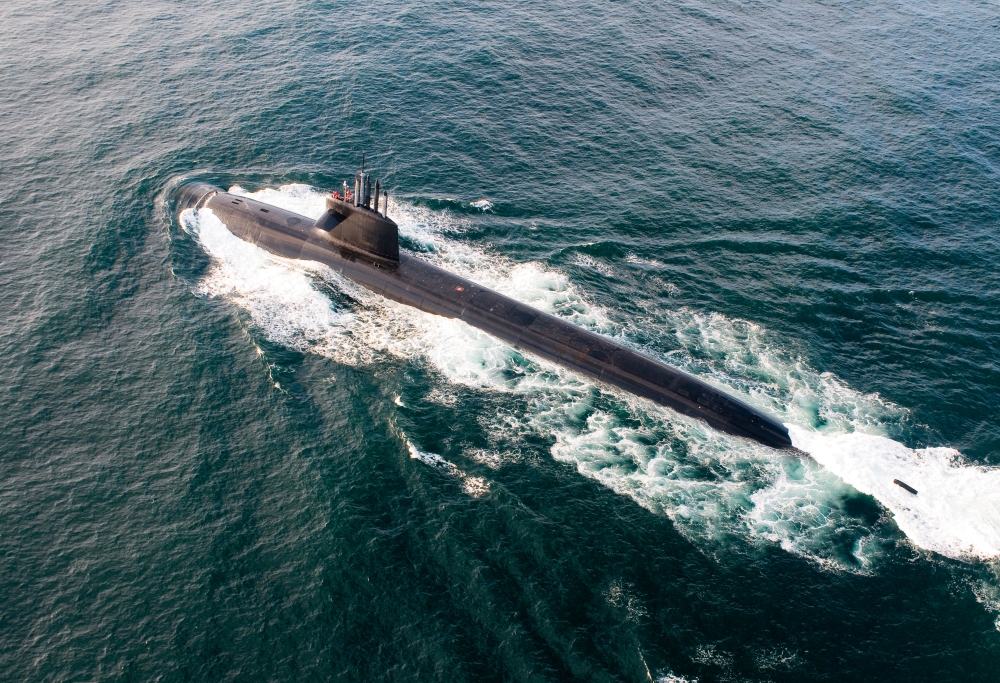
The probability that France would actually deploy nuclear weapons over Greenland remains extremely low, constrained by doctrine, capability, and alliance politics. French deterrence posture emphasizes "strict sufficiency" - maintaining the minimum arsenal necessary for self-defence, with use contemplated only in "extreme circumstances". France's relatively modest nuclear force (4 SSBNs and the air-launched component based on RAFALEs) lacks the capacity to credibly extend deterrence across multiple European allies while maintaining credible homeland protection against Russia.
Yet dismissing Macron's rhetoric as mere posturing would be strategically myopic. The French president is engaged in sophisticated signalling aimed at multiple audiences. To Washington, the message conveys that unilateral US violations of European sovereignty carry strategic costs, potentially fracturing the transatlantic alliance and driving European strategic autonomy. To European capitals, Macron demonstrates French willingness to assume security leadership amid US unreliability. To Moscow, coordinated Franco-British nuclear messaging reinforces that European deterrence exists independent of US guarantees.
Macron's Greenland Position
On the immediate Greenland question, Macron has adopted a maximalist defence of Danish sovereignty. France signed a seven-nation joint statement declaring that "Greenland belongs to its people" and that security in the Arctic must respect "sovereignty, territorial integrity and the inviolability of borders". Paris announced plans to open a consulate in Greenland on 6 February as a "political signal," with Foreign Minister Jean-Noël Barrot urging Washington to "stop blackmailing" Denmark.
Macron has explicitly linked France's position to its own territorial vulnerabilities, noting that France possesses overseas territories and "absolutely would not accept any questioning of French sovereignty over our own territories". This connection between Greenland and French territorial integrity in the Pacific, Caribbean, and Indian Ocean amplifies Paris's strategic interest beyond abstract European solidarity.
The French president's framing treats European territorial disputes as existential questions demanding deterrence-level responses. His July 2025 defence address emphasized that "pour être libres dans ce monde, il faut être craint. Pour être craint, il faut être puissants" (to be free in this world, we must be feared; to be feared, we must be powerful). He repeated the same exact sentence today, word by word. This philosophy explicitly rejects post-Cold War assumptions about inviolable borders among Western allies, instead embracing a realist posture where credible military power - including nuclear capabilities - underpins sovereignty.
Whether Macron's nuclear signalling represents genuine doctrine evolution or sophisticated bluffing, it marks a watershed in European security architecture. France is systematically constructing political and operational infrastructure for an extended deterrence role, including strategic dialogues with Germany, Poland, and other willing partners.
For Washington, Macron's rhetoric presents a strategic dilemma. Aggressive unilateralism toward Greenland risks accelerating precisely the European strategic autonomy that undermines US influence. Yet backing down in response to French nuclear posturing would establish dangerous precedents for adversaries globally. The crisis has exposed fundamental contradictions in an alliance where the security guarantor increasingly threatens the territorial integrity of protected allies.
As the Trump administration designs on Greenland persist, Macron has positioned France as the ultimate guarantor of European sovereignty - a role that implicitly invokes the full spectrum of French military power, including its force de dissuasion. Whether this represents credible extended deterrence or calculated strategic ambiguity, Paris has fundamentally altered the stakes of the Arctic territorial dispute.



Privacy Policy

Powered by © Mobilbyte s.a.s. Information Technology